The Bathroom Vanity Lighting: How to Avoid Shadows on Your Face
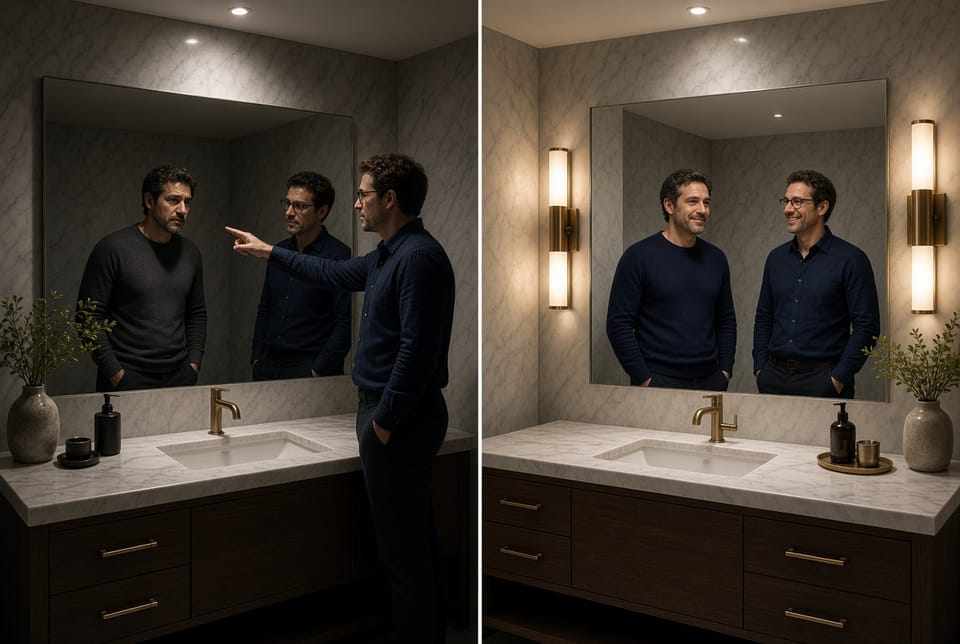
Standing in front of the bathroom mirror should feel clarifying, not frustrating. Yet many homeowners discover that their reflection looks tired, uneven, or simply inaccurate because of poorly planned vanity lighting. Shadows pool under the eyes, the nose appears sharper than it is, and makeup or grooming decisions made in that light often look different once you step into natural daylight. The solution is not more light on the ceiling. It is smarter lighting design that puts illumination where it belongs: on your face.
Get Shadow-Free Vanity Lighting Today
This guide explains why traditional overhead fixtures create unflattering shadows, why side lighting with properly placed sconces is the professional standard, and how choosing the right bulbs—specifically in the 3000-4000K range with high CRI—completes a vanity that works as well as it looks. When lighting is designed correctly, the bathroom becomes a reliable space for daily routines rather than a source of visual guesswork.
Why Facial Shadows Happen at the Vanity
Light travels in straight lines. When the primary source sits directly above the mirror, it strikes the forehead first and then drops downward. The brow ridge, nose, and chin interrupt that path and cast shadows onto the cheeks, under-eye area, and neck. The result is a face that appears older or more fatigued than it actually is. These shadows are not a personal issue; they are a predictable outcome of single-source overhead lighting.
Daily tasks magnify the problem. Applying foundation, shaping brows, or shaving requires even illumination so that color and texture can be judged accurately. Overhead light distorts both. Many people compensate by leaning closer to the mirror or turning on every fixture in the room, yet the core geometry remains unchanged. The light still originates from above, and the shadows persist.
A well-designed vanity treats the face as the primary task surface. That shift in thinking—from lighting the room to lighting the person—is the foundation of effective bathroom lighting.
The Problem with Overhead-Only Lighting
Overhead fixtures serve an important role in general room illumination, but they are poorly suited as the sole source at the vanity. Recessed cans, flush-mount ceilings, or a single bar light mounted above the mirror all share the same directional limitation. Light arrives from one high angle, creating the classic “raccoon-eye” effect and deepening every contour of the face.
Glare is another frequent companion. When the fixture is visible in the mirror or sits too close to the viewer’s line of sight, it forces the eyes to squint. The combination of glare and shadow makes precise work nearly impossible. Homeowners often describe the experience as “looking washed out” or “never quite seeing the real color.” Both complaints trace back to the same design choice: relying on ceiling light for a task that demands frontal and lateral illumination.
Layered lighting can include overhead sources for ambient brightness, yet those sources should never be the only ones serving the mirror. The vanity itself needs dedicated fixtures that wrap light around the face rather than striking it from above.
The Importance of Side Lighting with Sconces
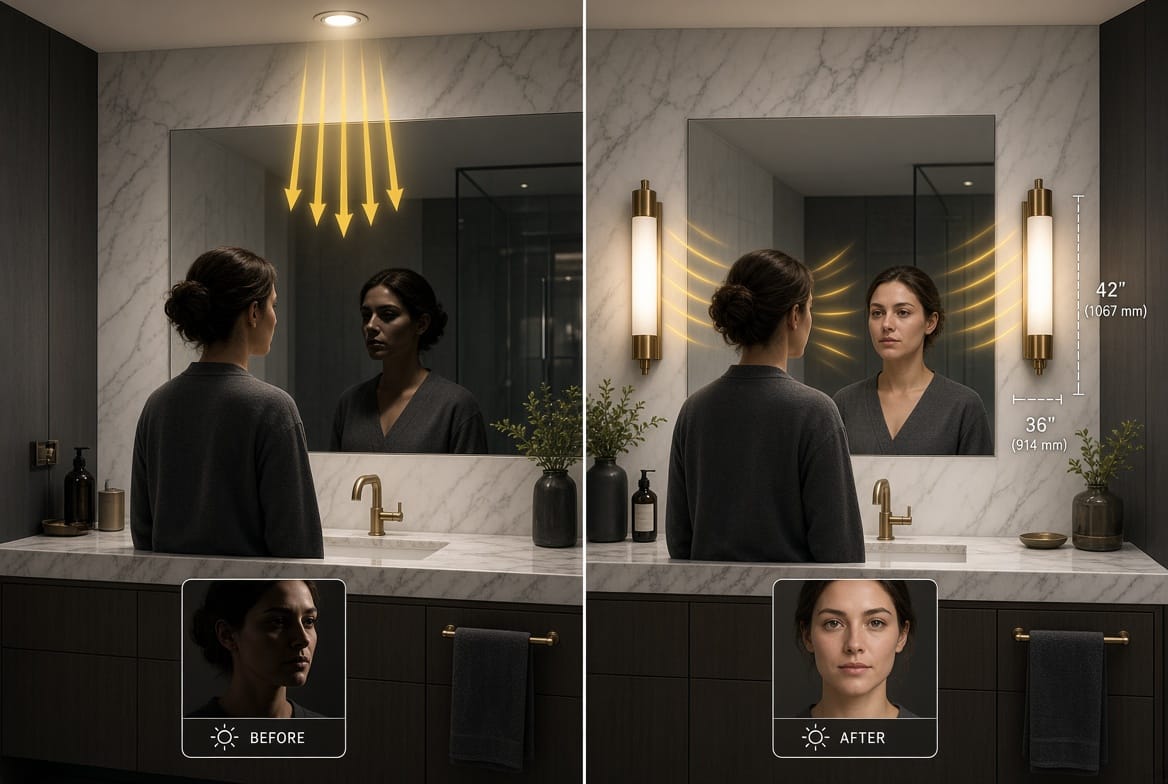
Side lighting solves the geometry problem that overhead fixtures cannot. When matching sconces are mounted on both sides of the mirror, light reaches the face from the left and the right simultaneously. Shadows that would otherwise form under the brow or along the nose are filled in. The result is a balanced, three-dimensional view that closely resembles natural daylight coming through a window.
Professionals specify sconces because they create a vertical plane of light at approximately face height. This plane wraps around facial contours instead of slicing across them. Makeup appears truer, skin tone looks consistent, and grooming becomes more precise. The same principle is used in professional makeup studios and photography lighting: two sources at roughly 45-degree angles produce even coverage without harsh modeling.
Placement matters as much as the decision to use sconces. Ideal height centers the fixtures near eye level or slightly above—typically 60 to 66 inches from the finished floor—so the light strikes the face rather than the ceiling or the countertop. Horizontal spacing usually falls between 28 and 36 inches apart, or simply flanking the outer edges of the mirror, depending on mirror width. The goal is coverage that reaches both sides of the face without leaving a dark center or creating glare in the glass.
When a mirror is extra wide, additional consideration is given to the distance between fixtures so that the center of the face still receives adequate light. In smaller powder rooms a pair of compact sconces may suffice; in master bathrooms a larger pair or even a combination of sconces and a modest overhead bar can be coordinated. The constant is the presence of light arriving from both sides.
Choosing Bulbs That Flatter Rather Than Distort
Fixture placement is only half the equation. The bulbs themselves determine whether the light feels natural or clinical. Two specifications dominate professional recommendations: color temperature and color rendering.
Color temperature measured in Kelvin tells you how warm or cool the light appears. The 3000-4000K range is widely regarded as the sweet spot for bathrooms. At 3000K the light is gently warm, flattering to skin and reminiscent of late-afternoon sun. At 3500K to 4000K it becomes more neutral, closer to midday daylight, which many people prefer for accurate makeup application. Temperatures below 2700K can look overly yellow and muddy colors; temperatures above 5000K often appear harsh and sterile. Staying inside 3000-4000K keeps the vanity inviting while remaining functional.
High CRI—Color Rendering Index of 90 or above—is equally critical. CRI measures how accurately a light source reveals the true colors of objects compared with natural light. A bulb with low CRI can make foundation look gray or lipstick appear off-tone. High-CRI LEDs render skin, hair, and cosmetics with fidelity, so the face you see in the mirror matches the face others will see later in the day. Many quality LED lamps now advertise CRI 90+ or even 95, making the specification easy to meet without sacrificing efficiency.
Dimmability adds another layer of control. A dimmer allows the same fixtures to serve bright morning routines and softer evening use. When selecting dimmable LEDs, confirm compatibility with the switch to avoid flicker. The combination of correct Kelvin, high CRI, and dimming capability turns a technically correct installation into a comfortable daily experience.
Layering Light Without Creating New Shadows
A single pair of sconces can transform the vanity, yet the most successful bathrooms employ layered lighting. Ambient light from the ceiling or a central fixture provides overall brightness so the room never feels cave-like. Task lighting at the vanity—the sconces—handles the close work. Accent lighting, such as toe-kick or shower fixtures, adds depth and safety.
The key is coordination. Ambient sources should be on a separate switch or dimmer from the vanity sconces so each layer can be adjusted independently. When both layers operate together, the overhead contribution remains secondary; it fills the room without overpowering the side light that protects the face from shadows.
Glare control is part of layering as well. Frosted or opal glass on sconces softens the source. Positioning the fixtures slightly behind the front plane of the mirror or choosing designs with shields prevents direct view of the bulb. These small details keep the light effective rather than uncomfortable.
Common Design Mistakes and How to Avoid Them
Several recurring errors undermine otherwise attractive bathrooms. Mounting a single light bar only above the mirror recreates the overhead-shadow problem even when the fixture looks stylish. Placing sconces too high turns them into additional ceiling lights. Choosing bulbs outside the 3000-4000K window or ignoring CRI produces light that is technically present but visually untrustworthy.
Another frequent oversight is failing to consider the mirror’s size and the user’s height. A fixture arrangement that works for one person may leave another in partial shadow. Measuring from the finished floor and accounting for typical eye height prevents this mismatch. Finally, neglecting dimmers or using non-dimmable lamps limits flexibility and can leave the space feeling either too bright or too dim at different times of day.
Each of these mistakes is avoidable with a clear lighting plan created before tile and cabinetry are finalized. Early coordination between designer, electrician, and homeowner ensures the wiring, box locations, and fixture selections support the intended result.
The Value of Professional Lighting Design
Bathroom remodeling involves many moving parts—plumbing, tile, ventilation, storage—yet lighting is the element that determines how the finished space actually functions each morning and evening. A professional lighting plan evaluates the specific vanity layout, mirror dimensions, ceiling height, and the people who will use the room. It specifies exact mounting heights, fixture styles that complement the architecture, and lamp types that meet both aesthetic and performance criteria.
The process typically includes a site review or detailed drawings, photometric consideration of how light will fall on the face, and selection of products that balance appearance with longevity. The outcome is a vanity that feels custom rather than generic: even illumination, accurate color, and no unexpected shadows.
Homeowners who have lived with poor lighting often describe the change as immediately noticeable. Makeup application becomes faster and more reliable. Shaving or skincare routines feel less like guesswork. The bathroom simply works better.

Bringing It All Together
Effective bathroom vanity lighting is not an accessory; it is a functional requirement. Overhead fixtures alone will continue to cast shadows no matter how expensive the bulb. Side lighting from properly located sconces supplies the missing lateral illumination that fills those shadows. Pairing those fixtures with lamps in the 3000-4000K range and high CRI ratings ensures the light is both flattering and truthful.
When these elements are planned together—placement, source type, color quality, and layered control—the vanity becomes a dependable workspace. Daily routines gain accuracy and comfort. The reflection in the mirror finally matches the person standing in front of it. Light your face, not your ceiling.
Call Now for Even, Flattering Bathroom Light