The Acacia Flooring: Exotic Hardness and Unique Grain
Homeowners searching for flooring that looks distinctive and performs under real family life often overlook one of the most capable exotic hardwoods available: acacia. This species delivers a rare combination of Janka hardness in the 2200–2300 range, dramatic grain patterns, natural color variation, and long-term durability. When specified and installed correctly, acacia flooring is not a decorative experiment. It is a practical, high-performance surface built for kitchens, living rooms, hallways, and high-traffic homes.
Call Now for Exotic Acacia Flooring Options
This guide explains what makes acacia different, how its hardness compares with familiar domestic woods, how its grain and color behave in a finished room, and what you should expect from professional installation and care. The goal is simple: help you decide whether exotic acacia is the right flooring investment for your space.
Why Acacia Stands Apart as an Exotic Hardwood
Acacia is not a single look-alike substitute for oak. It is a dense tropical hardwood with interlocked fiber, pronounced figure, and a color range that shifts from board to board. That combination produces floors that feel custom even when they are installed in a standard plank format.
Key characteristics that matter in a finished floor include:
- Exceptional surface hardness that resists dents from furniture, pets, and dropped objects
- Interlocked and often wavy grain that reads as movement and depth rather than a repeating stripe
- Natural color variation from light golden tones to rich browns within the same room
- Strong dimensional stability when properly milled, acclimated, and finished
- Long service life when maintained with the right products and professional installation
These traits make acacia especially useful for homeowners who want an exotic appearance without sacrificing everyday toughness.
Janka Hardness: What 2200–2300 Actually Means
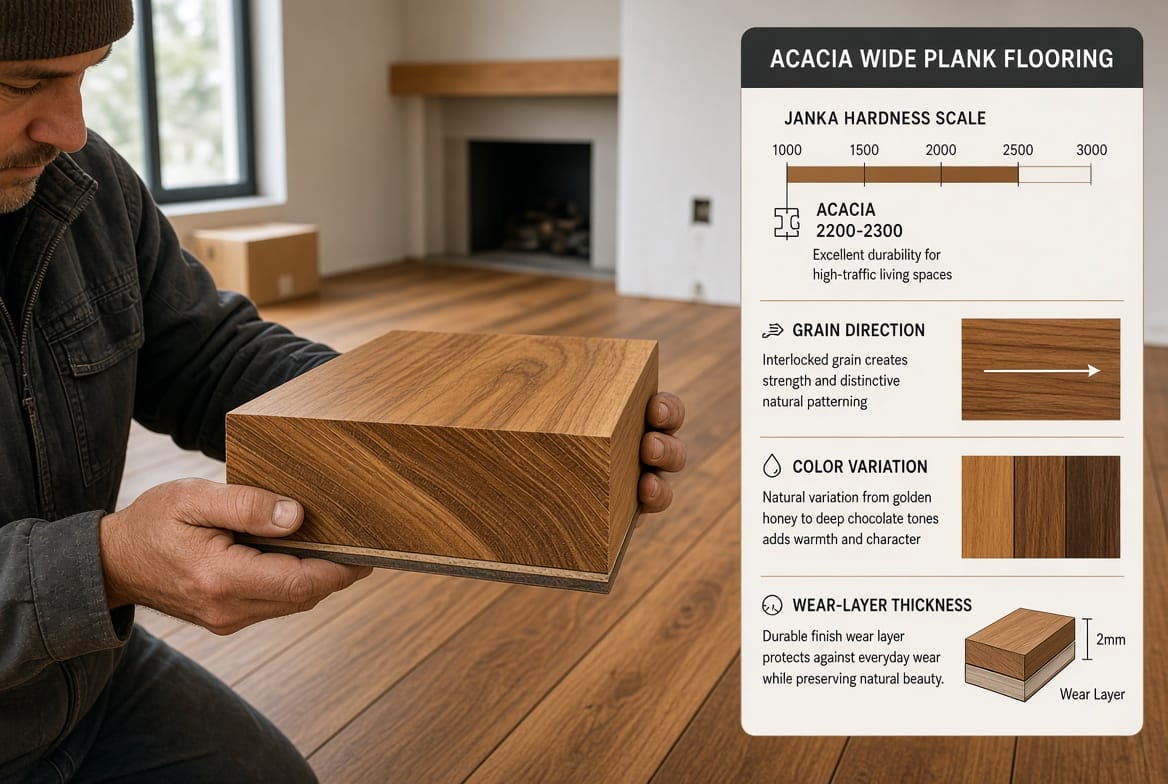
The Janka hardness test measures the force required to embed a steel ball into wood. It is the most widely used practical indicator of how well a floor will resist denting. Acacia flooring typically tests in the 2200–2300 Janka range, placing it well above many popular domestic species.
That number is not marketing language. It has direct consequences:
- Chairs, table legs, and appliance edges are less likely to leave lasting impressions
- Pet claws and children’s toys cause less visible damage
- High-traffic paths hold their appearance longer between refinishing cycles
- The floor can accept a durable factory or site-applied finish without feeling fragile
Hardness is only one part of performance. Grain orientation, moisture content, subfloor quality, and finish system still matter. A hard species installed over an uneven subfloor or left to swell from excess moisture will still fail. Professional preparation remains essential.
Reassuring point: A 2200–2300 Janka rating gives acacia a meaningful advantage in busy households. It does not make the floor indestructible, but it does make routine wear far less visible than on softer woods.
Dramatic Grain Patterns That Define the Look
The visual signature of acacia is its dramatic grain. Many boards show interlocked, wavy, or cathedral-like figure. Light catches the surface at different angles, so the floor changes character as you walk through the room or as daylight moves across it.
This grain behavior creates several design advantages:
- Rooms feel richer and less flat than with uniform, straight-grained woods
- Wide planks display the figure more clearly and often look more architectural
- Mixed board widths and carefully selected grades can amplify or calm the movement
- The floor rarely looks mass-produced, even in a large open plan
Because the grain is so active, finish sheen matters. A satin or low-luster finish usually shows the figure without turning the room into a mirror. High-gloss finishes can look stunning in controlled lighting but will highlight every scuff and every variation in the grain.
Professional installers also pay attention to board orientation and blending. Randomizing boards from several cartons prevents clusters of unusually dark or unusually figured pieces. That simple step keeps the unique grain from becoming chaotic.
Color Variation: From Honey Gold to Deep Chocolate
Color variation is one of acacia’s strongest design assets and one of its most important planning considerations. Individual planks can range from pale honey and golden tan to medium amber, reddish-brown, and near-chocolate tones. Some boards also show darker streaks or mineral-like contrast.
This variation is not a defect. It is the species. Homeowners who want a perfectly even, single-tone floor should choose a different product. Homeowners who want a floor that looks collected, warm, and naturally layered often prefer acacia for exactly this reason.
Practical implications:
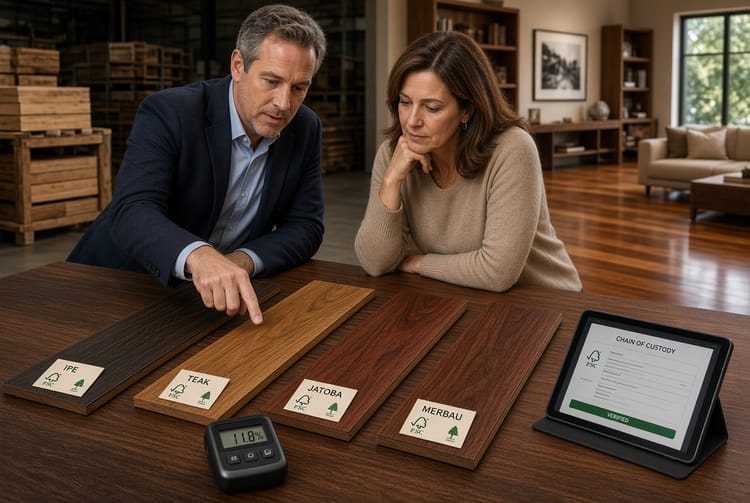
- Sample boards in the actual room lighting before you commit
- Expect the installed floor to read warmer and more complex than a single sample
- Pair the floor with cabinetry, stone, and textiles that can accept a range of browns rather than one exact match
- Use area rugs and furniture placement to frame, not hide, the color movement
Over time, UV exposure can deepen or shift some tones. Quality finishes with UV inhibitors slow that change. Window treatments and area rugs in the first months after installation also help the color mature more evenly.
Durability Beyond Hardness Ratings
Durability in flooring is more than dent resistance. It includes moisture behavior, finish adhesion, edge integrity, and the ability to be refinished. Acacia performs well across these points when the product is correctly manufactured and the job site is controlled.
A durable acacia installation typically includes:
- Proper acclimation to the home’s temperature and humidity
- A flat, dry, structurally sound subfloor
- An appropriate underlayment or vapor strategy
- Tight milling tolerances and a compatible finish system
- Expansion space at walls, transitions, and fixed objects
When those conditions are met, acacia holds up in family rooms, entries, and kitchens better than many people expect from an “exotic” species. The dense fiber structure helps the finish stay attached. The hardness reduces the number of dents that later become finish failures.
Important risk to acknowledge: No hardwood floor is immune to standing water, steam, or chronically high humidity. Spills should be wiped promptly. Bathrooms with poor ventilation and exterior doors that leak are still problem areas. Acacia is tough, not waterproof.
Installation Quality Determines the Final Result
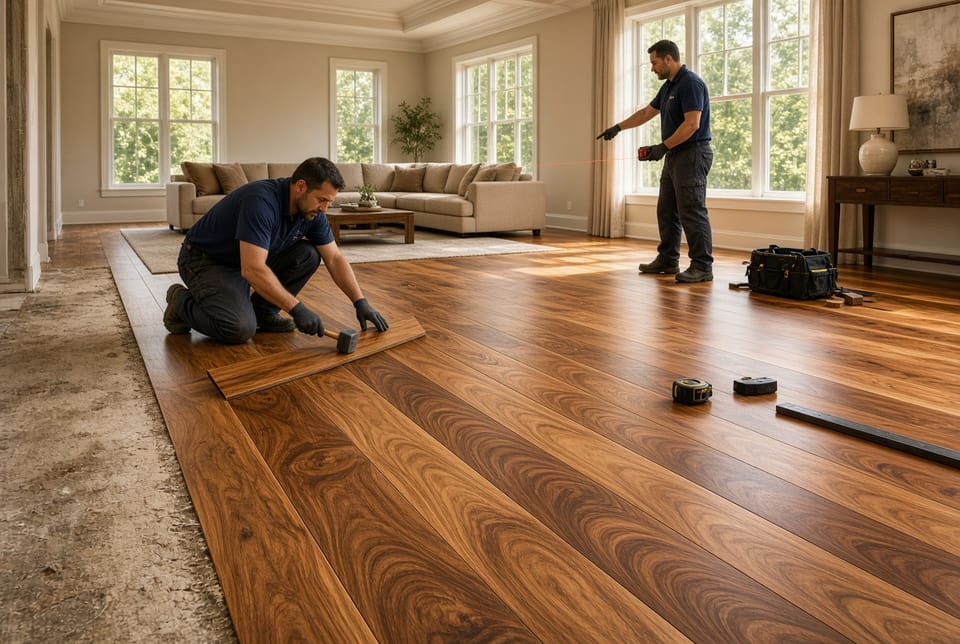
The species can only perform as well as the installation. Exotic hardwoods with active grain and color variation make layout decisions more visible. That is why professional installation is not a luxury with acacia; it is part of the product’s performance.
A competent crew will:
- Inspect and correct the subfloor before the first plank is opened
- Blend cartons so grain and color are distributed evenly
- Maintain consistent expansion gaps
- Protect the surface during and after installation
- Advise on finish sheen, transitions, and maintenance from day one
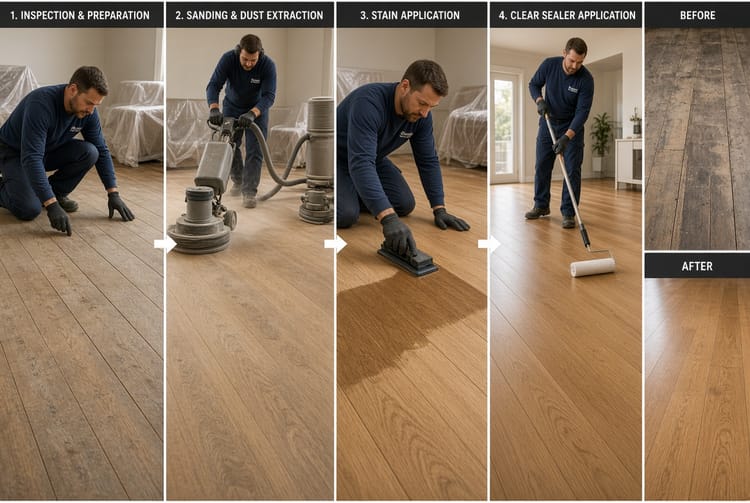
This is also where service quality becomes visible. A well-run flooring project does not just deliver boards. It solves the existing floor problem: worn carpet, scratched oak, uneven vinyl, or a dated surface that no longer matches the home.
Everyday Care That Protects the Investment
Once installed, acacia is relatively straightforward to live with. The same habits that protect any quality hardwood apply here, with extra attention to grit and standing moisture.
Recommended care habits:
- Sweep or vacuum with a hardwood-safe tool to remove abrasive grit
- Use a manufacturer-approved cleaner; avoid steam mops and harsh chemicals
- Place felt pads under furniture and use walk-off mats at exterior doors
- Maintain indoor humidity in a stable, moderate range
- Address scratches early rather than waiting for a full refinish
Because the grain is dramatic, minor scratches often blend better than they would on a perfectly uniform oak floor. That is a quiet practical benefit. Deep dents and water stains still require professional attention.
Acacia Compared With Oak and Hickory
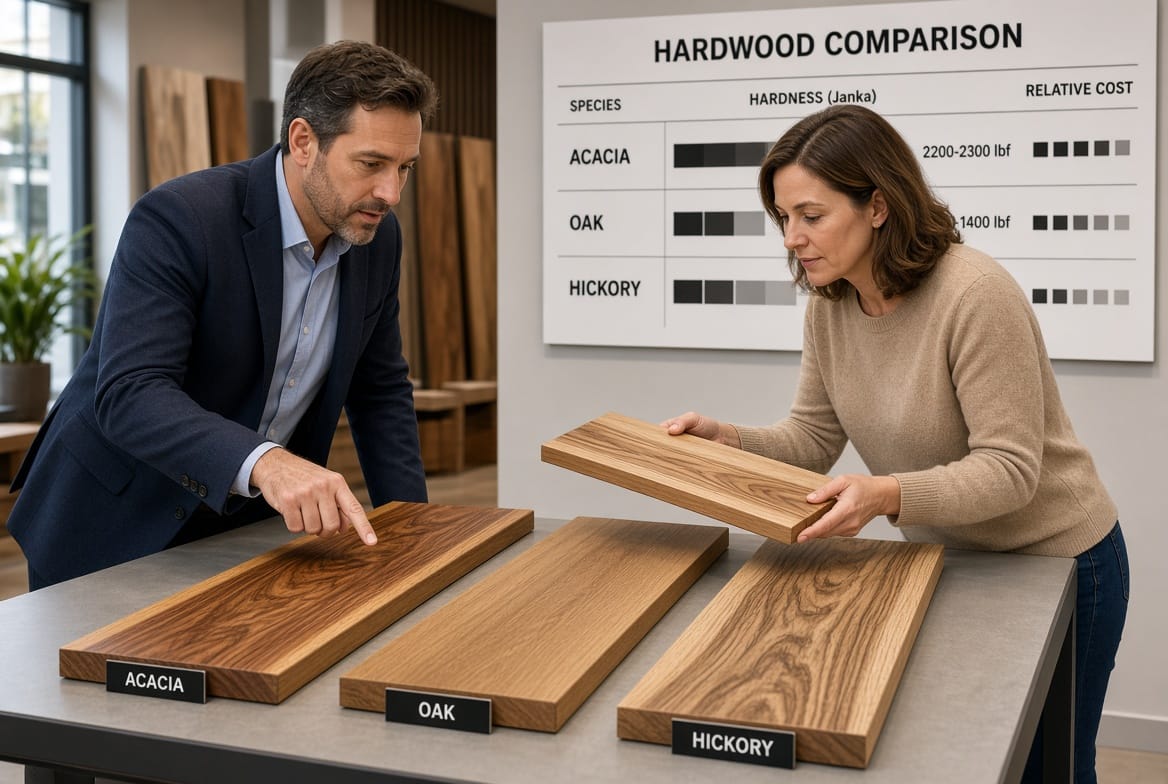
Many buyers start with oak or hickory because those species are familiar. The comparison below is useful, but it should be read as a planning tool, not a claim that one wood is universally better.
Typical decision factors:
- Hardness: Acacia’s 2200–2300 Janka rating generally exceeds common oak and often rivals or exceeds hickory, depending on the specific products compared
- Grain: Oak is usually more predictable; hickory is bold; acacia is exotic, swirling, and highly individual
- Color: Oak can be stained to a wide range; hickory already has contrast; acacia arrives with its own honey-to-chocolate variation
- Cost: Exotic acacia often sits above commodity oak and may be comparable to or higher than premium hickory, depending on grade, width, finish, and region
- Look: Choose acacia when you want an uncommon, high-character floor rather than a traditional American hardwood appearance
Cost should never be judged by the board price alone. Installation complexity, subfloor repair, transitions, and finish system affect the true project cost. A slightly higher material price can still be the better value if the floor lasts longer and needs fewer repairs.
Design Uses That Showcase Acacia Best
Acacia is especially effective in spaces where both beauty and toughness are required:
- Open-concept living and dining areas that need visual warmth
- Kitchens where dropped utensils and chair movement are common
- Hallways and entries that take grit and repeated traffic
- Offices and family rooms that must look finished but remain practical
Wide planks emphasize grain. Medium-width planks often balance character and calm. Distressed or hand-scraped textures can hide future wear, while a clean, smooth finish makes the color and figure the main event.
Lighting should be planned with the floor. Strong side light will exaggerate grain. Even, layered lighting will make the color range feel richer and more controlled.
Common Concerns and Straight Answers
Will the color variation look busy?
It can, if the room already has many competing patterns. Pair acacia with quieter walls, simpler rugs, and solid-tone upholstery if you want the floor to be the feature.
Is exotic wood harder to maintain?
Not if the finish system is high quality and the household follows basic hardwood care. The bigger issue is choosing the right sheen and protecting the floor from grit and water.
Can it be refinished?
Solid acacia can usually be refinished multiple times. Engineered acacia depends on wear-layer thickness. Confirm that specification before purchase.
Is it suitable for every room?
It is an excellent choice for most dry interior living spaces. Constant moisture exposure is still a risk for any hardwood.
These answers are meant to reduce uncertainty, not to oversell the product. The right floor is the one that matches both the look you want and the way the house is actually used.
Choosing Exotic Acacia for Durability
If you want a floor that is visually distinctive and measurably tough, acacia deserves serious consideration. Its 2200–2300 Janka hardness, dramatic grain patterns, and natural color variation create a surface that feels custom while remaining practical. Durability still depends on product quality, site conditions, and professional installation. When those pieces are in place, acacia is one of the strongest exotic hardwood options for real homes.
Choose exotic acacia for durability. A short consultation can confirm whether this species is the right fit for your rooms, traffic level, and design goals.
Call Now for Professional Acacia Flooring Installation