The Spider Identification: Which Ones Are Dangerous and Which Are Beneficial
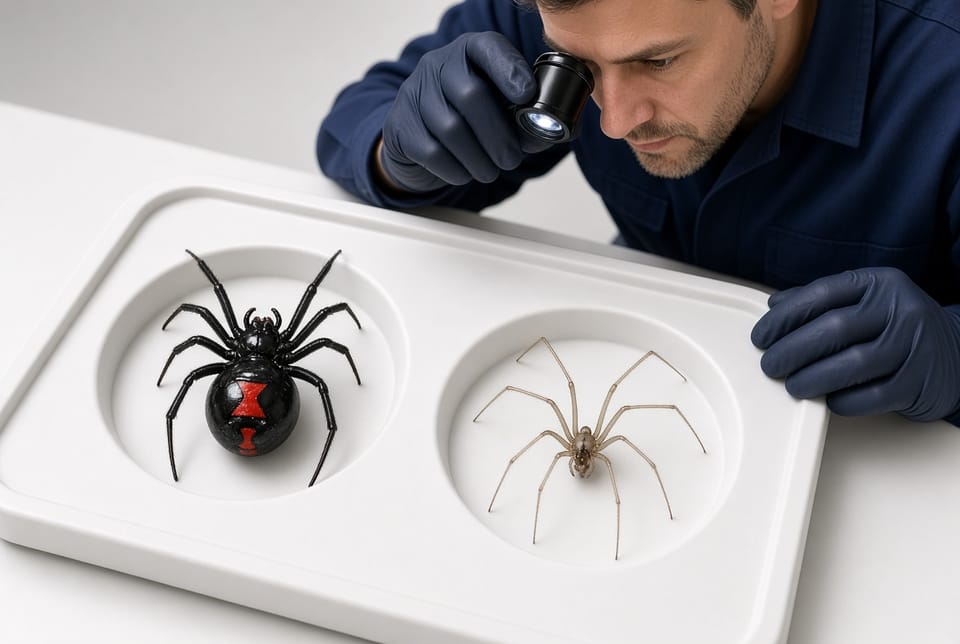
Most homeowners feel an immediate surge of concern the moment they notice a spider. That reaction is understandable. Spiders move quickly, occupy hidden corners, and carry a reputation that is often worse than the reality. The important truth is that the large majority of spiders found inside and around homes are beneficial predators, not threats. They consume flies, mosquitoes, cockroaches, and even other spiders. A smaller number of species can pose a genuine medical risk and require prompt, professional attention.
Get Expert Spider Identification Today – Call Now
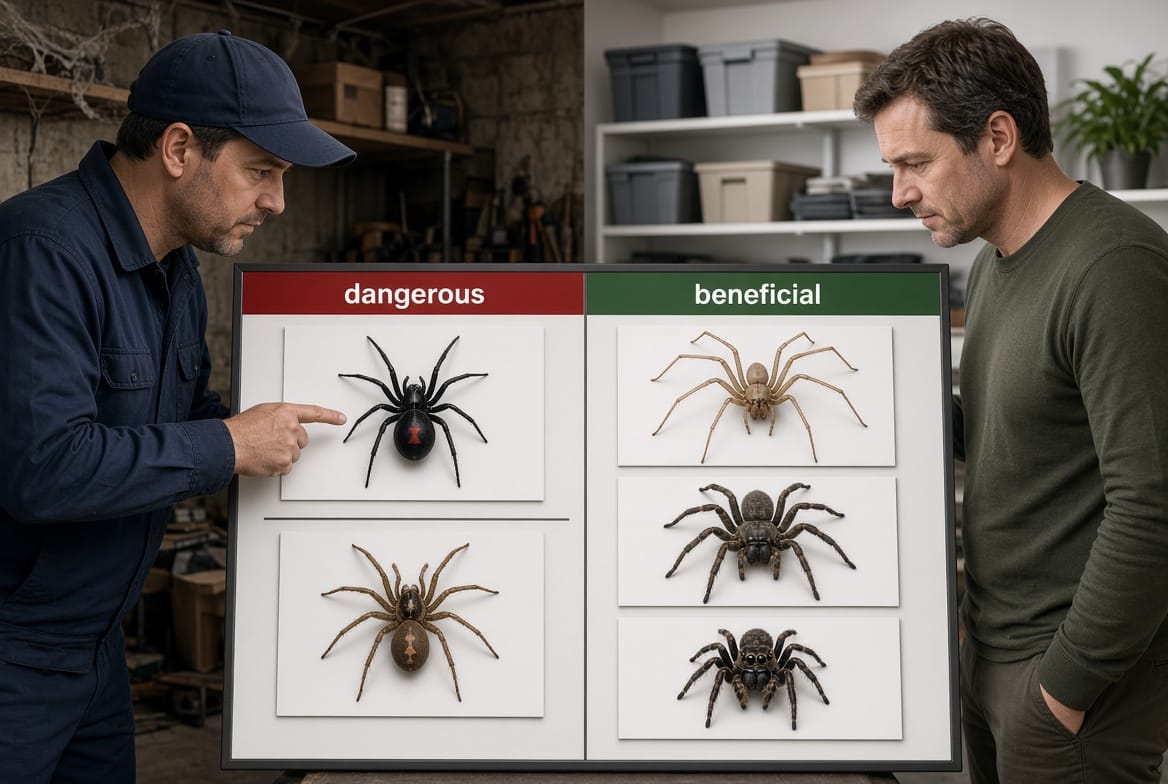
Effective spider management begins with accurate identification. Spraying every web or crushing every eight-legged visitor can eliminate helpful hunters while leaving the truly concerning species untouched. This guide explains the most common household spiders—wolf spiders, cellar spiders, and jumping spiders—alongside the two species that warrant extra caution in many regions of the United States: the black widow and the brown recluse. You will learn their typical behaviors, how to distinguish them, and the precise situations in which treatment is justified.
Why Identification Comes Before Any Treatment Decision
Spiders are not insects. They belong to the class Arachnida and possess two main body segments, eight legs, and fangs. Their role in the indoor and outdoor ecosystem is overwhelmingly positive. A single cellar spider can reduce populations of smaller pests that otherwise multiply in basements and garages. Jumping spiders patrol windowsills and consume flying insects that enter through screens. Wolf spiders hunt at ground level and help keep cricket and beetle numbers in check.
Panic-driven spraying often backfires. Broad-spectrum insecticides kill beneficial species first, remove natural control, and can drive remaining spiders into new hiding places. Worse, many “spider bites” reported to physicians later prove to be bacterial infections, allergic reactions, or bites from other arthropods. Confirming the species before applying any product protects both your family and the useful predators already working in your home.
Key Physical Features Used in Spider Identification
Reliable identification rests on a handful of consistent traits rather than overall size or color, both of which vary with age, sex, and lighting.
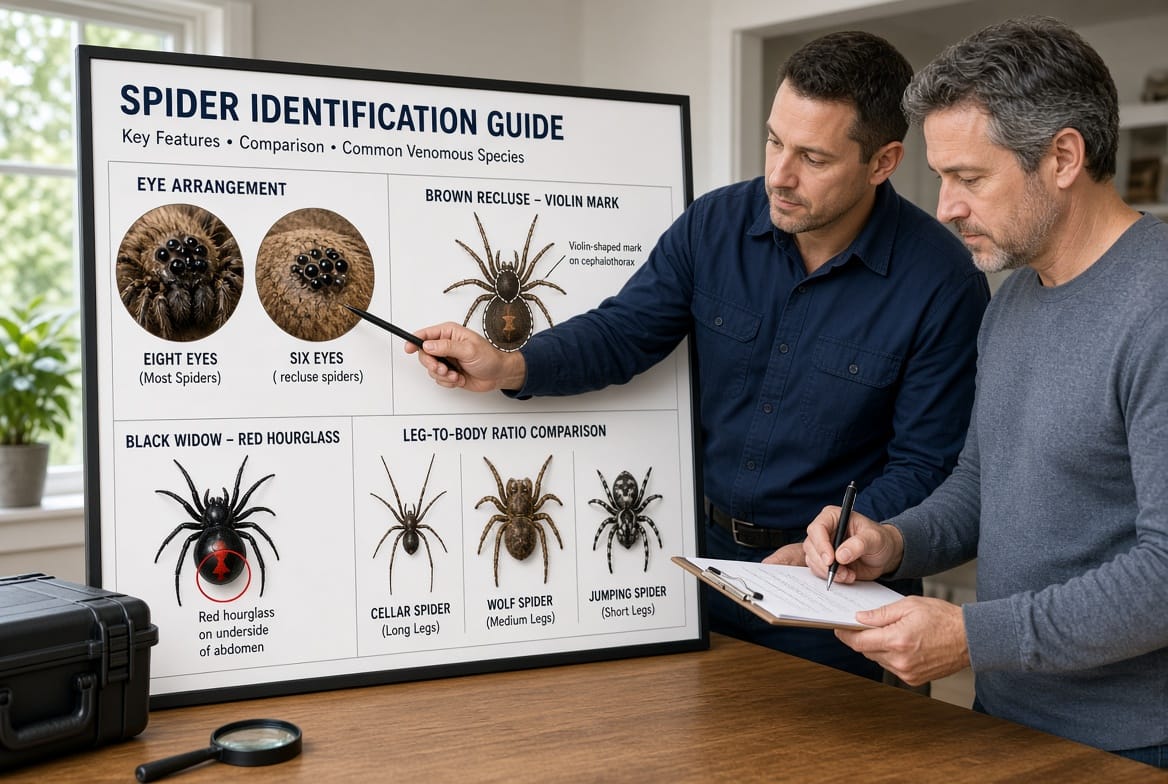
- Eye arrangement: Most spiders have eight eyes, but the pattern differs by family. Jumping spiders show a distinctive row of large forward-facing eyes. Brown recluses have six eyes arranged in three pairs.
- Body markings: Look for the red hourglass on the underside of a black widow’s abdomen or the violin-shaped mark on the cephalothorax of a brown recluse.
- Leg length and posture: Cellar spiders have extremely long, thin legs relative to a small body. Wolf spiders appear robust and hairy with legs held close to the ground.
- Web type: Irregular, messy tangle webs often belong to cellar spiders or widows. Wolf and jumping spiders do not rely on capture webs.
- Behavior when disturbed: Cellar spiders frequently vibrate rapidly in their webs. Jumping spiders turn to face movement and may hop short distances. Reclusive species typically retreat rather than advance.
These features allow a trained observer to separate harmless residents from species that deserve targeted action.
Beneficial Household Spiders You Usually Want to Keep
Cellar Spiders
Cellar spiders, often called daddy long-legs spiders (though they are true spiders, not harvestmen), build loose, irregular webs in basements, crawl spaces, garages, and upper corners of unused rooms. Their bodies are small and pale; the legs are remarkably long and fragile-looking. When threatened they bounce rapidly in the web, a behavior that can startle people but poses no danger.
These spiders are efficient predators of other arthropods, including mosquitoes and occasionally even more dangerous spiders that wander into their webs. Their venom is not medically significant to humans. Treatment is rarely necessary unless webs accumulate in high-traffic living areas and create an aesthetic concern. In those cases, vacuuming the webs and improving ventilation usually solves the issue without chemicals.
Wolf Spiders
Wolf spiders are active hunters rather than web-builders. They are typically brown or gray, robust, and covered with short hairs. Females are well known for carrying an egg sac attached to their spinnerets and later transporting spiderlings on their backs. They move quickly across floors, especially at night, which can surprise residents.
A wolf spider may bite if pressed against skin, but the result is usually limited to localized redness and mild discomfort comparable to a bee sting. They perform valuable pest-control work by consuming ground-dwelling insects. The best response is to escort one outside or leave it undisturbed in a garage or basement. Indoor sightings of several large wolf spiders may indicate cracks or gaps that also admit other pests; sealing those entry points is more effective than spraying.
Jumping Spiders
Jumping spiders are compact, often brightly patterned, and possess excellent vision. Their large anterior median eyes give them an almost curious appearance; they will frequently turn to watch a person who approaches. They stalk prey and leap with precision rather than spinning capture webs.
These spiders are among the most beneficial indoor hunters. They patrol walls, ceilings, and window frames, reducing populations of flies and small moths. Bites are uncommon and medically insignificant. Because they are active during daylight and readily visible, many homeowners simply relocate them outdoors. Their presence is generally a sign of a healthy, low-chemical environment.
Leaving these three groups in place supports natural pest suppression and reduces the need for repeated insecticide applications.
Dangerous Species That Require Careful Attention
Black Widow Spiders
The female black widow is glossy black with a distinctive red hourglass marking on the underside of the spherical abdomen. Males are smaller, lighter, and far less venomous. These spiders construct irregular, sticky tangle webs in protected, undisturbed locations: woodpiles, meter boxes, under eaves, in sheds, and occasionally in cluttered garages or basements.
Black widows are shy and bite only when they feel trapped—typically when a person reaches into a web or puts on clothing that has been stored in an infested area. The venom is neurotoxic. Symptoms can include intense muscle pain, abdominal cramping, sweating, and elevated blood pressure. Fatalities are rare with modern medical care, yet any suspected bite should receive prompt professional evaluation. Confirmed indoor populations, especially near living spaces or children’s play areas, justify targeted treatment by a licensed technician who can locate harborage sites without broadcasting insecticide throughout the home.
Brown Recluse Spiders
The brown recluse is tan to dark brown with a violin-shaped marking pointing toward the abdomen on the cephalothorax. It has six eyes grouped in three pairs—an unusual arrangement that helps distinguish it from the eight-eyed majority of household spiders. These spiders hide in dark, dry, undisturbed places: behind baseboards, in cardboard boxes, inside rarely worn shoes, and in attics or crawl spaces.
They are not aggressive. Bites almost always occur when the spider is compressed against skin. In a minority of cases the venom produces a necrotic lesion that can take weeks to heal. Many suspected recluse bites are later attributed to other causes, which is why photographic or specimen confirmation is valuable. When a brown recluse is positively identified inside occupied rooms, professional inspection of clutter, storage areas, and structural voids is the appropriate next step. Broad spraying is seldom the most effective first action.
Both species prefer to avoid people. Reducing clutter, sealing cracks, and storing items off the floor dramatically lowers encounter risk.
When Treatment Is Warranted—and When It Is Not
Treatment decisions should rest on three questions:
- Has the species been reliably identified?
- Is the spider located in a high-use living area or only in an unused storage space?
- Are there signs of a reproducing population (egg sacs, numerous individuals of different sizes) rather than a single wanderer?
A lone wolf spider on the basement floor or a jumping spider on a windowsill does not require chemical intervention. A black widow web inside a child’s playhouse or repeated brown-recluse sightings in bedrooms does. In the latter situations, a trained technician can apply targeted products, recommend exclusion work, and monitor results.
Over-the-counter sprays often miss the harborage sites these spiders actually use. They also kill the beneficial species that would otherwise compete with or prey upon the problem spiders. Professional identification therefore saves money, reduces chemical exposure, and produces longer-lasting results.
Practical Steps Homeowners Can Take Immediately
- Reduce clutter in basements, garages, and closets so hiding places disappear.
- Install door sweeps and seal gaps around pipes and utility penetrations.
- Shake out shoes and clothing stored in infrequently used areas.
- Use a vacuum to remove webs and egg sacs, then empty the canister outdoors.
- Photograph any unfamiliar spider from several angles (including the underside when safe) before deciding on action.
These measures alone resolve the majority of household spider concerns.
Common Myths That Lead to Unnecessary Fear
Many people believe every large brown spider is a recluse or that all shiny black spiders are widows. In reality, numerous harmless look-alikes exist. Another widespread misconception is that spiders seek out humans to bite; they do not. Most encounters occur because a person accidentally presses the spider. Finally, the idea that “the only good spider is a dead spider” ignores the substantial pest-control service these animals provide at no cost.
Education replaces fear with measured action. Once you can recognize the difference between a cellar spider vibrating in a corner web and a black widow tucked into a tight crevice, decisions become straightforward.
The Value of Professional Confirmation
Photographs help, yet lighting, angle, and camera quality can hide or exaggerate markings. A licensed technician carries the experience to distinguish regional look-alikes, locate hidden egg sacs, and recommend the least-disruptive control method. Identification also documents whether a medically significant species is actually present—an important record if a bite later occurs.
Homes that receive periodic professional inspections typically experience fewer surprise encounters because entry points are sealed and harborage is reduced before populations grow.
Knowing which spiders belong in your home and which do not is the most effective, lowest-impact approach to coexistence. Beneficial hunters can remain at work while genuine risks are addressed precisely and promptly.
Know your spiders before you spray.
Protect Your Home with Accurate Spider Identification – Call Now