The Sober Living Transition: Moving from Treatment to Independence

Leaving a treatment program is a milestone worth honoring. It is also one of the most vulnerable points in recovery. The clinical structure that protected you—scheduled therapy, constant staff presence, a substance-free campus, and a tightly organized day—ends. The real world returns with bills, old neighborhoods, unstructured hours, family tension, work stress, and the quiet pull of old habits. That gap between formal treatment and independent living is where many people lose momentum.
Start Your Transition to Independence – Call Today
Sober living exists to close that gap. It is not a second rehab and it is not a halfway house in the correctional sense. It is structured transitional housing: a substance-free home with clear expectations, peer accountability, and enough freedom to practice real life while still having a safety net. For many people, this step is the difference between a strong discharge plan and a fragile return to the same conditions that fed the addiction.
This article explains what sober living is, what daily life actually looks like, why the rules exist, and how the model helps you move from treatment toward genuine independence—without pretending the path is easy.
Why the Step After Treatment Matters
Treatment does essential work. It interrupts use, addresses withdrawal, teaches coping skills, and often begins to repair thinking patterns that kept the cycle going. What treatment cannot fully simulate is ordinary life: commuting, cooking dinner after a hard day, managing money, handling conflict with a roommate, or sitting with boredom on a Friday night.
The relapse risk after discharge is well recognized in recovery planning for a reason. Idle time, isolation, untested skills, and a return to triggering environments can undo weeks or months of progress. People who leave treatment and immediately live alone, or return to an unstable household, often face three simultaneous pressures:
- Loss of external structure
- Loss of daily accountability
- Loss of a recovery-focused community
Sober living answers those three pressures at once. It keeps the environment alcohol- and drug-free, restores predictable routines, and places you among people who are also working to stay sober. The goal is not to keep you dependent on a program. The goal is to help you become ready to live without one.
What Sober Living Is—and What It Is Not
Sober living (also called a recovery residence or sober home) is a residential setting designed for people who have completed or stepped down from treatment and need a stable place to practice sobriety. Residents typically share a house, pay program or housing fees, follow house rules, and participate in recovery activities while working, attending school, or continuing outpatient care.
It is important to be precise about what sober living does not provide. Most homes are not licensed clinical treatment centers. They do not replace detox, residential rehab, or therapy. They do not usually offer 24-hour medical care. Quality programs will connect residents to outpatient services, 12-step or alternative mutual-support groups, and community resources, but the house itself is housing plus structure.
What it does provide is a recovery-oriented living environment. That environment is built on a few non-negotiable ideas:
- Abstinence is the baseline, not an aspiration.
- Accountability is visible and consistent.
- Responsibility is practiced every day, not postponed.
- Community replaces isolation.
- Independence is the destination, not an afterthought.
Think of it as a rehearsal space for adult life. You still have to show up for work, keep your room in order, contribute to the household, manage your schedule, and stay honest. You do those things with people who understand why honesty matters and with rules that make slipping back into chaos harder.
The Continuum of Care: Where Sober Living Fits
Recovery is rarely a single event. It is a sequence of supports that should become less intensive as a person grows stronger. That sequence is often called the continuum of care.
A typical path looks like this:
- Medical detox or stabilization, when needed
- Residential or inpatient treatment
- Partial hospitalization or intensive outpatient care
- Standard outpatient therapy and mutual-support groups
- Sober living / recovery housing
- Independent living with ongoing community support
Sober living sits in the middle of that arc. It is the stage where clinical intensity decreases while real-world responsibility increases. You are no longer in a facility that organizes almost every hour. You are also not yet fully on your own. That middle ground is the point.
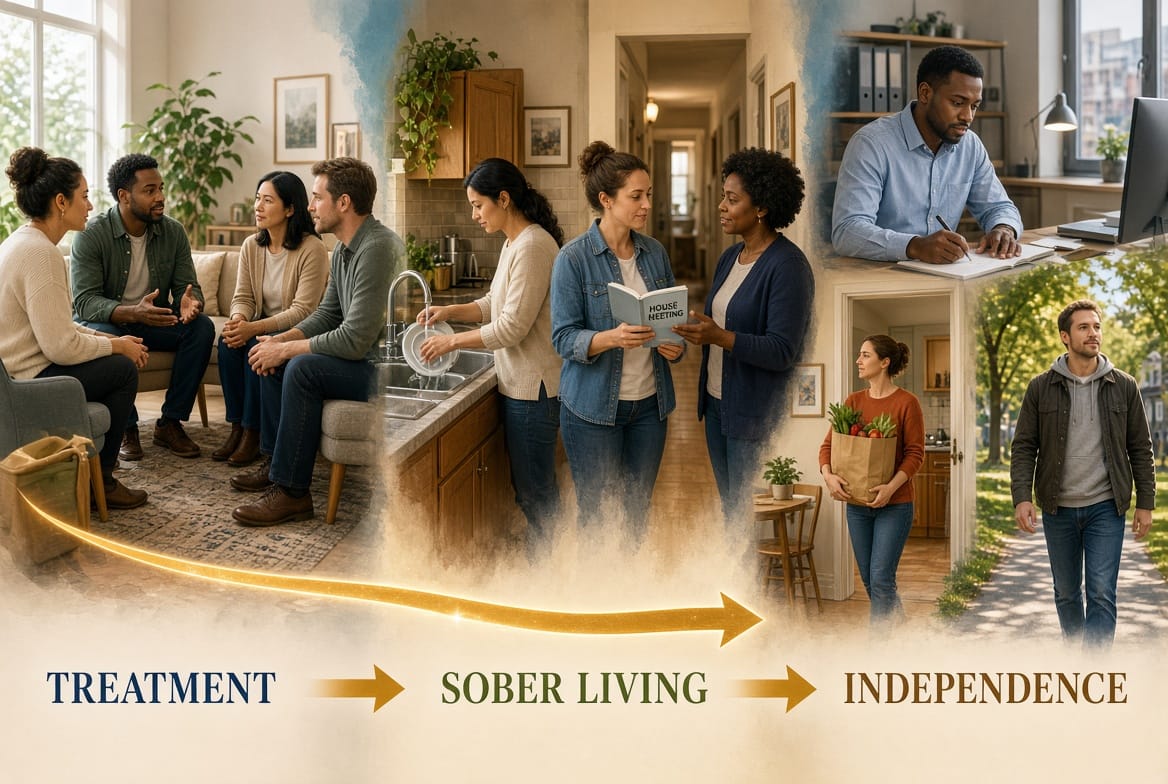
When this sequence is skipped—when someone leaves residential care and returns immediately to an unstructured apartment or a high-risk household—the jump is often too large. Skills learned in treatment remain theoretical. Sober living makes them practical.
What to Expect Day to Day
No two homes are identical. A well-run program, however, will feel recognizable. You should expect orientation, a written resident agreement, posted expectations, a house manager or senior resident leadership, and a daily rhythm that balances freedom with responsibility.
Mornings often include getting up on time, making your bed, completing assigned chores, eating, and leaving for work, school, appointments, or meetings. Evenings often include dinner, house check-ins, recovery meetings, and being home by curfew. Weekends usually allow more flexibility, but not chaos.
The details matter because they rebuild the habits addiction often erodes: showing up, following through, sharing space respectfully, and keeping commitments when no one is applauding.
House Rules Are Not Decoration
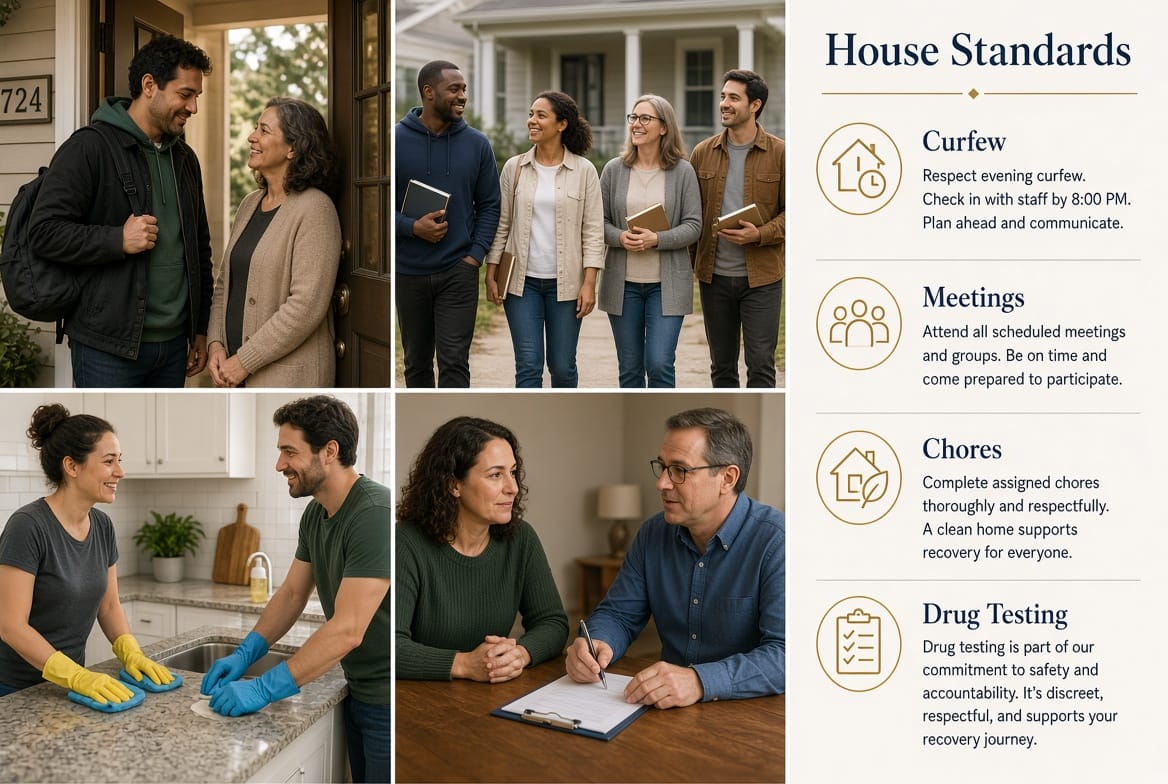
Rules can feel restrictive after the intensity of treatment, especially if you are eager to prove you “have this.” In sober living, rules are the architecture of safety. They protect the whole household, not just one resident.
Common expectations include:
- Zero tolerance for alcohol, illicit drugs, and misuse of medication
- Drug and alcohol testing, both scheduled and random
- A curfew, often earlier on weeknights and later on weekends
- Required or strongly expected recovery meetings
- Participation in house meetings
- Rotating chores and care of personal space
- Restrictions on overnight guests and high-risk visitors
- Expectations around work, school, volunteering, or active job search
- Respectful conduct: no violence, theft, intimidation, or disruption of others’ recovery
These rules exist because early recovery is fragile. Late nights, unstructured social scenes, hidden use, and neglected responsibilities are not small lifestyle issues. They are common pathways back to use. A curfew is not about treating adults like children. It reduces exposure to the hours and settings where impulse is highest. Chores are not busywork. They restore competence. Testing is not humiliation. It makes the abstinence standard real.
Meetings and Recovery Work
Most quality sober living homes require active recovery participation. That usually means a minimum number of mutual-support meetings each week—Alcoholics Anonymous, Narcotics Anonymous, SMART Recovery, or another recognized format—plus a weekly house meeting.
House meetings are practical. Residents discuss chores, conflicts, schedules, concerns, and progress. They are also a training ground for communication. Learning to raise an issue without exploding, listen without becoming defensive, and accept feedback without collapsing is part of becoming ready to live independently.
Meeting attendance does something else that private willpower cannot: it keeps you connected to people who tell the truth about cravings, shame, and the ordinary work of staying sober. Isolation is a major risk. Community is one of the most reliable protections against it.
Chores, Shared Space, and Life Skills
A sober living home is a household, not a hotel. Residents cook, clean, take out trash, sanitize bathrooms, vacuum, and keep bedrooms in order. Assignments usually rotate. Inspections are common. Personal space is expected to stay reasonably clean.
This can sound minor until you remember how thoroughly addiction can dismantle basic functioning. Unpaid bills, neglected rooms, uneaten food, broken routines, and conflict over mess are not side issues. They are part of the same disorder of responsibility that treatment begins to repair.
Doing chores on time teaches follow-through. Sharing a kitchen teaches consideration. Keeping a room orderly teaches self-respect. These are not moral decorations. They are the same skills required to keep an apartment, hold a job, and live with other people after you leave.
Testing and Accountability
Regular and random testing is standard because a substance-free house cannot depend on honor alone. Testing protects residents who are doing the work. It also gives the house a way to intervene early rather than discover a problem after the environment has already been compromised.
A positive test is serious. Policies vary, but consequences can include increased accountability, a return to a higher level of care, or discharge. The purpose is not punishment for its own sake. One person’s use can destabilize everyone else. That is why the standard is clear and why good programs explain it before move-in.
How Sober Living Bridges Treatment and Independence
The value of sober living is not that it is comfortable. The value is that it is transitional. It lets you practice independence in stages.
In treatment, many decisions are made for you. In independent living, every decision is yours. Sober living occupies the space between those extremes. You manage more of your own time, money, transportation, work, and relationships, while still having:
- A substance-free address
- People who notice if you disappear
- Rules that interrupt high-risk patterns
- A community that understands relapse warning signs
- A place to return after a difficult day that is not empty or triggering
This is how the bridge works in practice:
Structure becomes internal. At first the curfew, chore chart, and meeting requirement feel external. Over weeks and months, they become a personal rhythm: sleep, work, recovery, responsibility, rest.
Skills become usable. Coping tools learned in group therapy are tested in real conflict with a roommate, a frustrating supervisor, or a family phone call. You get to fail in small ways and correct course without losing housing and sobriety at the same time.
Identity shifts. People stop seeing themselves only as patients and begin seeing themselves as workers, students, housemates, and reliable adults. That identity change is one of the quiet engines of long-term recovery.
Support remains close. You do not have to invent a sober network from scratch on the day you leave treatment. You live inside one while you build a broader life.
Independence is earned, not declared. Readiness is demonstrated by consistency: paying your way, keeping commitments, handling stress without using, and participating in the household. That is a far stronger foundation than optimism alone.
Rebuilding the Practical Life That Supports Sobriety
Lasting recovery is not only an emotional or spiritual process. It is also logistical. People need a safe place to sleep, a way to earn money, a plan for transportation, a method for paying bills, and relationships that do not revolve around use.
Quality sober living programs take those practical needs seriously. Residents are commonly expected to work, attend school, volunteer, or document an active search for employment. That expectation is protective. Unstructured days create room for rumination, isolation, and old patterns.
Over time, residents often rebuild:
- Time management
- Budgeting and rent responsibility
- Employment consistency
- Household competence
- Conflict resolution
- Healthy boundaries with family and friends
- A weekly recovery routine that can travel with them after they move out
These are the unglamorous ingredients of independence. They are also the conditions that make sobriety sustainable when the house rules are no longer posted on the refrigerator.
Challenges You Should Anticipate
A reassuring tone should never become a dishonest one. Sober living is helpful. It is not effortless.
Some residents struggle with the loss of privacy. Shared bathrooms, house meetings, and testing can feel intrusive. Others bristle at curfew after years of doing whatever they wanted. Personality conflicts happen. Someone will not do their dishes. Someone will talk too much in the house meeting. Someone will test a boundary.
These frictions are not evidence that the model is failing. They are the curriculum. Learning to live with other people without escaping into substances is part of the work.
The larger challenge is internal. After treatment, many people feel a surge of confidence. That confidence can be real and still be premature. The first months after discharge are when the brain, habits, and social world are still reorganizing. Sober living respects that reality. It assumes you are capable and also assumes you still need scaffolding.
Success in the house usually comes down to a few postures:
- Follow the rules even when they feel inconvenient
- Tell the truth early, before a problem becomes a crisis
- Use meetings instead of isolating
- Treat chores and work as part of recovery, not distractions from it
- Ask for help when cravings, depression, or old thinking return
- Remember that the house is a bridge, not a hiding place
How Long Should Someone Stay?
There is no single correct length of stay. Some people benefit from a few months. Others do better with six months or longer. Research and clinical experience both suggest that more time in a stable, recovery-focused environment is often associated with stronger outcomes, but the right duration depends on the person.
A useful question is not “How soon can I leave?” It is “What evidence do I have that I can maintain this life without the house?” Signs of readiness often include consistent sobriety, reliable work or school participation, a functioning recovery routine, improved relationships, the ability to manage money, and a realistic housing plan that is not simply a return to the same high-risk setting.
Leaving too early to prove independence can recreate the original problem: a sudden drop in structure. Staying with purpose—using the house to build a life rather than to delay one—is the wiser use of the model.
What Quality Looks Like
Not every residence that calls itself sober living is equal. A serious program should be able to explain its rules, testing process, fees, guest policy, house leadership, and expectations around meetings and work. The home should be clean, supervised in a clear way, and oriented toward recovery rather than warehousing people.
Look for transparency. Residents should know what happens after a missed curfew, a missed meeting, or a positive test. The culture should be firm without being chaotic or punitive for its own sake. Peer support should feel real. The physical environment should support dignity.
A good program also recognizes that housing is only one part of the picture. Outpatient therapy, medication support when appropriate, medical care, family work, and employment help all strengthen the transition. Sober living works best when it is connected to the rest of a person’s recovery plan.
From Bridge to Independence
Independence is not the absence of support. It is the ability to live a self-directed life without returning to substances when stress arrives. That ability is built, not announced.
Sober living helps build it by combining three things treatment cannot fully provide at once: a safe home, a structured day, and a community of people practicing the same change. You learn to wake up, contribute, work, attend meetings, handle conflict, and come home to a place that does not undermine your progress.
When the transition is done well, residents leave with more than time away from drugs or alcohol. They leave with routines, relationships, skills, and a clearer sense of themselves as people who can keep a life together. That is the point of the step. Treatment starts the change. Sober living gives that change somewhere stable to take root. Independence becomes possible because it has already been practiced.
Take the Next Step in Recovery
If you or someone you love is leaving treatment and is not ready to face daily life alone, sober living may be the most important next decision you make. You do not have to leap from a structured program into an unstructured world and hope willpower is enough.
Call Now for Structured Sober Living Support