The Roof Sheathing Thickness: Why OSB vs. Plywood and Proper Spacing Matter for Roof Strength
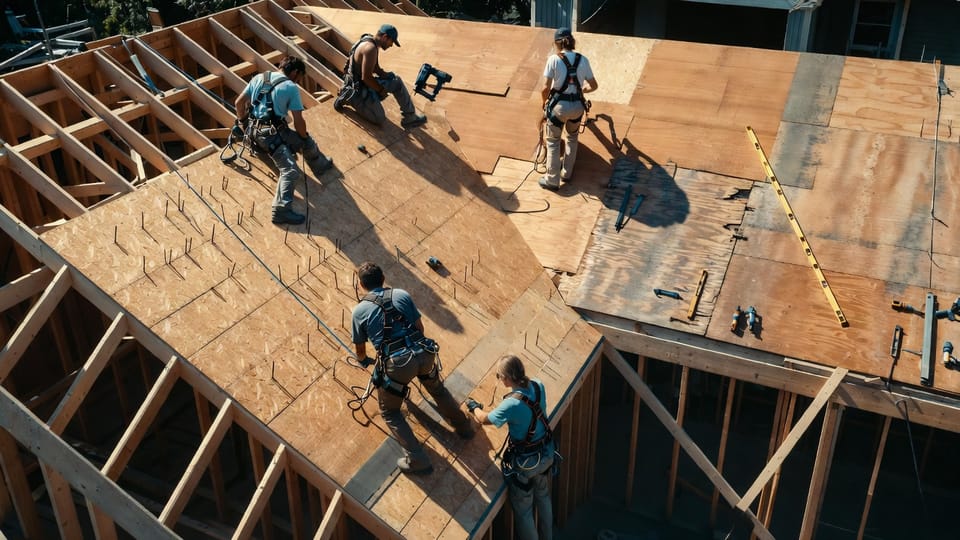
Your roof is more than shingles and flashing – it begins with the structural deck. This critical layer, known as roof sheathing, ties rafters together, supports roofing materials, and forms a rigid diaphragm that resists wind uplift, snow loads, and everyday stresses. Choosing the right roof sheathing thickness, deciding between OSB and plywood, maintaining proper spacing, and following exact nailing patterns are not optional details. They determine whether your roof stands strong or fails when storms hit.
Get Expert Sheathing Advice – Call Today!
Homeowners often overlook the deck until problems appear – sagging, leaks, or wind damage. Yet investing in proper sheathing upfront delivers decades of reliable protection. At our roofing company, we treat the structural deck as the foundation of every successful roof. When installed correctly, it quietly safeguards your home, your family, and your investment. Rest assured: the right choices in materials, thickness, spacing, and fastening create a roof built to last.
Understanding Roof Sheathing: The Structural Backbone
Roof sheathing is the plywood or OSB panels fastened directly to rafters, creating a continuous surface beneath underlayment and shingles. It distributes loads, prevents rafter twisting, and provides a nailable base for the entire roof system. Without a properly engineered deck, even the best shingles cannot perform.
Key risks arise when sheathing is too thin, improperly spaced, or poorly nailed: panels can buckle under heat expansion, pull away in high winds, or allow moisture intrusion that leads to rot. These issues compound quickly, turning minor storms into major repairs. A strong deck, however, acts like a rigid shield, transferring forces evenly and keeping your home dry and secure.
Proper sheathing also contributes to overall home stability. In high-wind zones, a well-nailed deck can mean the difference between intact roofing and widespread loss. Building codes recognize this importance, setting minimum standards for thickness and installation that professionals follow rigorously to exceed expectations.
OSB vs. Plywood: Breaking Down the Differences
Oriented strand board (OSB) and plywood are both engineered wood panels, yet they differ in construction, performance, and application. Understanding these differences helps you appreciate why thickness and spacing matter equally for both.
OSB is manufactured from thin wood strands coated with resin and oriented in layers for maximum strength along the panel length. It offers consistent quality, excellent shear resistance, and a lower price point – making it a popular choice for modern roofing projects. OSB performs exceptionally well when kept dry during installation and protected by quality underlayment. Its uniform composition reduces voids, delivering reliable load-bearing capacity across large spans.
Plywood, by contrast, consists of thin wood veneers glued in alternating grain directions. This cross-lamination provides superior dimensional stability and resistance to splitting when fasteners are driven near edges. Plywood often holds screws more securely and shows slightly better performance in certain moisture-prone environments, though both materials require proper ventilation and protection.
Neither material is universally “better” – the choice depends on rafter spacing, local climate, and project budget. What matters most is matching the panel type and roof sheathing thickness to the specific structural demands of your roof. When either is installed with correct spacing and nailing, both deliver outstanding long-term strength and wind resistance.
- OSB advantages: Cost-effective, consistent strength, widely available in structural grades
- Plywood advantages: Excellent edge holding, slightly better moisture tolerance in some conditions
- Shared benefit: Both create a strong diaphragm when properly fastened
Professionals evaluate every roof individually, selecting the material that best balances performance, cost, and code compliance while ensuring the final deck exceeds minimum requirements.
Determining the Right Thickness for Your Rafter Spacing
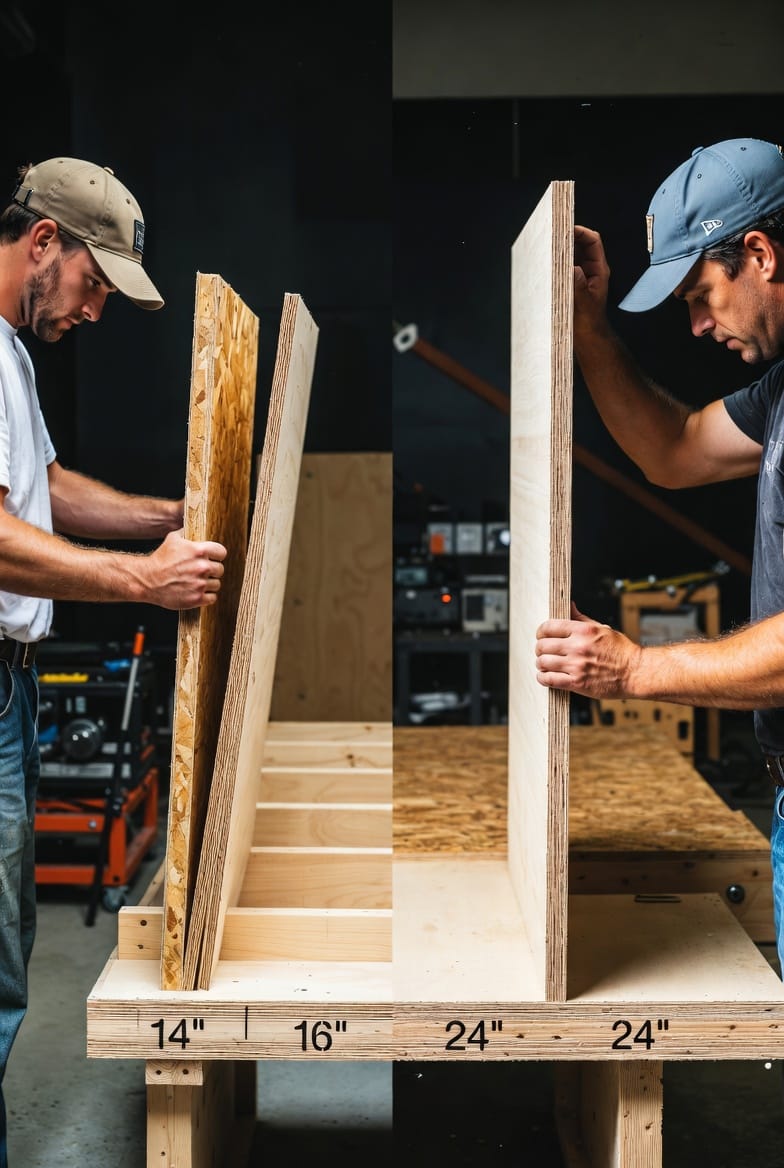
Roof sheathing thickness must increase as rafter spacing widens to prevent excessive deflection and maintain structural integrity. Building codes provide clear tables that link rafter centers (commonly 16 inches or 24 inches on center) to minimum panel thickness for both OSB and plywood.
For 16-inch rafter spacing, a minimum of 7/16-inch OSB or 1/2-inch plywood typically suffices when using standard structural grades. At 24-inch spacing – common in many modern homes for efficiency – thickness increases to 5/8-inch for both materials to limit sagging under live loads. Wider spacings, such as 32 inches or more in engineered designs, may require 3/4-inch or thicker panels.
Choosing the correct thickness eliminates risks like “soft spots” underfoot during installation or long-term sagging that damages shingles and creates ponding water. Thicker panels also improve the roof’s ability to resist uplift forces during high winds, as they transfer shear loads more effectively to the rafters.
Homeowners sometimes ask whether thinner panels save money. The short answer: only if rafter spacing allows it. Cutting corners on thickness creates hidden weaknesses that surface years later as costly repairs. Professionals calculate exact requirements based on your rafter layout, local codes, and wind zone, then specify the appropriate roof sheathing thickness to deliver peace of mind.
The Importance of Proper Panel Spacing
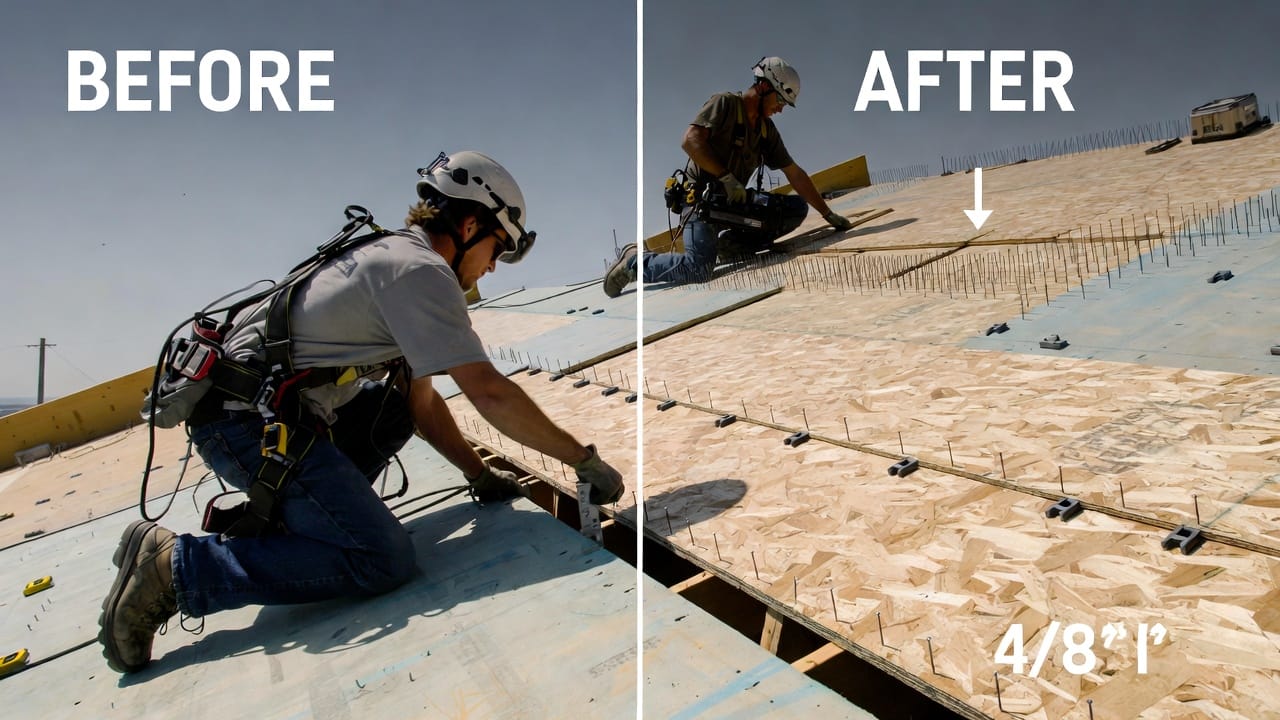
Wood expands and contracts with temperature and humidity changes. Without proper spacing – typically a 1/8-inch gap between panel edges and ends – panels can buckle, creating ridges that telegraph through shingles and compromise waterproofing.
This simple gap serves a powerful purpose: it allows controlled expansion while maintaining a continuous structural plane. Installers use specialized spacers or careful layout techniques to achieve uniform gaps across the entire deck. Edge nailing then locks panels in place without restricting movement.
Skipping spacing invites serious risks: warped surfaces, fastener pull-out, and reduced wind resistance. A properly spaced deck remains flat and rigid, transferring wind loads smoothly and preventing panel-to-panel stress that weakens the entire system.
Mastering Nailing Patterns for Wind Resistance
Proper nailing patterns transform individual panels into a unified structural diaphragm capable of resisting extreme wind uplift. Standard schedules call for 6-inch spacing along panel edges and 12-inch spacing in the field, using ring-shank or deformed-shank nails of the correct length to penetrate rafters sufficiently.
Staggered nailing at panel ends and edges creates overlapping reinforcement that dramatically increases shear strength. Every nail contributes to the roof’s ability to hold together when hurricane-force winds attempt to peel panels upward.
Critical risks of improper nailing include loose panels, progressive failure during storms, and code violations that may affect insurance coverage. When executed correctly, these patterns ensure your roof not only meets but exceeds wind-resistance requirements, giving you confidence through every season.
Avoiding Common Pitfalls and Risks
Many roof failures trace directly back to sheathing mistakes: incorrect thickness for the span, missing expansion gaps, or insufficient nailing. These errors create weak points that worsen over time, leading to leaks, mold, and structural concerns.
DIY attempts or rushed installations often overlook these details, resulting in callbacks and frustration. Professional crews avoid pitfalls through training, proper material selection, and systematic quality checks at every step.
Why Professional Installation Makes All the Difference
When experienced roofers handle your structural deck, every detail – from OSB vs. plywood selection to precise roof sheathing thickness, proper spacing, and nailing patterns – receives expert attention. The result is a roof that performs silently and reliably for decades.
You gain more than code compliance: you receive a customized solution tailored to your home’s architecture, local climate, and wind exposure. Peace of mind comes standard.
Build Your Roof on a Solid Foundation
The structural deck beneath your shingles determines how well your roof will protect everything you value. Choose OSB or plywood wisely, match roof sheathing thickness to rafter spacing, maintain proper spacing for expansion, and secure panels with proven nailing patterns. These steps create wind-resistant strength you can count on.
Let us deliver the durable foundation your home deserves – strong, reliable, and professionally installed for lasting peace of mind.
Choose OSB or Plywood Right – Call for Help!