The Home Insurance Claim Denial: Common Reasons and How to Appeal
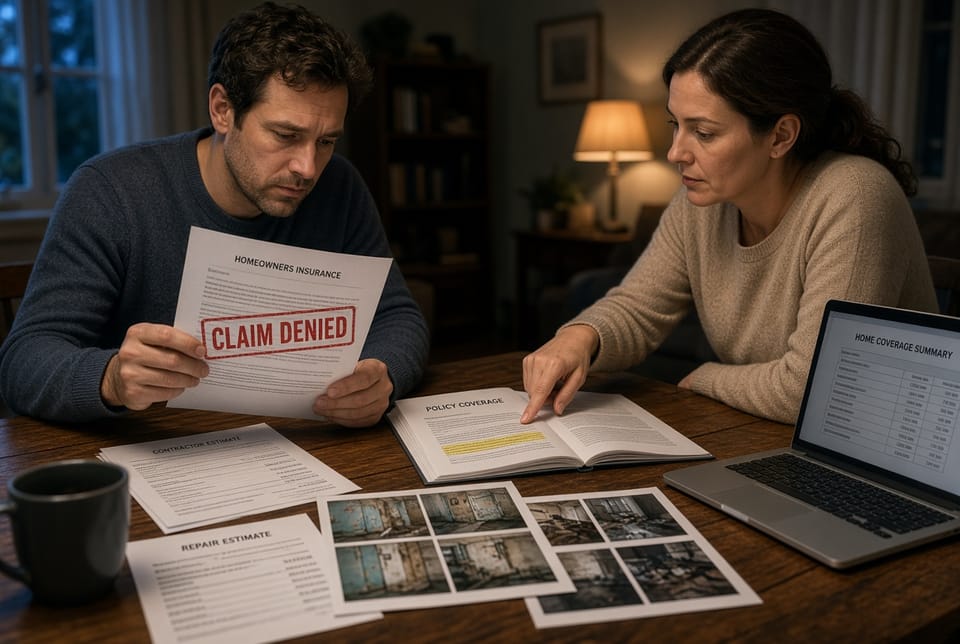
Few moments in homeownership feel as deflating as opening a letter that says your home insurance claim has been denied. You paid premiums. You reported the loss. You expected help. Instead you received a formal refusal, a claim number, and a short explanation that may not match what you saw in your kitchen, basement, or roof.
Get Claim Denial Guidance – Call Now
A denial is not automatically the end of the story. It is a decision based on how the insurer interpreted your policy, the cause of loss, the timing of notice, and the proof you submitted. Many denials can be challenged when the facts, the policy language, and the documentation are assembled carefully. This guide explains the most common reasons claims are refused, how a structured appeal works, and when professional guidance is the smarter next step.
The goal is not to fight every decision for its own sake. The goal is to recover covered losses fairly, avoid avoidable mistakes, and protect the value of the coverage you already purchased.
Why a Denial Feels So Personal
A home is not just a structure. It is shelter, savings, and daily life. When a pipe fails, a storm tears shingles, a fire damages a room, or a sudden water event ruins flooring, the financial shock arrives immediately. Repair estimates grow. Temporary housing may be needed. Contents may be unusable.
Then the claim denial arrives. The language is often technical: excluded peril, wear and tear, lack of maintenance, policy not in force, insufficient documentation. Those phrases can sound final. They are not always final.
Insurers evaluate claims against a written contract. If the loss falls outside that contract—or if the file does not yet prove that it falls inside it—the claim can be declined even when the damage is real. Understanding that distinction is the first step toward a stronger appeal.
Start With the Denial Letter and the Policy
Before you argue, read. The denial letter should identify:
- The date of loss the insurer used
- The policy number and coverage period
- The stated reason for denial
- The policy provisions cited
- Deadlines and rights to request review, appraisal, or further documentation
- Contact information for the adjuster or claims unit
Place that letter beside the full homeowners policy, including declarations, endorsements, exclusions, conditions, and any notices about premium or cancellation. The declarations page tells you what was in force. The exclusions tell you what was never intended to be covered. The conditions tell you what you were required to do after a loss.
Bold risk to remember: appealing without reading the cited exclusion is like arguing in the dark. You may spend weeks gathering photos that do not address the actual reason for denial.
If the letter is vague, request a written explanation that quotes the exact policy language. A precise reason is easier to answer than a general refusal.
Common Reasons Home Insurance Claims Are Denied
Denials cluster around a handful of recurring issues. Knowing them helps you test whether the insurer’s position is complete—or incomplete.
Neglect, Deferred Maintenance, and “Wear and Tear”
Most standard homeowners policies cover sudden and accidental damage. They generally do not cover gradual deterioration. If a roof leaked for years, a pipe corroded over time, or wood rot was visible long before collapse, the insurer may classify the loss as neglect or wear and tear.
This is one of the most common—and most disputed—grounds for denial. The disagreement is often about timing. Was the failure sudden, or was it the last stage of a long, unaddressed problem?
A stronger file usually includes:
- Maintenance records and prior repair invoices
- Inspection reports from before the loss
- Contractor opinions that distinguish sudden failure from long-term decay
- Photos that show the condition immediately after the event, not only the aftermath weeks later
- Evidence that you acted reasonably once the problem became known
Key phrase: lack of maintenance is not the same as a single missed appointment. Insurers look for a pattern of ignoring an obvious, worsening condition. Homeowners look for a sudden event that made an existing system fail. The appeal must address that difference with facts, not frustration.
Excluded Perils
A peril is a cause of loss. Many policies are written on a “named peril” or “open peril” (all-risk) basis for the dwelling, with a separate list of exclusions. Typical exclusions or separately purchased coverages include:
- Flood, including overflow of surface water and many groundwater events
- Earthquake and earth movement
- Sewer backup, unless an endorsement applies
- Mold arising from long-term moisture, depending on policy wording
- Damage from birds, rodents, or insects in some forms
- Intentional acts
- Ordinance or law costs unless endorsed
- Certain water damage originating off the property or from poor grading
A burst supply line inside the home may be covered as sudden water damage. Water entering because of a flood event may be excluded. Those two situations can look similar on a wet floor. They are treated very differently in the contract.
Risk: assuming “water damage is water damage.” It is not. Cause of loss controls coverage.
An appeal on an excluded-peril denial must show why the actual cause fits a covered peril, or why an endorsement applies. Weather data, plumber reports, moisture mapping, and a clear sequence of events matter more than a general statement that “the house was damaged.”
Lapsed Coverage and Policy Not in Force
Coverage only exists while the policy is active. A claim can be denied if:
- The premium was unpaid and the policy lapsed
- A cancellation notice was issued and the loss occurred after the effective date
- The property was vacant beyond the period allowed by the policy
- A material change in use or occupancy was not disclosed
- The loss date falls outside the policy period
This category is procedural and often documentation-heavy. Bank records, premium notices, reinstatement letters, mortgage-escrow statements, and proof of mailing can change the outcome if the insurer’s dates are wrong.
If coverage truly lapsed, an appeal will not create coverage that no longer existed. It can still correct a date error, a misapplied cancellation, or a payment that was received but not posted.
Other Frequent Denial Grounds
Several additional reasons appear regularly:
- Late notice. Policies require prompt reporting. Delay can prejudice the insurer’s ability to inspect.
- Insufficient documentation. Missing inventories, no photos, no estimates, or incomplete proof of ownership.
- Pre-existing damage. The insurer concludes the condition existed before the claimed event.
- Policy limits and deductibles. The loss may be covered but fall below the deductible, or exceed a sublimit for a category such as jewelry or water backup.
- Misrepresentation. Application answers or claim statements that the insurer considers inaccurate.
- Failure to protect the property after the loss. You generally must take reasonable steps to prevent further damage.
- Wrong policy form. A dwelling fire policy, landlord policy, or HO-3 form may treat the same event differently.
None of these labels should be accepted at face value. Each can be tested against records, timelines, and the exact wording of the contract.
How Insurers Evaluate a Claim File
Understanding the process reduces the sense that a denial is arbitrary. A typical file includes the first notice of loss, recorded statements, adjuster notes, photos, expert reports, weather or municipal data, estimates, and a coverage analysis.
The adjuster is looking for four questions:
- Was there a policy in force on the date of loss?
- Was the cause a covered peril after exclusions?
- Did the insured comply with policy conditions?
- What is the amount of covered damage after deductible and limits?
A denial means the insurer answered “no” to one of the first three questions, or concluded that no payable amount remains. Your appeal should identify which question is in dispute and answer that question with better evidence.
How to Appeal a Denied Home Insurance Claim
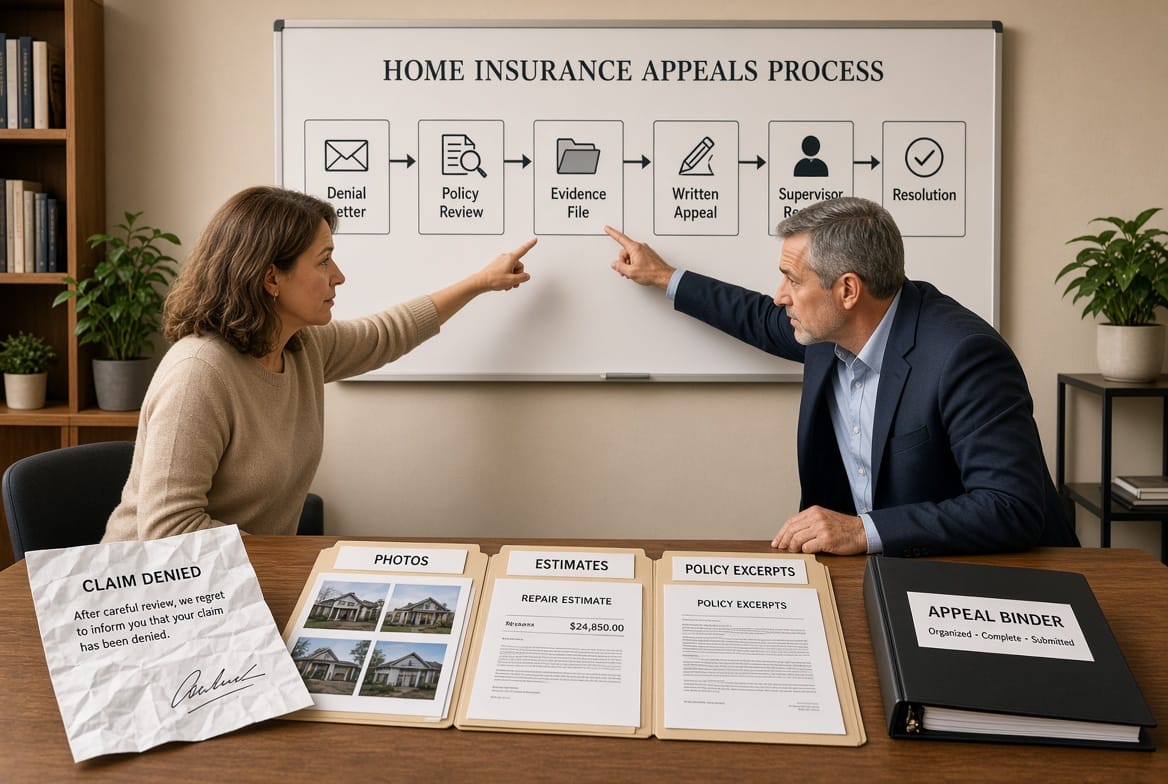
An appeal is not a heated phone call. It is a written, organized request that the insurer reopen the file and reconsider coverage based on additional facts or a different reading of the policy.
Step 1: Calendar Every Deadline
Denial letters and policy conditions may include time limits for additional proof of loss, appraisal, or suit. State rules can add complaint windows. Missing a deadline can close a path that was still open. Write the dates down first.
Step 2: Separate Facts From Feelings
Write a one-page chronology:
- When the damage was discovered
- What you did immediately
- Whom you called
- When the insurer inspected
- What the denial says
- What you believe the cause of loss actually was
This chronology becomes the spine of the appeal.
Step 3: Review the Policy Language Cited in the Denial
Copy the exclusion or condition into your notes. Then ask:
- Does the cited language actually describe this loss?
- Is there an exception to the exclusion?
- Is there an endorsement that restores coverage?
- Did the insurer apply a maintenance exclusion to a sudden event?
Authoritative point: policy interpretation is about the words on the page, applied to the facts of this loss. Broad slogans about “what insurance should cover” rarely move a claims department. Precise language can.
Step 4: Gather Evidence That Answers the Denial Reason
Match evidence to the stated reason.
If the denial is neglect, gather maintenance history and expert opinions on sudden failure.
If the denial is an excluded peril, gather cause-of-loss reports, plumbing or roofing diagnostics, and weather or water-source analysis.
If the denial is lapsed coverage, gather premium payments, notices, and effective dates.
If the denial is insufficient documentation, rebuild the inventory, add photos, receipts, and contractor scopes.
Useful materials often include dated photographs, videos, contractor reports, plumber or roofer findings, moisture readings, prior inspection reports, receipts for emergency mitigation, inventories of damaged contents, and correspondence with the insurer.
Do not flood the file with unrelated paper. Relevance is more persuasive than volume.
Step 5: Write a Clear Appeal Letter
A strong appeal letter is calm, specific, and complete. Include:
- Claim number, policy number, and date of loss
- A short statement that you are requesting reconsideration
- The denial reason you are addressing
- The facts, in order
- The policy provisions you believe apply
- A list of enclosed exhibits
- The resolution you are requesting: coverage acceptance, re-inspection, or a revised estimate
- Your contact information and a reasonable response date
Avoid accusations in the first letter. Ask for a supervisor review and a written response that addresses each point.
Step 6: Request Re-inspection or a Different Adjuster When Needed
If the original inspection was brief, incomplete, or performed before hidden damage was opened up, request another visit. Provide access. Point to specific areas. Hidden moisture behind cabinets, damaged subfloors, or roof decking that was not visible from the ground can change the evaluation.
Step 7: Use Internal Escalation, Then External Options
If the assigned adjuster maintains the denial, ask for a claims supervisor or an internal appeals unit. Keep everything in writing.
If the internal review fails and the amount at stake is significant, additional paths may include:
- A complaint to your state insurance department
- The policy’s appraisal clause for disputes about the amount of loss (this usually does not decide coverage questions)
- A public adjuster, where permitted
- Policyholder counsel when coverage, bad-faith issues, or large losses are involved
Each option has costs, timing, and strategic tradeoffs. They are tools, not automatic next steps.
Building an Evidence File That Decision-Makers Can Use
Claims reviewers work from documents. Help them see the loss the way you saw it.
Organize exhibits with labels: Exhibit A — Denial Letter. Exhibit B — Declarations Page. Exhibit C — Photos, dated. Exhibit D — Plumber Report. Exhibit E — Mitigation Invoice. A reviewer should be able to move from your letter to the proof without guessing.
Photos should show context, not only close-ups of damage. A wide shot of the room, a shot of the failed component, a shot of the water path, and a shot of the damaged finish tell a sequence. Date stamps or metadata help.
Estimates should separate emergency mitigation from permanent repairs. Insurers often treat those categories differently.
Reassuring note: you do not need a perfect file on day one. You need a file that answers the reason for denial more completely than the original submission did.
When to Seek Professional Help
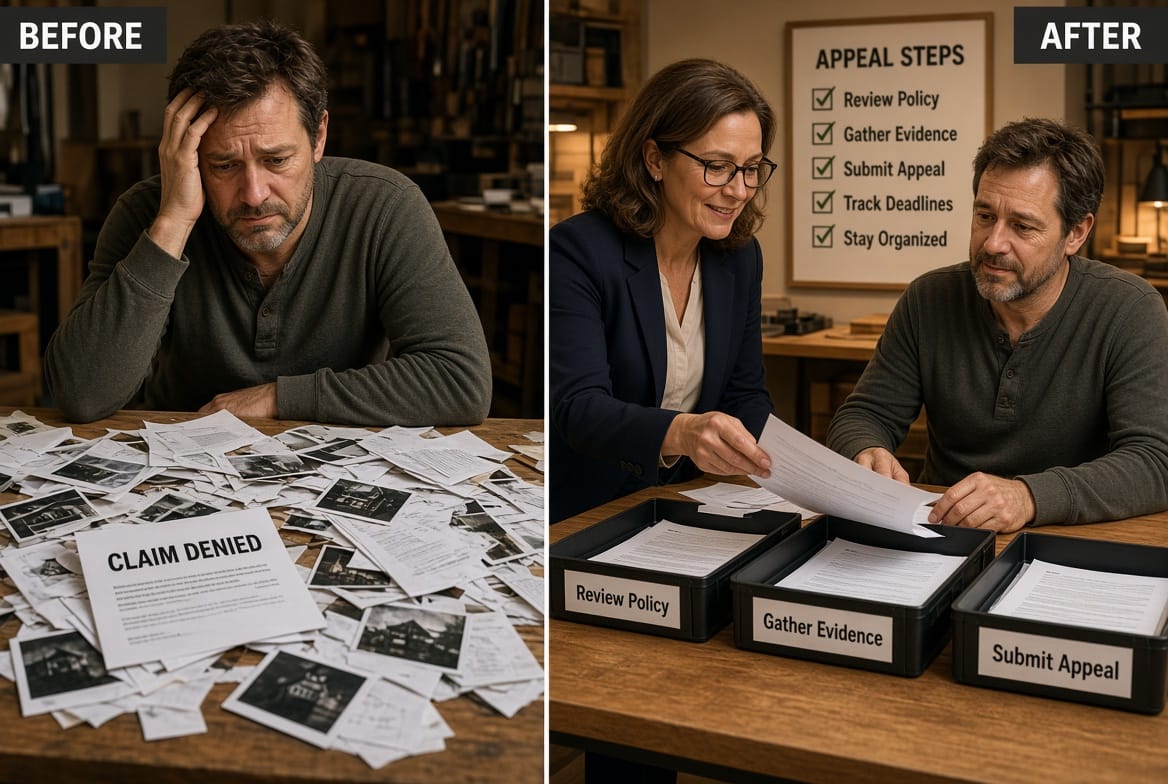
Some denials can be handled by a careful homeowner. Others benefit from experienced help. Consider professional guidance when:
- The loss is large relative to your finances
- The cause of loss is technically disputed (water origin, structural movement, fire causation)
- The insurer alleges fraud, concealment, or material misrepresentation
- Living conditions are unsafe and delays are compounding the damage
- You received conflicting explanations
- The denial appears to ignore an endorsement you purchased
- Deadlines are approaching and the file is still incomplete
- You suspect the claim was under-investigated
A public adjuster can document damage and present the claim, subject to state licensing rules and fees. An attorney can evaluate coverage, bad-faith exposure, and suit deadlines. A licensed contractor or independent engineer can address cause-and-origin questions that a homeowner cannot settle with photos alone.
Important caution: hiring help does not guarantee payment. It improves organization, technical clarity, and the chance that covered damage is not left out of the file.
Professional help is especially useful when plumbing-related water losses are involved. Sudden pipe failure, supply-line rupture, and certain appliance leaks are often claimed as covered water damage, while long-term seepage, flood, and neglected corrosion are often excluded. The difference may rest on a plumber’s findings and the timeline of discovery. That is a documentation problem as much as a coverage problem.
How to Talk to the Insurer Without Weakening the File
Stay factual. Do not guess about the cause if you do not know it. “I discovered water in the hallway on Tuesday morning and shut the valve” is stronger than a theory you cannot prove.
Do not refuse inspection. Do not discard damaged property until the insurer has had a reasonable chance to view it, unless it is a safety hazard and you have photographed it thoroughly.
Confirm conversations in a short follow-up email: date, who you spoke with, what was requested, and what you will send.
Risk phrase: casual recorded statements can be used later. If you are uncertain, it is acceptable to say you will provide details in writing after you review records.
Preventing the Next Denial
Not every future loss can be controlled. Some preparation reduces avoidable refusals:
- Read the declarations page after each renewal
- Confirm flood, sewer-backup, and scheduled-property needs separately
- Keep premium payments current and watch cancellation notices
- Maintain roofs, plumbing, caulking, grading, and smoke systems
- Photograph major rooms and high-value items before a loss
- Report claims promptly and mitigate further damage
- Store the policy where you can find it under stress
Prevention does not make a denial impossible. It makes the next file easier to prove.
What a Realistic Outcome Looks Like
An appeal can produce several results:
- Full or partial reversal and payment
- Agreement to re-inspect and revise the estimate
- Confirmation of the denial with a more detailed explanation
- A compromise on a disputed portion of the loss
- Transfer of a coverage dispute to another process
A detailed denial after appeal is still useful. It tells you whether the remaining issue is coverage, price, or proof. That clarity helps you decide whether to stop, escalate, or seek outside help.
Stay measured. Insurers respond better to complete files than to volume alone. Policyholders do better when they treat the appeal as a professional presentation of facts.
Fight a Claim Denial Effectively
A home insurance claim denial is a serious setback, not a verdict carved in stone. The most common reasons—neglect, excluded perils, and lapsed coverage—can be tested against the policy, the timeline, and the evidence. The homeowners who improve their results are usually the ones who slow down, read the letter, organize proof, and ask for review in writing.
If the damage is real, the coverage may still be available. If the coverage was never there, a clear explanation still helps you plan repairs and future protection. Either way, a structured response is better than silence.
Fight a claim denial effectively. If you need guidance on reviewing a denial, assembling an appeal file, or deciding whether professional help is warranted.
Don’t Accept a Denial—Call for Help