The Home Appliance Insurance: Warranty vs. Homeowners Coverage
Your refrigerator, washer, dryer, dishwasher, oven, and HVAC system represent thousands of dollars in household investment. When one of them fails, the question is never simply “Can it be fixed?” It is “Who pays?” Many homeowners assume a single document will handle every breakdown. That assumption creates expensive gaps. Manufacturer warranties, home warranties (service contracts), and homeowners insurance protect appliances in completely different ways. Understanding those differences is the only reliable way to avoid surprise repair bills and coverage denials.
Protect Your Appliances Today – Call Now
This guide explains exactly what each layer covers, what it excludes, and how the three work together. The goal is straightforward: give you clear, authoritative information so you can protect your appliances properly.
What Appliance Coverage Actually Means
Appliance coverage is not one product. It is a combination of limited promises from the manufacturer, optional service contracts you purchase later, and the sudden-and-accidental protection already built into most homeowners policies.
- A manufacturer warranty addresses defects that exist when the product leaves the factory.
- A home warranty is a service contract that pays for certain repairs after the factory warranty ends.
- Homeowners insurance responds only when a covered peril causes sudden, accidental physical damage.
None of the three pays for ordinary wear and tear, lack of maintenance, or gradual decline. Confusing these categories is the most common reason claims are denied.
Manufacturer Warranties: Limited Protection from Day One
Almost every new major appliance arrives with a limited manufacturer warranty. The word “limited” is important. These warranties are narrow by design.
Typical terms include:
- One year of parts and labor for defects in materials or workmanship.
- Longer coverage (five to ten years) on selected components such as a sealed refrigeration system or a washer motor.
- Coverage that begins on the date of purchase or installation and ends automatically.
What the manufacturer warranty does not cover:
- Damage from power surges, improper installation, or failure to follow the owner’s manual.
- Cosmetic issues, rust, or discoloration.
- Normal wear and tear or parts that simply reach the end of their expected life.
- Labor after the first year on many models.
- Commercial use or appliances moved to a second home.
The manufacturer’s obligation ends when the stated period expires. After that date the homeowner is responsible unless another form of protection is in place. Keeping the original receipt, registration confirmation, and serial-number records is essential; without them even a valid warranty claim can be delayed or refused.
Home Warranties: Service Contracts, Not Insurance
A home warranty is a service contract, not an insurance policy. You pay an annual premium plus a per-visit service fee (commonly $75–$150). In return the contract company arranges and pays for covered repairs or replacements of listed appliances and systems once the manufacturer warranty has expired.
Typical covered items include:
- Refrigerator, washer, dryer, dishwasher, range, oven, cooktop, and built-in microwave.
- Some contracts also list water heaters, garbage disposals, and garage-door openers.
Important limitations:
- Pre-existing conditions are almost always excluded.
- The contract requires proof of regular maintenance.
- Coverage is limited to mechanical or electrical breakdown from normal use.
- The company, not you, chooses the repair technician.
- There are annual or per-item payout caps.
- Cosmetic damage, rust, and poor installation are excluded.
A home warranty can be useful when an older appliance fails from ordinary use. It is not a substitute for homeowners insurance and it will not pay when a fire, burst pipe, or theft damages the unit. Read the contract’s list of covered components and the exact definition of “breakdown” before you buy. Many denials occur because the homeowner expected the contract to act like insurance.
Homeowners Insurance: Sudden Damage Only
Standard homeowners insurance (most commonly an HO-3 policy) treats major appliances as personal property under Coverage C. The policy pays to repair or replace an appliance when a covered peril causes sudden and accidental physical damage.
Covered perils typically include:
- Fire and lightning
- Windstorm and hail
- Theft and vandalism
- Falling objects
- Weight of ice, snow, or sleet
- Accidental discharge or overflow of water from plumbing (subject to policy language)
- Certain explosion and riot events
What homeowners insurance does not cover:
- Mechanical or electrical breakdown from age or use.
- Gradual wear and tear, deterioration, or lack of maintenance.
- Flood (requires a separate flood policy).
- Earthquake (usually requires an endorsement or separate policy).
- Power surge unless an endorsement is added.
- Damage that occurs over time rather than in a single sudden event.
A deductible (often $1,000 or more) applies to every claim. High-value or custom appliances may need to be scheduled separately so the full replacement cost is available. Appliances that are permanently installed (built-in cooktops, wall ovens) may fall under dwelling coverage rather than personal-property coverage; the distinction matters when limits and deductibles are calculated.
The policy’s job is to restore the home after a sudden event, not to keep aging machines running. That distinction is the single most important point homeowners miss.
How the Three Layers Differ in Practice
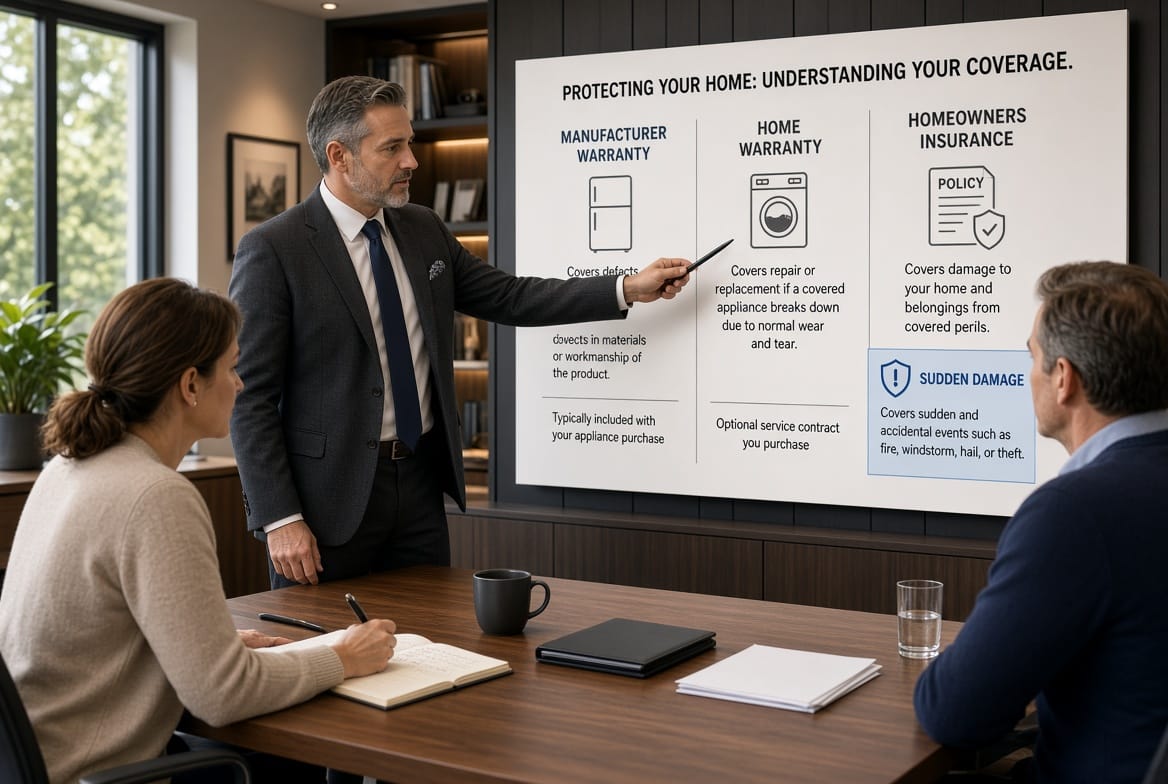
The simplest way to remember the division of responsibility is:
- Manufacturer warranty = defects that existed when the appliance was new.
- Home warranty = later mechanical or electrical failure from normal operation (subject to contract terms).
- Homeowners insurance = sudden physical damage caused by a listed peril.
A refrigerator whose compressor fails after four years of ordinary use is a home-warranty or out-of-pocket event. The same refrigerator destroyed by a kitchen fire is a homeowners-insurance claim. A brand-new unit that never cooled properly is a manufacturer-warranty claim.
Overlaps are rare. Gaps are common. The most expensive gap occurs when an appliance suffers both age-related failure and incidental damage; each policy or contract will point to the other as the responsible party. Clear documentation of the date, cause, and maintenance history is the only practical defense.
Real-World Situations Homeowners Face
Consider three frequent scenarios.
- A five-year-old washer stops spinning. The manufacturer warranty expired years ago. A home-warranty contract, if one is in force and maintenance records exist, will usually dispatch a technician and cover the repair after the service fee. Homeowners insurance will not respond because the failure is mechanical, not sudden accidental damage from a covered peril.
- Lightning strikes the house and ruins the control board of a two-year-old range. The manufacturer warranty does not cover surge damage. A home warranty may also exclude electrical surge. Homeowners insurance typically will cover the loss after the deductible, because lightning is a named peril.
- A dishwasher leaks slowly for months and ruins the cabinet floor. Neither the manufacturer warranty nor a home warranty will pay for the cabinetry. Homeowners insurance may deny the claim if the leak is judged gradual rather than sudden. Prompt discovery and documentation become critical.
These examples illustrate why stacking the right combination of protections, rather than relying on a single document, is the prudent approach.
Risks of Incomplete or Misunderstood Coverage
Leaving gaps exposes households to several predictable costs:
- Repair or replacement bills of $800–$2,500 for a single major appliance.
- Service-call fees plus parts when a home-warranty claim is only partially approved.
- Deductible plus depreciation if an insurance claim is accepted but the appliance is older.
- Complete out-of-pocket replacement when every layer declines.
The financial risk is highest for households that own multiple aging appliances and have never reviewed their policy declarations page or warranty contracts side by side.
Practical Steps to Close Coverage Gaps
- Register every new appliance with the manufacturer and store digital copies of receipts and serial numbers.
- Read the exact wording of any home-warranty contract before purchase; pay special attention to maintenance requirements and payout caps.
- Review your homeowners policy’s Coverage C limit, deductible, and any available endorsements for equipment breakdown or service-line coverage.
- Schedule annual professional maintenance for HVAC and major appliances; keep the invoices.
- Photograph model and serial plates and store them with policy documents.
- Ask your insurance professional whether a scheduled personal-property endorsement or an equipment-breakdown endorsement would be cost-effective for high-value units.
These actions do not eliminate every possible loss, but they dramatically reduce the chance of an unexpected four-figure bill.
Protecting Appliances Is a Matter of Matching the Right Tool to the Right Risk
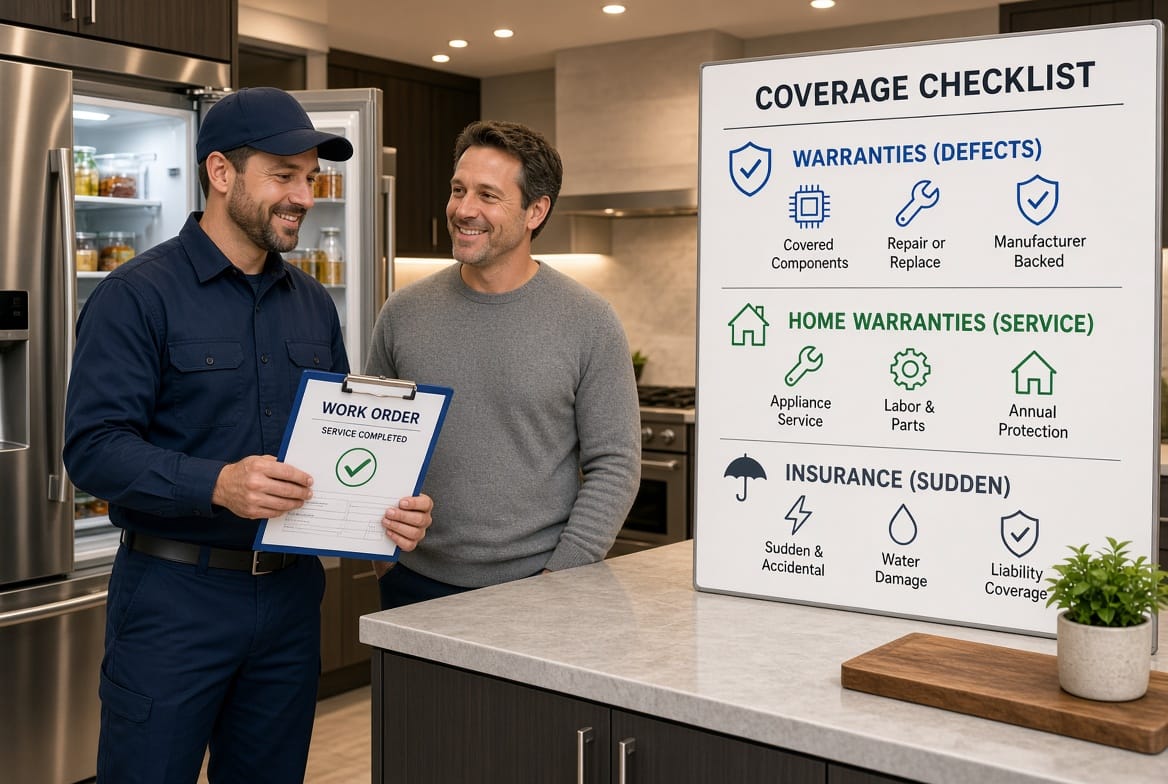
No single product covers every possible appliance failure. The manufacturer warranty is short and limited. The home warranty is a paid service contract with its own exclusions and fees. Homeowners insurance responds only to sudden, accidental damage from covered perils and never to ordinary wear. When homeowners treat these three instruments as interchangeable, claims are denied and repair costs land on the household budget.
The authoritative approach is simple: keep manufacturer documents current, decide whether a service contract adds value for your particular appliances and budget, and confirm that your homeowners policy limits and deductibles match the replacement cost of the equipment you own. Regular maintenance and good records turn each of those layers from a piece of paper into usable protection.
Protect your applian hces properly. Speak with a licensed professional who can review your current warranties and policy together. One conversation can prevent the next unexpected repair from becoming a financial surprise.
Talk to an Expert About Home Appliance Insurance