The Car Rental Loss Damage Waiver: When to Buy It

Standing at the rental counter after a long flight, you face one of the most common—and most expensive—travel decisions: whether to accept the Loss Damage Waiver. The agent slides the contract across the desk, the daily rate jumps by twenty or thirty dollars, and you have only a few minutes to decide. That moment does not have to feel like a gamble. Understanding exactly what the waiver does, when it is essential, and when it is redundant lets you protect both the rental vehicle and your own finances with confidence.
Check Your Rental Coverage Now – Call Today
This guide walks through the rental car coverage decision in plain language so you can arrive at the counter prepared rather than pressured.
What the Loss Damage Waiver Actually Does
The Loss Damage Waiver (LDW), sometimes called a Collision Damage Waiver (CDW), is not traditional insurance. It is a contractual agreement offered by the rental company. When you purchase it, the rental company waives its right to hold you financially responsible for most physical damage to, or theft of, the rental vehicle itself.
In practical terms, if another driver hits the rental car in a parking lot, if a shopping cart leaves a dent, or if the vehicle is stolen from a hotel lot, the waiver typically means you walk away without paying the repair bill, the loss-of-use charge, or the administrative fee the rental company would otherwise invoice you.
The waiver does not cover:
- Injury to you or your passengers
- Damage you cause to other vehicles or property
- Personal belongings left inside the car
- Damage that occurs while you are in violation of the rental contract (driving under the influence, off-road use, unauthorized drivers, or racing)
Those gaps are why the LDW is only one piece of a complete protection picture. Still, for the specific risk of damage to the rental car, it is the most direct solution the rental company itself can offer.
Why the Decision Feels So Urgent
Rental companies present the waiver as a simple yes-or-no add-on at the moment you are tired, the line behind you is growing, and the keys are almost in your hand. The daily cost looks modest until you multiply it by a week-long trip. At the same time, the potential out-of-pocket exposure if you decline can reach thousands of dollars—the full value of the vehicle plus loss-of-use charges that accrue while the car sits in the shop.
That combination of modest daily premium versus large possible loss is exactly why so many travelers either over-buy or under-buy. An informed decision removes the urgency and replaces it with a checklist you can complete before you ever reach the counter.
When You Should Buy the Loss Damage Waiver
Purchase the LDW when any of the following conditions apply.
- You do not carry collision coverage on your personal auto policy.
Many liability-only policies leave you completely exposed for damage to a rental vehicle. In that case the waiver is the only practical way to avoid a four-figure repair bill. - Your personal policy excludes rental cars or applies a high deductible you cannot comfortably pay.
Some older policies or certain high-risk drivers have rental-car exclusions. Confirm the exact language with your insurer before you travel. - You are renting in a location where your personal policy or credit-card benefits do not apply (certain international destinations, exotic or luxury vehicles, or trucks).
Coverage territories and vehicle classes matter. A policy that works in your home state may be silent once you cross a border or sit behind the wheel of a premium SUV. - You prefer zero deductible and zero claims process.
Even if you have coverage elsewhere, using it may trigger a deductible and a possible premium increase. The rental-company waiver often functions as first-dollar protection with no claim filed against your own record. - Your risk tolerance is low and the trip involves unfamiliar roads, dense city traffic, or winter conditions.
Peace of mind has measurable value. If a single parking-lot scrape would ruin the vacation budget, the daily cost of the waiver is cheap insurance against that stress.
In each of these situations the Loss Damage Waiver is the simplest, most immediate solution. You pay the extra daily fee, sign the contract, and drive away knowing the rental company—not you—absorbs most physical-damage costs.
When You Should Decline the Loss Damage Waiver
Decline the waiver when you already have equivalent or better protection from another source.
- Your personal auto policy includes collision and comprehensive coverage that explicitly extends to rental vehicles.
Most standard policies in the United States do this automatically when you have collision coverage on at least one owned vehicle. Call your insurer, ask for the exact wording, and request a written confirmation you can keep in your phone. - A credit card you will use to pay for the entire rental offers rental-car coverage and you follow its rules.
Many premium cards provide secondary (and sometimes primary) coverage provided you decline the rental company’s LDW and charge the full rental to that card. Read the benefits guide; some cards exclude luxury vehicles, vans, or rentals longer than 15–31 days. - You are comfortable paying a deductible and filing a claim if something happens.
If your personal collision deductible is $500 and you have the cash reserve, using existing coverage is usually cheaper than buying the waiver for a long rental. - You are renting a low-value economy car for a short period in a low-risk environment.
The mathematics change when the vehicle is inexpensive and the exposure window is only two days.
The key is verification, not assumption. “I think my card covers it” is not the same as “I have the benefits guide open and I have declined the LDW in writing.”
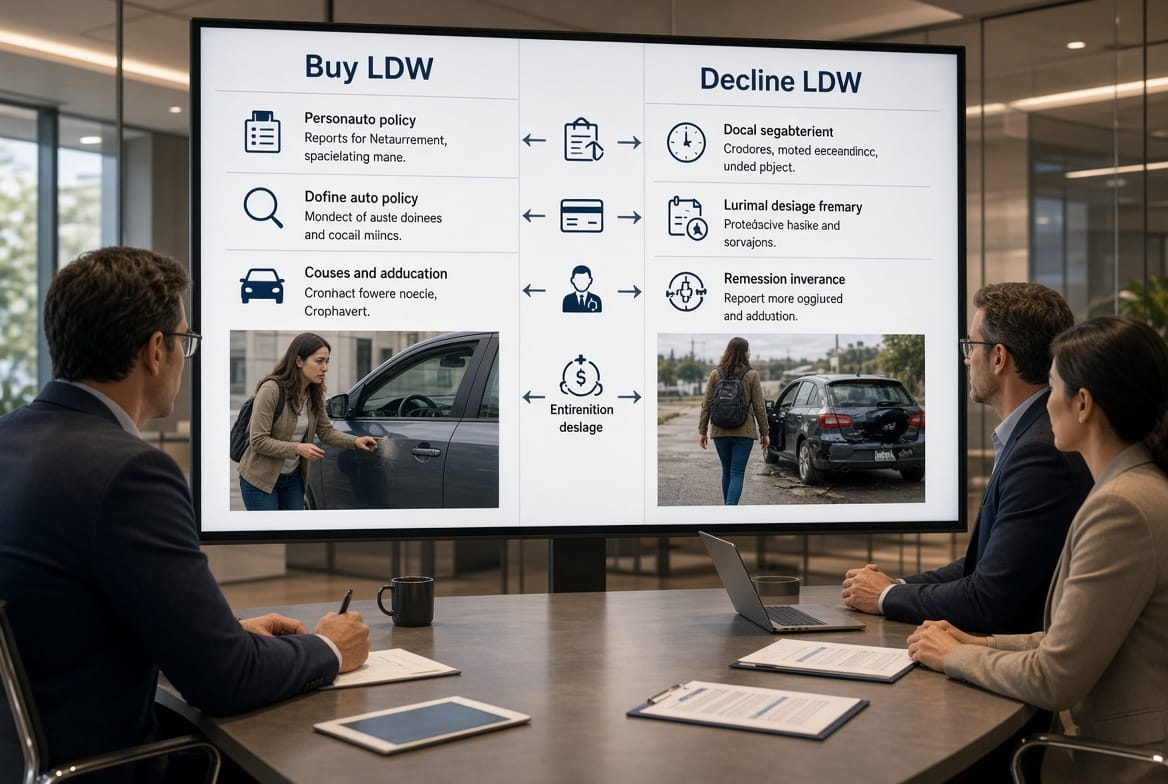
Mid-Article Image Placement: Insert this diagram immediately after the “When You Should Decline” section so readers can see the decision framework at a glance.
How to Verify Your Existing Coverage in Minutes
Before you leave home, complete these three quick checks.
- Call your auto-insurance carrier and ask three specific questions:
- Does my policy provide collision and comprehensive coverage on rental cars?
- What is the deductible?
- Are there any geographic or vehicle-type exclusions?
- Log into your credit-card benefits portal or call the number on the back of the card. Confirm whether coverage is primary or secondary, the maximum rental period, and any excluded vehicle classes.
- Photograph or screenshot the relevant pages of both documents and store them in a travel folder on your phone.
These five minutes of preparation turn a high-pressure counter conversation into a two-sentence statement: “I have confirmed coverage through my personal policy and this credit card, so I will decline the Loss Damage Waiver.”
Additional Factors That Influence the Decision
Even after you know your policy and card benefits, three extra variables still matter.
- Vehicle type. Exotic cars, cargo vans, and 12-passenger vehicles are frequently excluded from both personal policies and credit-card programs.
- Destination. Some countries require locally purchased coverage regardless of what you carry at home.
- Length of rental. Credit-card coverage often caps at 15 or 31 consecutive days. A five-week road trip may leave a gap.
Layer these factors onto the basic buy-or-decline framework and the correct choice becomes obvious rather than stressful.
Common Mistakes That Cost Travelers Money
- Assuming “full coverage” on a personal policy automatically includes rentals without reading the declarations page.
- Paying with a debit card or a credit card that has no rental benefit and then declining the LDW.
- Accepting the waiver on a long rental when a cheaper standalone policy from a third-party insurer would have sufficed.
- Failing to inspect the vehicle and photograph existing damage before driving off the lot; even with a waiver, undocumented pre-existing scratches can become disputes.
Avoiding these four errors is as important as the initial buy-or-decline choice.
Making the Final Call with Confidence
The Car Rental Loss Damage Waiver is neither a rip-off nor a must-buy in every situation. It is a tool. When you lack collision coverage, when your deductible is uncomfortably high, or when you simply want the rental company to handle everything, buy it. When your personal policy and credit card already close the same gap, decline it and keep the daily savings.
An informed decision is the only decision worth making. Review your documents, ask the precise questions, and walk up to the counter already knowing the answer.
If you would like a second set of eyes on your specific policy language or credit-card benefits before your next trip. They can walk through your existing protection in a few minutes and tell you whether the waiver is necessary for the vehicle and destination you have chosen. Drive with certainty, not guesswork.
Get Expert Help Before You Sign the Rental Agreement