The Emotional Regulation Skills: Managing Feelings in Recovery

Recovery is more than stopping a substance or harmful behavior. It is the process of rebuilding a life where emotions no longer control every decision. At the heart of this transformation sits one essential therapy skill: emotional regulation. This skill teaches people how to identify what they feel, understand why those feelings arise, and manage them in healthy ways. When practiced consistently, emotional regulation becomes a reliable shield against relapse.
Gain Relapse-Prevention Tools That Work – Call Today
Many individuals enter recovery believing willpower alone will keep them safe. Experience quickly shows otherwise. Unprocessed anger, sudden loneliness, or quiet shame can surface without warning and pull someone back toward old patterns. Emotional regulation skills interrupt that cycle. They replace automatic reactions with deliberate, skillful responses. This article explores what emotional regulation truly means, the core techniques that make it work—deep breathing, opposite action, and labeling emotions—and why mastering these tools is critical for long-term relapse prevention.
Understanding Emotional Regulation
Emotional regulation is the ability to recognize, make sense of, and influence one’s emotional experience. It does not mean suppressing feelings or pretending everything is fine. Instead, it means developing a working relationship with emotions so they inform life rather than dominate it.
The process unfolds in three connected stages:
- Identifying the emotion: noticing the physical sensations, thoughts, and impulses that signal something is happening inside.
- Understanding the emotion: connecting the feeling to its trigger, its purpose, and its intensity.
- Managing the emotion: choosing a response that reduces distress without creating new problems.
In recovery settings, these stages are practiced daily. A person who once reached for a drink the moment frustration appeared now pauses, names the frustration, examines its source, and selects a different action. Over time the pause becomes automatic. The skill grows stronger with repetition, much like a muscle.
People often arrive in treatment believing their emotions are too intense or too dangerous to face. Professional guidance reveals the opposite truth: emotions lose power when they are approached with curiosity and skill rather than fear. Emotional regulation restores a sense of agency. It reminds individuals that while they cannot always control what they feel, they can always influence what they do next.
Core Techniques That Build Emotional Regulation
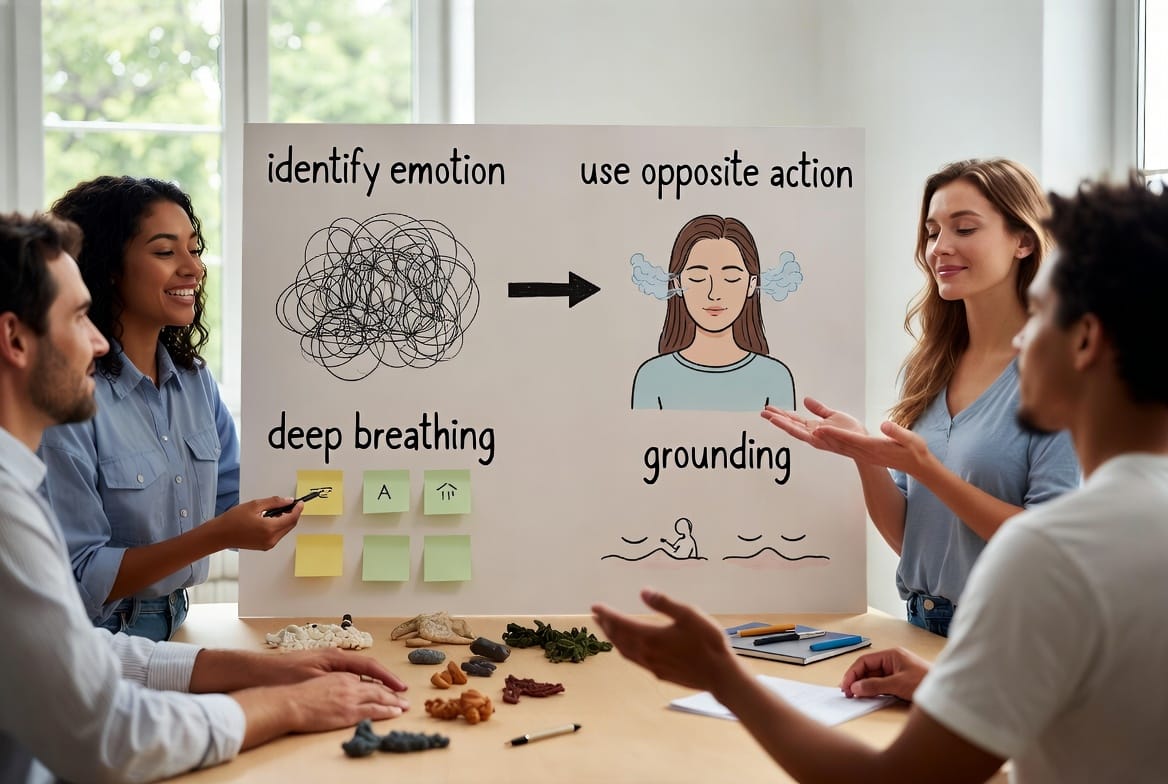
Three practical techniques form the foundation of most evidence-based emotional regulation work in recovery programs. Each technique is simple enough to use in the moment yet powerful enough to change long-standing patterns.
Labeling Emotions
The first and most accessible technique is labeling emotions. Putting a precise name to a feeling reduces its intensity. Research and clinical observation both confirm that the act of naming creates distance between the person and the emotion. Instead of being swallowed by “I feel awful,” a person can say “I notice sadness mixed with embarrassment.” That small shift activates the thinking part of the brain and quiets the reactive part.
In practice, labeling begins with a short internal check-in:
- What is happening in my body right now?
- What word best matches this sensation?
- Is there more than one emotion present?
Many people keep a short list of emotion words until the vocabulary becomes natural. Over weeks the labels grow more accurate—“irritated” instead of “mad,” “lonely” instead of “empty.” Accurate labeling is the doorway to every other skill.
Deep Breathing
Once an emotion is named, deep breathing provides immediate physiological support. Slow, intentional breaths activate the body’s calming system. The technique is straightforward yet remarkably effective under stress.
A common sequence used in recovery is:
- Inhale quietly through the nose for a count of four.
- Hold the breath gently for a count of four.
- Exhale slowly through the mouth for a count of six.
- Repeat for one to three minutes.
The longer exhale signals safety to the nervous system. Heart rate slows, muscle tension eases, and the urge to act impulsively loses momentum. Deep breathing can be practiced anywhere—waiting in line, sitting in a meeting, or lying awake at night. It requires no special equipment and produces results within minutes.
People who once believed they needed a substance to “take the edge off” discover that controlled breathing achieves a similar calming effect without the destructive aftermath. The skill becomes a portable tool that travels with them into every high-risk situation.
Opposite Action
The third cornerstone technique is opposite action. When an emotion urges a person toward a behavior that will make the situation worse, the skill is to do the opposite of that urge.
If anger pushes someone to yell or leave, opposite action might mean speaking calmly or staying present. If shame urges isolation, opposite action means reaching out to a trusted person. If craving insists on using, opposite action means contacting a support network or engaging in a healthy activity instead.
Opposite action works because emotions are temporary. Acting on the urge reinforces the emotion and strengthens the pathway back to old habits. Choosing the opposite weakens that pathway and builds a new one. The technique feels unnatural at first. With practice it becomes empowering. Individuals learn they are not prisoners of their feelings; they are capable of choosing responses that align with their recovery goals.
Why Emotional Regulation Is Critical for Relapse Prevention
Relapse rarely begins with the substance itself. It usually begins with an unmanaged emotion. Stress at work, conflict in a relationship, boredom on a quiet evening, or the anniversary of a painful loss can all generate feelings that feel unbearable. Without regulation skills, the brain quickly offers the old solution: use the substance or behavior that once provided temporary relief.
Emotional regulation interrupts this sequence at multiple points. By identifying the emotion early, a person gains time. By understanding its source, they reduce the sense of mystery and threat. By managing it skillfully, they remove the immediate pressure to escape. Each successful use of the skills builds confidence and rewires the brain’s response patterns.
Clinical experience shows that individuals who develop strong emotional regulation skills experience fewer intense cravings and recover more quickly when setbacks occur. They also report improved relationships, better sleep, and a greater sense of self-respect. These secondary benefits further protect against relapse by creating a life worth protecting.
Importantly, the skills are not reserved for crisis moments. Daily practice during calm periods makes them available when intensity rises. Recovery programs that emphasize emotional regulation therefore focus on both structured therapy sessions and real-world application between sessions.

Integrating the Skills into Daily Recovery Life
Learning the techniques is only the beginning. Integration turns knowledge into reliable protection. Most recovery programs teach a structured approach that combines individual practice, group discussion, and real-time coaching.
A typical day might include:
- Morning emotion check-in using labeling.
- Several short deep breathing sessions during transitions.
- Deliberate use of opposite action whenever an unhelpful urge appears.
- Evening reflection on what worked and what still needs attention.
Grounding techniques often accompany these three core skills. Simple grounding methods—feeling the feet on the floor, naming five things visible in the room, or holding a cold object—anchor attention in the present moment and prevent emotional flooding. When combined with labeling, breathing, and opposite action, grounding creates a complete toolkit.
Support from peers and professionals accelerates progress. Hearing others describe similar struggles normalizes the experience. Receiving feedback on technique use refines the skills. Over months the internal dialogue changes. Instead of “I can’t handle this feeling,” the thought becomes “I know what to do with this feeling.”
Challenges still arise. Old habits surface under fatigue or unexpected stress. The difference is that a person equipped with emotional regulation skills recognizes the danger earlier and responds more effectively. Setbacks become data rather than disasters. Each return to the skills strengthens the recovery foundation.
Building Long-Term Emotional Resilience
Beyond immediate relapse prevention, emotional regulation fosters deeper resilience. People begin to trust their capacity to feel without being destroyed. They develop tolerance for discomfort and greater appreciation for positive emotions that were once numbed. Relationships improve because communication becomes clearer and reactivity decreases. Work performance often rises as concentration and decision-making stabilize.
The process is gradual. Early weeks may feel awkward or effortful. Consistency matters more than perfection. Programs that track skill use and celebrate small wins help maintain motivation. Many individuals eventually teach the same techniques to family members or newer peers, reinforcing their own mastery while expanding the recovery community.
Emotional regulation is not a one-time achievement. It is a lifelong practice that evolves with changing life circumstances. The foundational techniques remain the same, yet their application grows more nuanced. A person who once used deep breathing mainly to survive cravings later uses it to stay present during important conversations or creative work. Opposite action that once prevented relapse later supports career risks or deeper intimacy.
This expansion of purpose is one of the quiet rewards of recovery. Skills learned under pressure become tools for a richer, more intentional life.
Moving Forward with Confidence
Every person in recovery already possesses the capacity for emotional regulation. The skills simply make that capacity conscious and reliable. With guidance, practice, and support, identifying, understanding, and managing emotions becomes second nature. The result is not the absence of difficult feelings but the presence of effective responses to them.
Relapse prevention is strongest when it rests on daily emotional competence rather than constant vigilance. Emotional regulation skills provide that competence. They turn moments of vulnerability into moments of choice. They replace fear of feelings with respect for the information feelings carry. Most importantly, they return control to the individual.
The journey requires patience and persistence. It also offers profound relief. Many people describe the first time they successfully rode out a strong emotion without acting on it as a turning point—an experience of genuine freedom. That freedom multiplies with continued practice.
Recovery is possible, sustainable, and deeply rewarding when emotions are no longer the enemy. They become allies in building the life that was always meant to be lived.
Learn to Manage Feelings in Recovery – Call Today!