The Economizer Cycle: Using Outdoor Air for Free Cooling in Commercial and Large Residential Systems
In the pursuit of energy efficiency and operational cost savings, one of the most underutilized tools in the HVAC industry is right outside your door: the air itself. For facility managers of light commercial buildings and owners of large residential properties, the concept of “free cooling” isn’t just a buzzword—it’s a fundamental mechanical strategy that can drastically reduce utility bills while extending the life of critical equipment.
Ask About Economizer Retrofit Options – Call Today
The mechanism behind this strategy is the economizer cycle. When properly installed and maintained, an economizer acts as the brain of your HVAC system, intelligently deciding when to shut off the energy-sucking compressor and simply pull in cool, conditioned outdoor air to satisfy the building’s cooling demand.
This guide explores the mechanics, benefits, and critical maintenance requirements of the economizer cycle, ensuring your system performs at its peak without wasting energy.
What Is an Economizer Cycle?
At its core, an economizer is a mechanical ventilation system designed to bypass the refrigeration cycle of an air conditioner. In a standard setup, when your thermostat calls for cooling, the compressor kicks on, refrigerant circulates, and heat is expelled outside. This process consumes a significant amount of electricity.
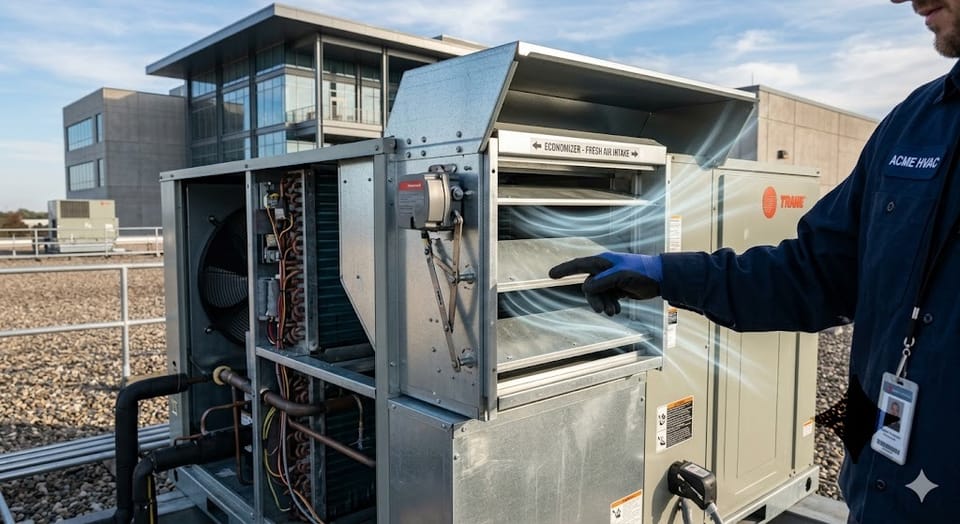
The economizer cycle changes the equation. It utilizes a series of sensors, actuators, and motorized dampers located in the ductwork or rooftop unit. When the outdoor air is cooler and drier than the return air inside the building—and when the ambient conditions fall within a specific enthalpy setpoint—the economizer opens the outdoor air dampers, closes the return air dampers, and allows the fan to circulate fresh, cool air throughout the structure.
Key Benefits:
- Reduced Compressor Run Time: The compressor remains off, drastically lowering energy consumption.
- Extended Equipment Lifespan: Less mechanical strain on the compressor and condenser coils.
- Improved Indoor Air Quality (IAQ): Increased fresh air ventilation dilutes indoor pollutants and CO2.
- Lower Utility Bills: Significant reductions in peak demand charges during shoulder seasons.
The Difference Between Commercial and Large Residential Applications
While the technology is similar, the application varies between light commercial (offices, retail spaces, restaurants) and large residential (homes over 3,000 sq. ft., multi-family units, luxury estates).
Light Commercial Systems
In commercial settings, economizers are typically integrated into rooftop units (RTUs) . These systems often run 12 to 16 hours a day, making the energy savings from economizers substantial. Commercial codes, such as ASHRAE 90.1, often mandate economizers on RTUs above a certain tonnage due to the high return on investment (ROI).
Large Residential Systems
For large homes, economizers are usually integrated into split systems or packaged units located on the ground or roof. Homeowners benefit from:
- Zone-specific cooling: Economizers can be tied to smart thermostats to prioritize fresh air during the night.
- Humidity control: Unlike a standard AC that cools and dehumidifies, an economizer can provide “dry” cooling when humidity levels are acceptable, preventing the home from becoming clammy.
How the Economizer Decides: The Control Sequence
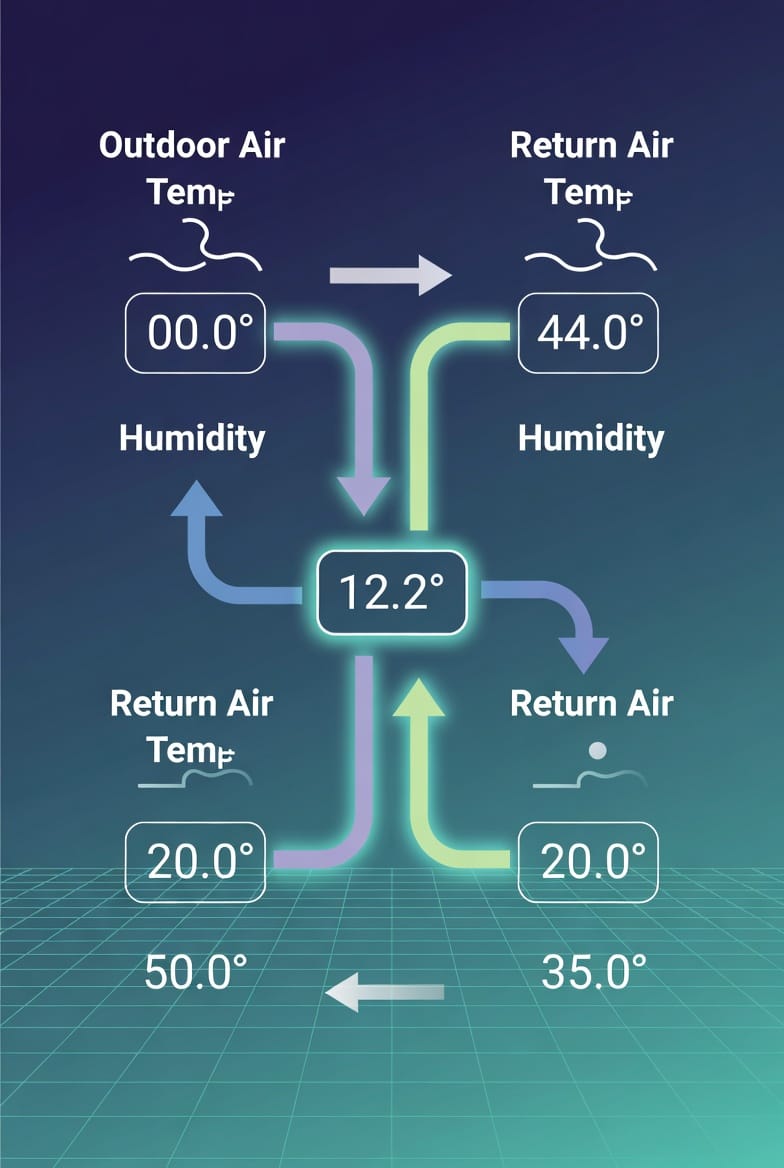
To understand why economizers are so effective, one must understand the logic that governs them. It is not simply “open the damper when it’s cold outside.” Modern economizer controllers use differential enthalpy logic to prevent energy waste.
1. Sensor Inputs
The system constantly monitors:
- Outdoor Air Temperature (OAT)
- Outdoor Air Humidity (RH)
- Return Air Temperature (RAT)
- Return Air Humidity
2. Comparison Logic
The economizer controller compares the total heat content (enthalpy) of the outside air versus the inside air. If the outside air has less total heat than the return air, the system enters economizer mode.
3. Damper Modulation
Instead of a simple open/close action, the dampers modulate. They open progressively to maintain the supply air temperature setpoint. If the outside air is too cold (below 45°F typically), the dampers will modulate to mix in return air to prevent freezing the space or the coils.
4. Compressor Lockout
When the economizer can satisfy the cooling load 100%, the compressors are locked out. This is the “free cooling” sweet spot. If the outdoor air is cool but not cool enough to meet the demand alone, the system will use a mixed air approach, running the compressors minimally while supplementing with fresh air.
The Financial Impact: Energy Savings Analysis
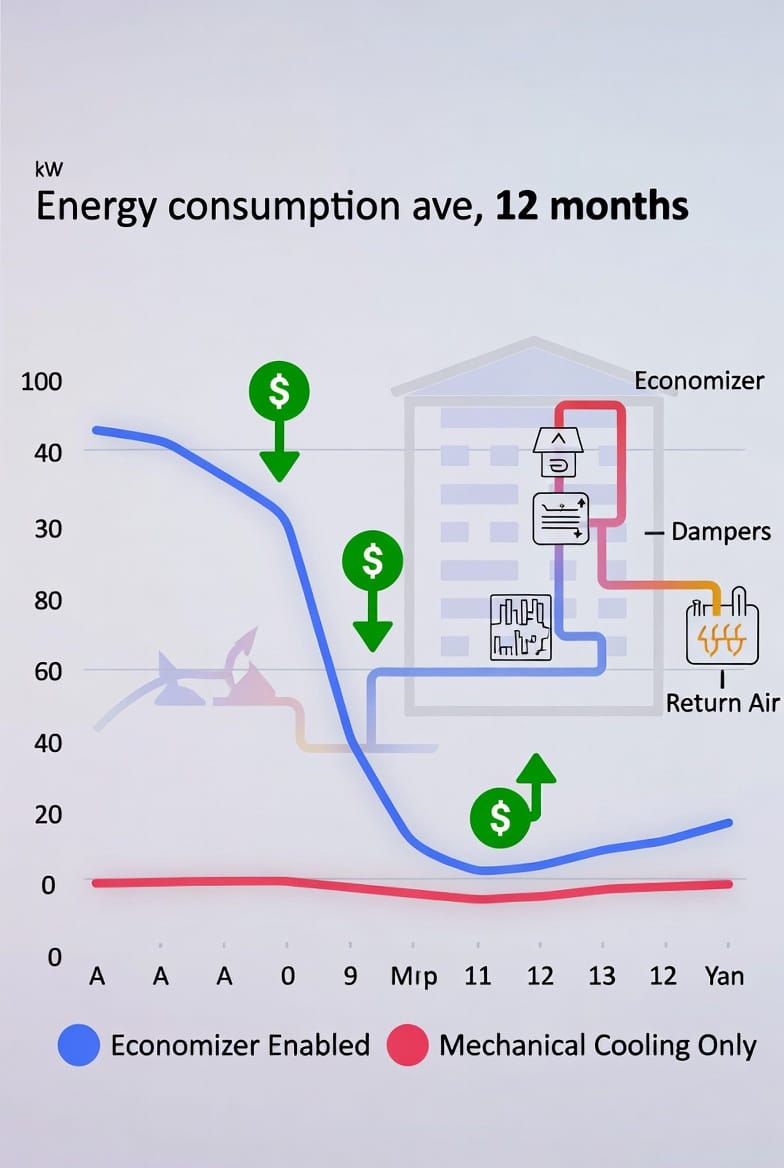
The return on investment for installing or repairing an economizer is often measured in months, not years. For a light commercial building in a temperate climate, the energy savings from economizers can account for 10% to 30% of total cooling costs.
Consider a 10-ton rooftop unit running 2,000 hours a year. During the spring and fall (“shoulder seasons”), the outdoor air is frequently cool enough to provide full cooling without the compressor. By utilizing the economizer, the system avoids running the compressor for hundreds of hours annually.
Cost-Saving Factors:
- Peak Demand Reduction: Utilities often charge commercial customers based on peak demand. Compressors cause spikes in demand; economizers eliminate those spikes.
- Reduced Wear and Tear: Fewer compressor cycles mean fewer repairs. Compressor replacements can cost thousands of dollars—a cost avoided by utilizing the economizer cycle.
Common Problems That Sabotage Economizer Efficiency
Despite their potential, economizers are often the most neglected component of an HVAC system. A malfunctioning economizer can actually increase energy bills by allowing hot, humid air into the building when it shouldn’t, or failing to provide free cooling when it should.
Here are the most common issues technicians encounter:
Stuck or Seized Dampers
The Risk: Dampers that are frozen open allow unconditioned air to pour in 24/7, overworking the compressors and creating humidity issues. Dampers stuck closed render the economizer useless, forcing the compressor to run year-round.
The Solution: Regular semi-annual inspections. Lubrication of linkages and actuator testing are essential.
Failed Actuators
The Risk: The actuator is the motor that moves the damper. If it fails, the damper remains in a fail-safe position—often closed—negating the economizer function.
The Solution: Actuators have a limited lifespan (typically 5-10 years). Proactive replacement during routine maintenance prevents system inefficiency.
Faulty Sensors (Temperature and Humidity)
The Risk: If the outdoor air temperature sensor reads inaccurately, the controller may believe it’s 100°F outside when it’s actually 65°F, preventing the economizer from engaging.
The Solution: Calibration checks during seasonal tune-ups. Dry bulb sensors are common, but for humid climates, enthalpy sensors are critical to avoid bringing in cool but swampy air.
Incorrect Wiring or Setup
The Risk: Often, economizers are installed but never properly integrated with the thermostat or building automation system (BAS). If the wiring is wrong, the system may try to run the compressor and economizer simultaneously, wasting energy.
The Solution: A start-up verification by a qualified HVAC professional ensures the control sequence matches the manufacturer specifications.
Maintenance: The Key to Reliable Free Cooling
To ensure your economizer is providing the guaranteed savings, a strict maintenance schedule is required. Unlike standard residential systems where the homeowner might change a filter, commercial and large residential economizers require professional oversight.
Quarterly Visual Inspections
Technicians should inspect the economizer housing for debris. Leaves, bird nests, and dust can obstruct damper movement. The outdoor air intake hood must be clear of obstructions.
Semi-Annual Operational Tests
During spring and fall maintenance visits, technicians should perform a full operational test:
- Simulate cooling demand while heating the sensor to ensure the damper closes.
- Simulate cool outdoor conditions to verify the damper opens and the compressor locks out.
- Check minimum position. Even when not cooling, the dampers should open to a minimum position to meet ventilation codes (ASHRAE 62.1).
Linkage and Bearing Lubrication
Mechanical linkages dry out over time. Lubricating the damper linkages and bearings ensures smooth operation and prevents the actuator from burning out due to high torque.
Advanced Economizer Strategies: Demand Control Ventilation
For those looking to maximize efficiency, modern Building Automation Systems (BAS) integrate Demand Control Ventilation (DCV) with economizer functions. DCV uses CO2 sensors inside the space.
- How it works: If the CO2 levels are low (few people present), the economizer reduces fresh air intake to save energy on heating or cooling the extra air.
- The Synergy: When combined with the economizer cycle, DCV ensures that you are not only using free cooling when available but also minimizing the energy required to condition the air you bring in.
Is Your System Ready for the Shoulder Seasons?
The true value of a properly functioning economizer becomes most apparent during the shoulder seasons—spring and autumn. During these months, daytime temperatures may rise enough to require cooling, but mornings and evenings are crisp and cold.
A system without a functioning economizer will kick on the compressor at 10:00 AM when the sun hits the building, burning energy to cool the space.
A system with a functioning economizer will simply open the dampers, flush out the warm air, and maintain comfort using 90% less energy.
Signs Your Economizer Needs Attention:
- High energy bills during mild weather months.
- Humidity issues inside the building even when the AC is running.
- Short cycling of the compressor.
- Rust or water stains inside the ductwork near the intake hood (indicating rain infiltration or condensation issues).
Professional Installation and Retrofit Options
If your existing system lacks an economizer, retrofitting is often a viable option. For rooftop units, factory-authorized economizer kits are available that integrate seamlessly with the unit’s existing controls. For split systems in large homes, add-on economizer assemblies can be installed in the ductwork, provided there is adequate space for the mixing box and intake hood.
Critical Consideration: Retrofits require a load calculation. Simply slapping an economizer on a system without ensuring the ductwork can handle the increased static pressure can lead to fan failures and uneven cooling.
Conclusion: Cool Your Home or Business with Free Outdoor Air
The economizer cycle represents one of the most elegant solutions in HVAC design: using nature to do the work that machines usually do. By intelligently harnessing cool outdoor air, you reduce compressor wear, slash energy costs, and improve indoor air quality.
However, this technology is only as good as its installation and maintenance. A neglected economizer is an energy liability; a well-tuned economizer is a financial asset.
Don’t let your HVAC system work harder than it needs to. Ensure your commercial or large residential system is equipped to take advantage of free cooling every season of the year.
Ready to optimize your system? Ask about professional economizer diagnostics, retrofits, and preventative maintenance plans to start saving today.
Get Your HVAC Efficiency Audit – Call Today