The Solar Panel Tilt Optimization: Seasonal Adjustments for Maximum Production
In today’s rapidly evolving renewable energy landscape, solar panel tilt optimization stands as one of the smartest, most cost-effective ways to unlock hidden performance from any photovoltaic system. Homeowners and businesses alike are discovering that a fixed tilt, while simple, often leaves valuable energy on the table. By embracing seasonal adjustments through adjustable tilt racks, you can dramatically boost annual output without replacing panels or adding expensive equipment.
Get Seasonal Tilt Adjustments Today – Call Now
At its core, solar panel tilt optimization is about aligning your array with the sun’s ever-changing path across the sky. The sun sits lower in winter and higher in summer, and a one-size-fits-all angle simply cannot capture maximum irradiance year-round. Professional installers who recommend adjustable tilt mounting systems deliver systems that adapt—delivering 10-25% more annual production depending on your latitude. This guide walks you through the science, the hardware, the process, and the proven results so you can make an informed decision with complete confidence.
Why Fixed-Tilt Systems Fall Short
Most residential and commercial arrays are installed with a permanent angle calculated as roughly equal to your latitude. While this compromise works adequately, it sacrifices performance during the seasons when you need it most. In winter, when daylight hours are shortest and energy demand for heating rises, a summer-optimized tilt misses low-angle rays. Conversely, a winter-optimized fixed tilt wastes high summer sun.
Adjustable tilt racks solve this mismatch elegantly. They allow you to change the panel angle two to four times per year—typically in spring, summer, fall, and winter—ensuring your system stays in perfect harmony with solar geometry. The result? Higher kWh production, faster payback periods, and greater energy independence.
The Science Behind Seasonal Solar Angles
The Earth’s 23.5-degree axial tilt creates predictable seasonal shifts in solar elevation. At 40° north latitude (much of the continental United States), optimal tilt varies by roughly 15-20 degrees between summer and winter. Winter demands a steeper angle to catch the low sun; summer favors a flatter profile to avoid excessive reflection and overheating.
Solar panel tilt optimization leverages these angles. Data from thousands of monitored systems shows that seasonal adjustments consistently outperform fixed mounts. For example, a system in Denver can gain up to 25% more annual energy, while locations closer to the equator still see solid 10-15% improvements. These gains compound over the 25-30 year lifespan of modern panels, translating into thousands of extra kilowatt-hours and significant utility bill savings.
How Adjustable Tilt Racks Work
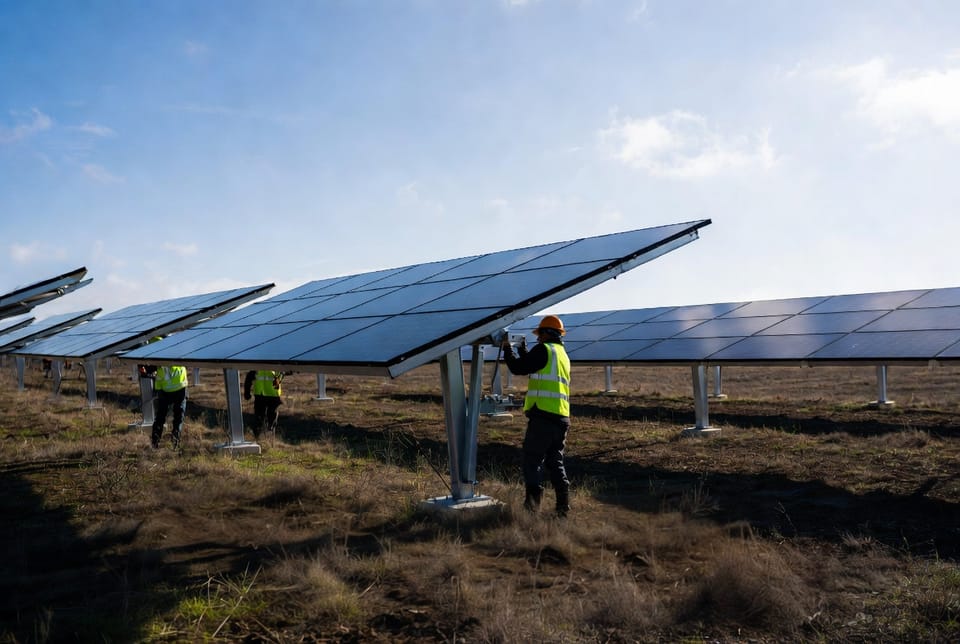
Adjustable tilt racks are engineered with sturdy, weatherproof pivoting mechanisms and simple locking hardware. Ground-mounted arrays especially benefit because they offer easy access and unlimited angle range. Roof-mounted versions use specialized rails and brackets that maintain structural integrity while permitting seasonal changes.
Installation is straightforward for certified professionals. The racks feature incremental settings—usually every 5-10 degrees—so you can dial in the precise angle recommended for your zip code. No tools beyond a wrench and angle finder are required, and the entire process for a typical residential array takes less than an hour.
Key advantages of adjustable tilt racks include:
- Durability – Heavy-gauge steel or aluminum construction withstands high winds and snow loads.
- Simplicity – Manual crank or quick-release systems require no electricity or automation.
- Scalability – Works equally well for small home arrays or large commercial ground mounts.
- Future-proofing – Easily upgraded if panel technology advances.
Owners report peace of mind knowing their investment is always performing at peak efficiency, season after season.
Calculating Your Optimal Seasonal Angles
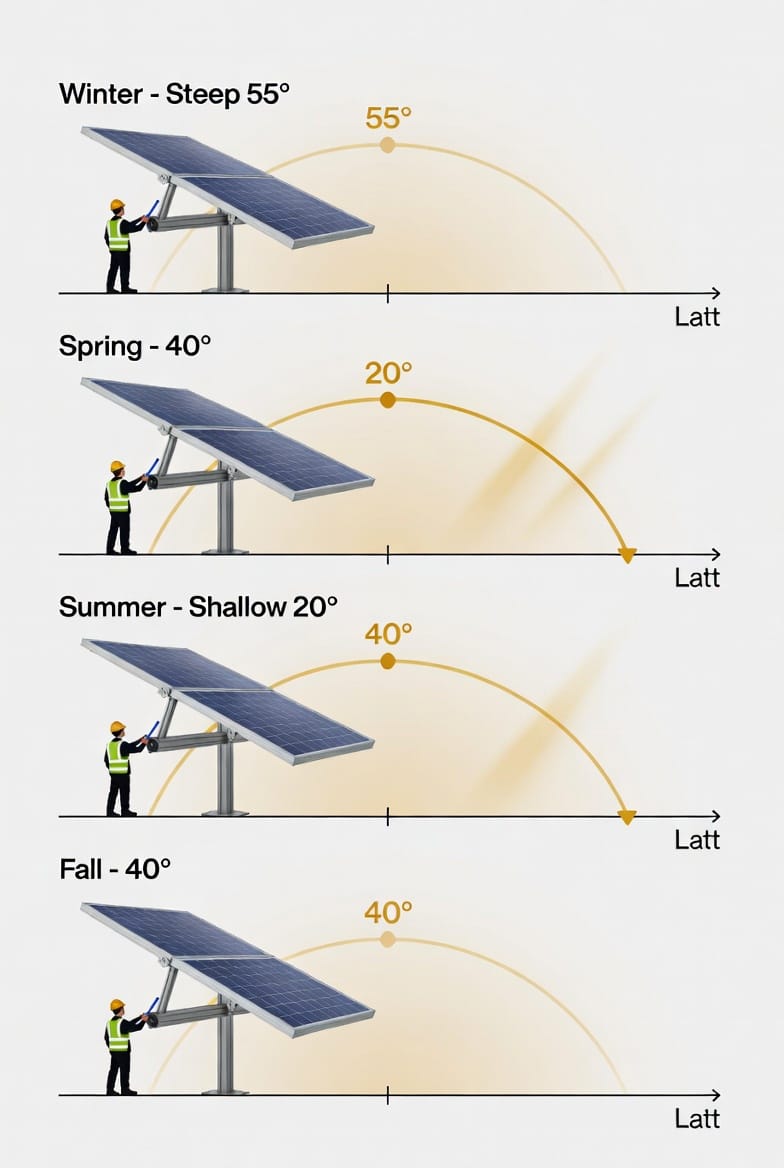
Determining the right tilt is easier than most people expect. A widely accepted rule of thumb is:
- Winter (November-February): Latitude + 15°
- Spring/Fall (March, April, September, October): Latitude
- Summer (May-August): Latitude – 15°
For a home in Chicago (latitude 42°), that means adjusting from 57° in winter to 27° in summer. Online calculators and professional installers refine these numbers further by factoring local climate, typical cloud cover, and even micro-shading from nearby trees or buildings.
The beauty of adjustable tilt racks is that once the optimal angles are set during initial installation, future adjustments become routine maintenance rather than complex engineering.
Quantifying the Production Gains
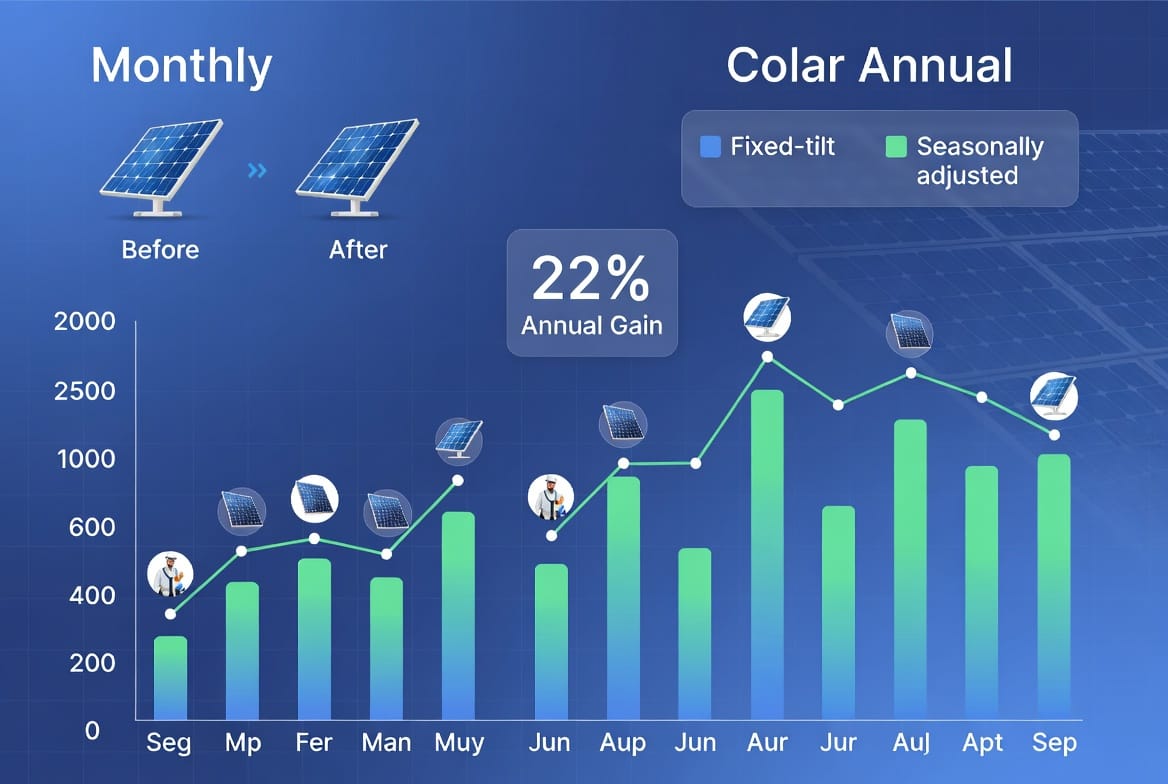
Independent monitoring consistently demonstrates the power of solar panel tilt optimization. Systems with seasonal adjustments routinely achieve:
- 15-25% higher annual output in northern latitudes (above 35°)
- 10-18% gains in southern states where winter sun angles are less extreme
- Reduced seasonal variability—smoother monthly production curves that better match household energy use
Consider a 10 kW ground-mounted system in Pennsylvania. Fixed-tilt might produce 12,500 kWh per year. With seasonal adjustments, the same array can deliver 14,500–15,600 kWh—enough to power an additional household or offset more expensive peak-rate electricity.
These gains accelerate ROI. Many homeowners recoup the modest added cost of adjustable hardware within 2-3 years through increased energy credits and lower bills. The environmental benefit is equally compelling: every extra kilowatt-hour displaces fossil-fuel generation, reducing your carbon footprint.
Step-by-Step Guide to Performing Seasonal Adjustments
Performing your own adjustments is safe and straightforward when following manufacturer guidelines. Here’s the professional process:
- Schedule – Mark your calendar for the first day of each season or when daylight savings changes.
- Safety first – Wear gloves, use a stable ladder or lift, and ensure the system is disconnected if required by local code.
- Loosen hardware – Release the locking bolts or clamps on each rack.
- Adjust angle – Use the built-in gauge or a digital inclinometer to reach the target degree.
- Secure – Tighten all hardware to manufacturer torque specs and perform a visual inspection.
- Monitor – Check your monitoring app over the following weeks to confirm improved output.
Most systems require only two adjustments per year (spring and fall) for excellent results, though four adjustments maximize gains in extreme climates.
Professional service teams make the process even easier. A quick visit ensures perfect alignment and includes a full system health check—reassuring you that everything is operating at peak efficiency.
Addressing Common Concerns
Many homeowners worry about added maintenance or structural risk. In reality, adjustable tilt racks are designed to exceed standard fixed-mount wind and snow ratings. Routine inspections every six months keep everything in top condition, and the hardware typically carries the same 25-year warranty as the panels themselves.
Another frequent question involves cost. The upgrade to adjustable mounting adds only a small percentage to the overall project budget, yet the production increase often pays for itself rapidly. For those prioritizing simplicity, automated tracking systems exist—but manual seasonal adjustments remain the most reliable, lowest-maintenance solution for the vast majority of installations.
Location-Specific Considerations Across the United States
Your geographic position determines the exact benefit level. Northern states like Minnesota or Maine enjoy the largest percentage gains because winter sun angles are extremely low. Southern states such as Arizona still see worthwhile improvements, especially during the critical summer months when air-conditioning loads peak.
Coastal areas with frequent fog or mountain regions with snow cover benefit doubly: steeper winter tilts shed snow faster while capturing scarce sunlight. Urban installations with partial shading can use solar panel tilt optimization to fine-tune around seasonal shadow patterns.
No matter where you live, a qualified installer will model your exact location using the latest solar irradiance data to guarantee maximum return on investment.
Long-Term Maintenance and System Longevity
Adjustable tilt racks actually extend system life by reducing thermal stress. Panels operating at optimal angles stay cooler in summer and produce more consistently, lowering the chance of micro-cracks or hot spots. Annual professional tune-ups include cleaning, torque checks, and performance verification—ensuring your array delivers full value for decades.
Why Choose Professional Installation for Adjustable Systems
While DIY adjustments are possible, initial design and installation of adjustable tilt racks demand expertise. Certified installers understand local permitting, structural engineering, and optimal rack selection. They also provide training on safe adjustment procedures and ongoing support.
When you partner with experienced solar professionals, you gain peace of mind, warranty protection, and access to the latest rack technology. The result is a system engineered for your unique site conditions and energy goals.
Ready to Maximize Every Ray of Sun?
Solar panel tilt optimization through seasonal adjustments represents one of the most practical upgrades available today. Whether you are planning a new installation or retrofitting an existing array, adjustable tilt racks deliver measurable, bankable results—more clean energy, lower bills, and greater energy security.
Maximize every ray of sun. Our team is ready to evaluate your site, model the exact production gains for your location, and design a system that works harder for you all year long.
Maximize Every Ray of Sun – Call for Adjustable Racks