The Solar Panel Recycling: What Happens to Panels at End of Life and Why It Matters
In an era where solar energy powers millions of homes and businesses, true sustainability extends far beyond installation. Solar panel recycling stands as the final, essential step that closes the loop on your clean-energy investment. When panels reach the end of their productive life, they do not become waste — they become a valuable resource mine. Understanding exactly what happens to solar panels at end of life reassures every owner that choosing solar today protects the planet tomorrow.
Recycle Your Panels Responsibly – Get Expert Help
This authoritative guide walks through the complete journey of end-of-life solar panels. You will discover their natural lifespan, the high-value materials they contain, the advanced technologies that recover nearly everything, and the reassuring programs available to make responsible disposal seamless. With proactive end-of-life management, your solar system remains an environmental win from day one to its final chapter.
The Reliable Lifespan of Modern Solar Panels
High-quality solar panels are engineered for decades of dependable service. Most premium modules carry a performance warranty of 25 to 30 years, delivering at least 80–85 % of original output even after three decades of sun, wind, and weather exposure. This longevity reflects rigorous testing and robust construction using tempered glass, anodized aluminum frames, and stable silicon cells.
After the warranty period, output gradually declines, yet the physical structure stays largely intact. Panels do not suddenly fail; they simply produce less electricity. At this stage, many homeowners and commercial operators choose to replace them with newer, more efficient models — creating a growing stream of end-of-life solar panels ready for responsible handling.
The industry anticipates this wave with confidence. Because panels installed during the solar boom of the 2010s are now approaching retirement, forward-thinking manufacturers and recyclers have built infrastructure to match. Rest assured, the same innovation that made solar affordable has also made solar panel recycling efficient and accessible. Proper planning today ensures your investment never burdens landfills and instead returns critical materials to the supply chain.
Breaking Down What Solar Panels Are Made Of
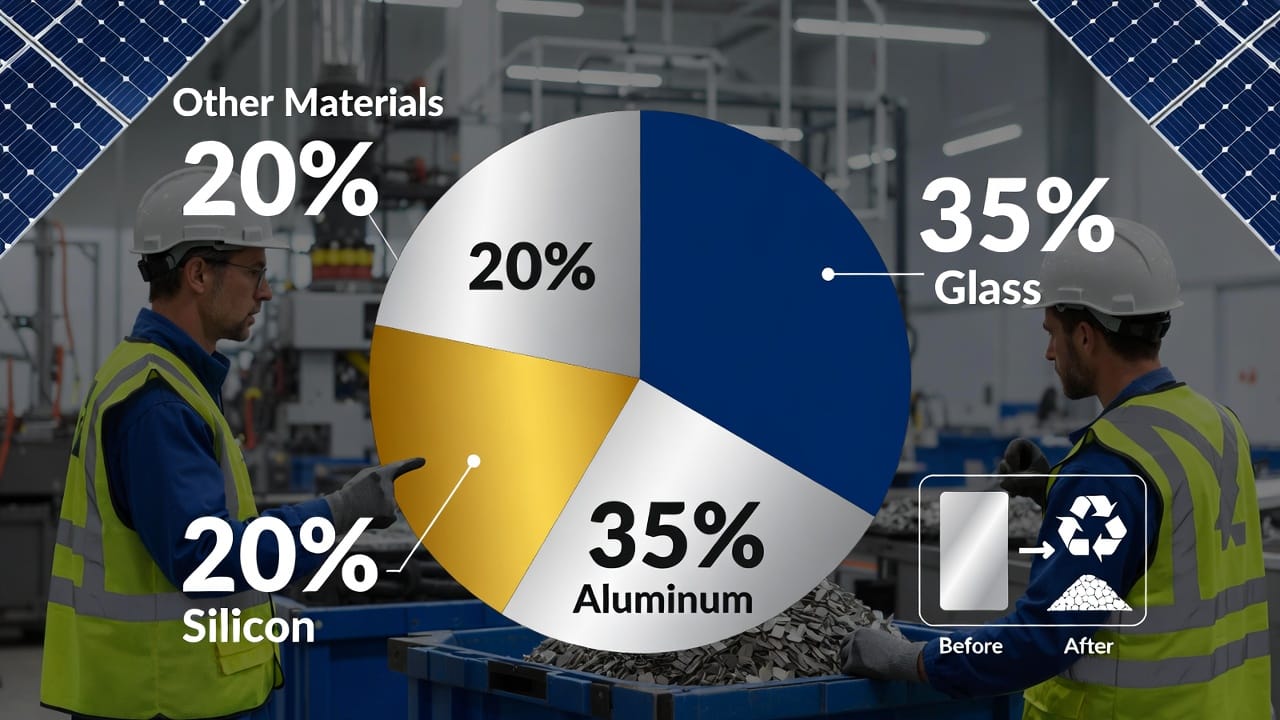
Every solar panel is a carefully assembled package of recyclable components. A typical crystalline module contains approximately:
- Glass – 75 %
- Aluminum frame – 10 %
- Silicon cells – 5 %
- Other materials (polymers, copper wiring, silver contacts, junction boxes) – 10 %
These percentages reveal why solar panel recycling recovers such high value. The thick tempered glass protects the cells and can be melted and reformed into new panels or windows. The aluminum frame is 100 % recyclable into new frames or countless other products. Silicon cells, the heart of power generation, can be purified and reused in fresh modules. Even the smaller fractions — copper, silver, and plastics — hold economic worth when separated correctly.
This composition means up to 95 % of a panel’s mass can be diverted from landfill through today’s proven processes. Far from being disposable, end-of-life panels represent a rich urban mine of raw materials that would otherwise require energy-intensive mining. By choosing solar panel recycling, you directly reduce demand for virgin resources and lower the overall carbon footprint of solar energy.
The Step-by-Step Journey of End-of-Life Solar Panels
When a solar panel reaches retirement, the recycling process follows a structured, efficient path designed for maximum recovery and minimal environmental impact.
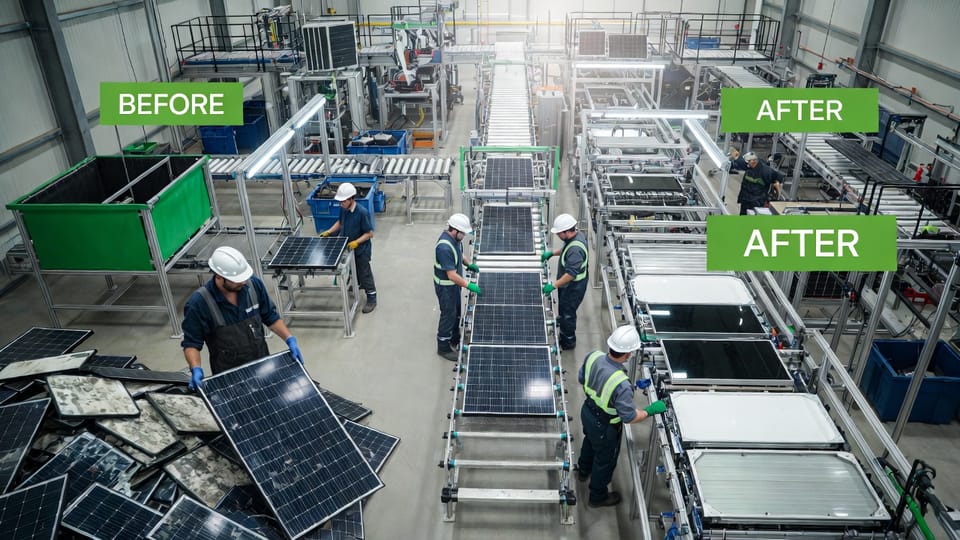
First, panels are collected from rooftops, ground mounts, or commercial arrays. Certified teams safely disconnect wiring and remove mounting hardware. Next, panels arrive at specialized facilities where automated and manual disassembly begins. Frames are detached, junction boxes removed, and glass separated from the cells.
Mechanical shredding and sieving then isolate the aluminum, glass, and silicon layers. Advanced chemical or thermal treatments purify the silicon wafers, removing encapsulants so the high-purity silicon can be reintroduced into new cell manufacturing. Copper and silver are recovered through targeted extraction methods that preserve their quality for electronics and renewable applications.
Throughout every stage, rigorous quality controls ensure recovered materials meet industry standards. The entire operation runs under strict environmental safeguards, preventing any release of hazardous substances. Modern facilities achieve recovery rates that exceed 90 %, turning what once seemed like waste into feedstock for tomorrow’s solar panels and other products.
This closed-loop process demonstrates why solar panel recycling is not an afterthought — it is an integral part of sustainable solar energy. Homeowners and businesses who partner with responsible providers enjoy peace of mind knowing their panels complete a full, honorable lifecycle.
Current Recycling Technologies Driving Progress
The solar recycling sector has matured rapidly. Mechanical separation remains the foundation, efficiently stripping frames and glass with minimal energy use. Thermal processes heat panels to release polymers, leaving clean glass and cells. Chemical leaching selectively dissolves encapsulants to liberate high-grade silicon and precious metals.
Newer innovations combine robotics with artificial intelligence for precision disassembly, reducing labor while increasing throughput. Some facilities employ laser cutting to separate layers without contamination. Emerging bio-based solvents promise even greener chemistry in the near future.
These technologies continue to improve, driving costs down and recovery rates up. Industry leaders invest millions annually in research, ensuring end-of-life solar panels face an ever-brighter recycling outlook. The result? A resilient supply chain that reduces reliance on raw mining and supports the global transition to renewable energy.
Manufacturer Take-Back Programs and Extended Responsibility
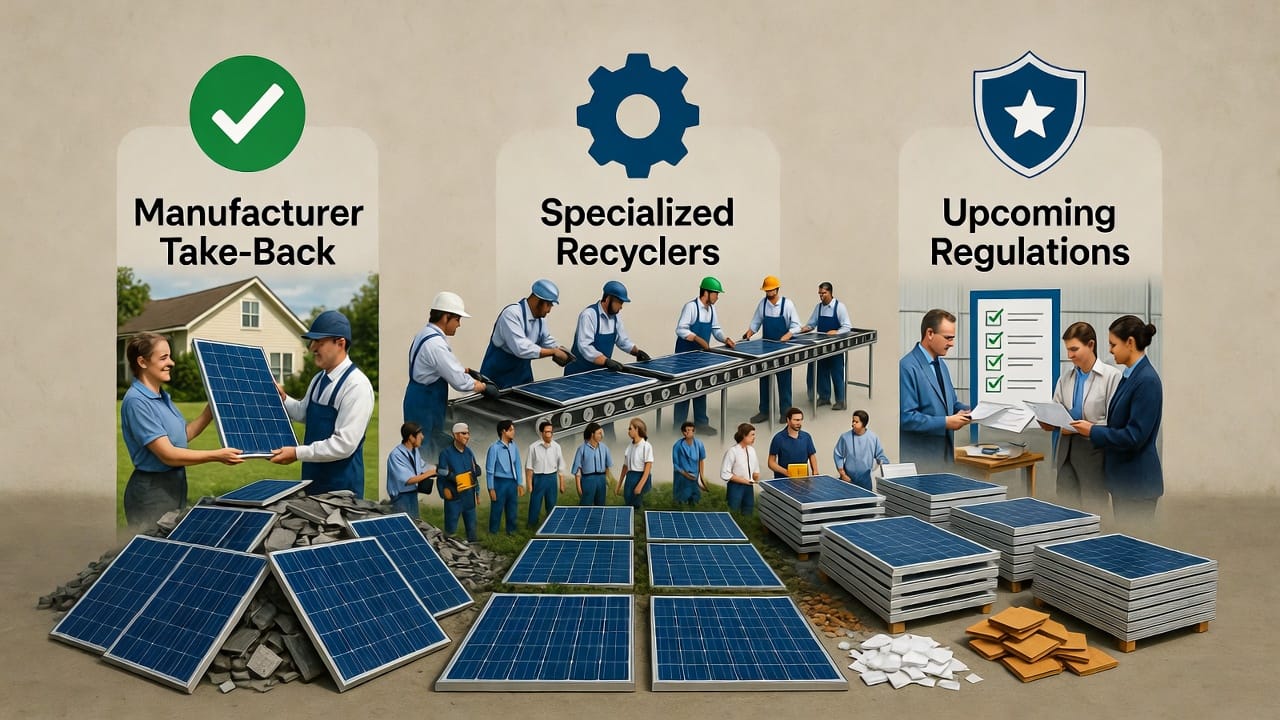
Many leading solar manufacturers now operate formal take-back programs. Under these initiatives, installers or owners return decommissioned panels at no or low cost. The manufacturer coordinates logistics and partners with certified recyclers, guaranteeing responsible processing.
Extended Producer Responsibility (EPR) policies further strengthen this model. Producers assume accountability for the full product lifecycle, creating powerful incentives for design improvements that simplify future recycling. Several major brands already ship panels with standardized labeling that speeds identification and sorting.
Participating in a manufacturer take-back program offers the simplest route for residential and commercial owners. You schedule pickup, and the rest is handled professionally. This convenience removes barriers and ensures your panels enter proven recovery streams.
Additional Recycling Options for Every Situation
Beyond manufacturer programs, several practical pathways exist:
- Specialized solar recyclers accept panels from any source and focus exclusively on photovoltaic material recovery.
- Local waste-management partnerships often route solar waste to certified facilities through municipal or commercial collection.
- Upcoming regulations in multiple regions will mandate recycling targets, creating standardized infrastructure nationwide.
Each option prioritizes safety, efficiency, and transparency. Professional services provide documentation of recovered materials, allowing you to verify the environmental benefit of your decision.
Why Solar Panel Recycling Matters for Long-Term Sustainability
Landfill disposal of solar panels would squander finite resources and consume valuable space. Solar panel recycling prevents this outcome while delivering multiple benefits:
- Conserves raw materials needed for new panels and other industries
- Reduces energy and emissions associated with primary mining
- Supports job creation in the green recycling sector
- Strengthens the circular economy that defines responsible renewable energy
By recovering glass, aluminum, and silicon, recycling lowers the carbon footprint of future solar installations. Every recovered kilogram means one less kilogram extracted from the earth. This compounding effect amplifies the already impressive environmental advantages of solar power.
Homeowners who plan for end-of-life management demonstrate leadership in sustainability. They complete the story of clean energy — generation, use, and responsible rebirth — setting an example for neighbors and future generations.
Ensuring Your Panels Receive Responsible Care
The easiest way to guarantee proper handling is to work with experienced solar professionals who integrate solar panel recycling into their service offerings. Reputable installers maintain partnerships with certified recyclers and can guide you through manufacturer programs or direct recycling services.
When evaluating solar providers, ask specifically about end-of-life options. Companies committed to full-lifecycle responsibility proudly detail their recycling pathways. This transparency builds confidence that your investment remains sustainable for decades.
Choose Solar with a Sustainable Future
The solar industry has matured. Today, solar panel recycling is not a distant promise — it is an established, effective reality backed by technology, regulation, and responsible manufacturers. Your decision to go solar can now encompass every stage, from the first kilowatt generated to the final material recovered.
At the end of a panel’s 25- to 30-year journey, you have options that protect the environment and honor the value of your investment. The process is straightforward, the materials are highly recoverable, and the benefits extend far beyond your property line.
Ready to build a solar system designed for complete sustainability? Our team stands ready to answer every question about performance, installation, maintenance — and end-of-life options.
Let us show you the full lifecycle advantage that turns today’s smart energy choice into tomorrow’s environmental legacy.
Ready for Responsible Solar? Talk to Us Today