The Solar Panel Orientation: Why South is Best, But East-West Can Work Too
When it comes to harnessing the power of the sun for your home, solar panel orientation plays a pivotal role in determining how much energy you can generate annually. Many homeowners worry about their roof's direction—especially if it's not perfectly south-facing—but rest assured, modern solar technology offers flexible solutions. In this comprehensive guide, we'll explore why south-facing panels are often the gold standard, how east-west setups can still deliver impressive results, and strategies for homes with non-ideal roof angles. Whether you're in the Northern Hemisphere or dealing with unique architectural constraints, understanding azimuth (compass direction) and tilt angle can empower you to make informed decisions that lead to substantial energy savings.
Get Your Custom Solar Production Estimate – Call Now!
What Is Solar Panel Orientation and Why Does It Matter?
Solar panel orientation refers to the direction your panels face (azimuth) and the angle at which they're tilted relative to the horizon. These factors directly influence how much sunlight your system captures throughout the day and year. In the Northern Hemisphere, the sun arcs from east to west, rising higher in summer and lower in winter. Optimal orientation aligns panels to maximize exposure during peak sunlight hours, boosting annual energy production and shortening your return on investment.
- Azimuth Explained: This is the compass bearing of your panels. South (180 degrees) is ideal because it captures the most direct sunlight at midday when the sun is strongest.
- Tilt Angle Basics: Typically set to match your latitude (e.g., around 30-40 degrees in many U.S. regions), this angle ensures panels are perpendicular to the sun's rays for efficiency.
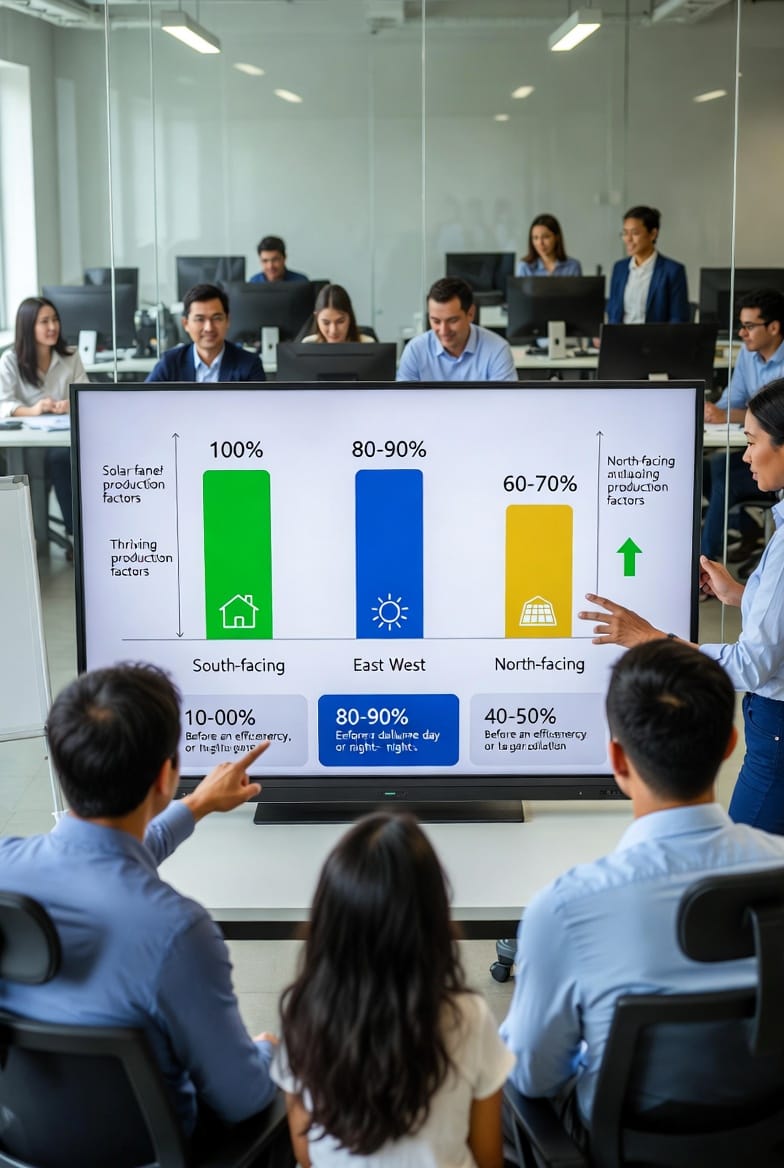
Non-ideal roofs—those with steep pitches, shading from trees, or unconventional shapes—don't have to disqualify you from solar. With adjustable racking systems and professional assessments, even challenging setups can perform well. Studies from the National Renewable Energy Laboratory (NREL) show that while south-facing arrays achieve peak output, alternatives like east-west can still provide 80-90% of that potential, making solar accessible for more homes.
The Gold Standard: South-Facing Solar Panels
South-facing orientations are revered for a reason—they align perfectly with the sun's path, maximizing energy capture from morning to evening. In practical terms, a south-facing array at optimal tilt can produce up to 100% of its rated capacity annually, depending on location and weather.
Consider a real-world example: A 5kW system in sunny Phoenix, Arizona, facing due south at a 30-degree tilt might generate around 8,000-9,000 kWh per year. This could offset 70-80% of an average household's electricity needs, leading to savings of $1,000+ annually on utility bills. The key is direct irradiance; south-facing panels receive the most intense sunlight during peak hours (10 AM to 2 PM), when electricity demand—and rates—are often highest.
However, not every roof is south-facing. If yours isn't, don't despair. Factors like local incentives, battery storage integration, and net metering can amplify returns. For instance, in California, where time-of-use rates favor afternoon production, south-facing systems shine by aligning with high-demand periods.
To illustrate the impact of tilt: Deviating from ideal angles by 10-15 degrees might reduce output by only 5-10%, per NREL data. This flexibility is reassuring for homes with fixed roof pitches—professional installers can use ballasted mounts or ground arrays to fine-tune.
How Azimuth and Tilt Affect Annual Production
Diving deeper, azimuth and tilt interact to shape your system's performance. Azimuth determines when your panels produce power, while tilt affects how much throughout the seasons.
- Optimal Combinations: South azimuth with latitude-matched tilt yields the highest yields. In Boston (latitude ~42 degrees), this setup could produce 1,200-1,400 kWh per kW installed annually.
- Seasonal Variations: Steeper tilts favor winter production (when the sun is low), while shallower ones boost summer output. Balancing both ensures year-round efficiency.
Real-world differences highlight this: A south-facing array in Denver might outperform an east-facing one by 20-30% annually, but the east setup could generate more in the morning, ideal for homes with high early-day usage like EV charging.
East-West Orientations: A Smart Compromise for Many Homes
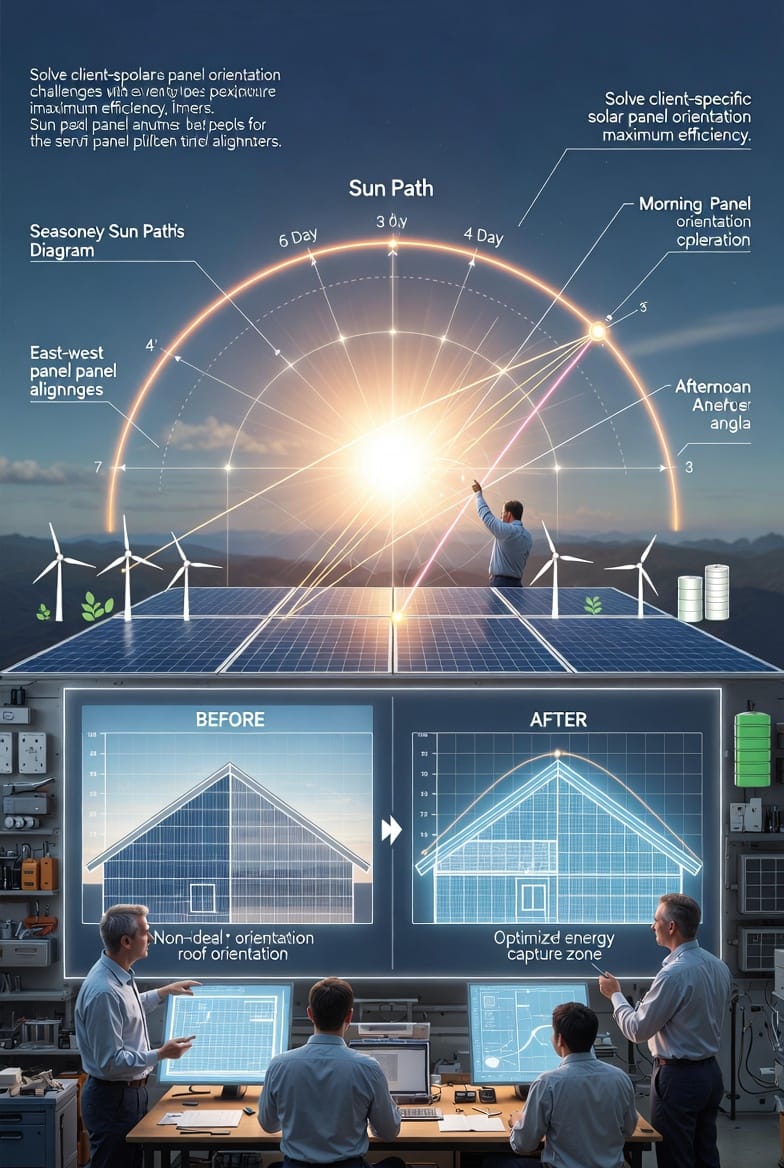
If your roof faces east or west—or a combination— you're in good company. Many urban and suburban homes have gable roofs that naturally lend themselves to split orientations. While not as efficient as south, east-west setups can work exceptionally well, often achieving 80-90% of south-facing production.
Why does this matter? East-facing panels peak in the morning, capturing sunrise energy when grids are less strained, potentially earning higher credits in some utility programs. West-facing ones excel in the afternoon, aligning with peak demand and reducing reliance on expensive grid power.
Take a case study from Seattle: A homeowner with an east-west roof installed a 6kW system. South-facing estimates promised 7,500 kWh/year, but the east-west array delivered 6,500 kWh—still enough to cut bills by 60%. The difference? About 15% less output, but with no need for costly re-roofing. Adding microinverters allowed each panel to operate independently, mitigating shading issues common in non-ideal setups.
For homes with steep or flat roofs, east-west can even outperform south in certain latitudes. In equatorial regions, flatter tilts with dual orientations spread production evenly, avoiding midday overloads on the grid.
Pros of east-west:
- Broader Production Window: Energy from dawn to dusk, ideal for all-day households.
- Space Efficiency: Utilizes both roof sides, increasing total panel count.
- Cost Savings: Often requires less structural modification.
Risks to note: Potential for uneven wear if one side gets more sun, but quality panels mitigate this. Always consult experts to model your specific scenario using tools like PVWatts.
Addressing Non-Ideal Roof Angles and North-Facing Challenges
Non-ideal roof angles—too steep, too flat, or oddly shaped—can seem daunting, but they're solvable. Tilt adjustments via mounting hardware can compensate, bringing production close to optimal.
North-facing arrays are the least favorable in the Northern Hemisphere, typically yielding 60-70% of south-facing output due to indirect sunlight. However, they're not worthless. In a Minneapolis example, a north-facing 4kW system generated 4,000 kWh/year versus 6,000 for south—still offsetting 40% of bills and qualifying for incentives.
Strategies for success:
- Hybrid Systems: Combine north with south or east-west for balanced output.
- Ground-Mounted Alternatives: If roof space is limited, ground arrays allow perfect orientation.
- Advanced Tech: Bifacial panels capture reflected light from north sides, boosting efficiency by 10-20%.
Remember, location matters: In southern latitudes or hilly areas, north-facing can surprisingly perform if unshaded.
Real-World Examples of Production Differences
Let's ground this in reality with more examples. In Texas, a south-facing ranch home with a 7kW system at 25-degree tilt produced 11,000 kWh/year, slashing bills by $1,200. An identical east-west setup nearby hit 9,500 kWh—still a win, especially with morning EV charging.
In contrast, a north-facing condo in Chicago managed 5,000 kWh from 5kW, or 65% efficiency, but paired with batteries, it provided blackout protection worth the trade-off.
Differences stem from:
- Solar Irradiance: South gets 5-6 peak sun hours daily; east-west, 4-5; north, 3-4.
- Weather Impacts: Cloudy regions like the Pacific Northwest favor broader orientations to capture diffuse light.
Tools like Google's Project Sunroof or NREL's calculators can simulate your home's potential, factoring in azimuth, tilt, and shading.
Maximizing Efficiency Regardless of Orientation
To reassure you, even suboptimal setups benefit from enhancements:
- Shading Mitigation: Trim trees or use optimizers.
- Monitoring Apps: Track production in real-time.
- Incentives: Federal tax credits cover 30% of costs, amplifying ROI.
In essence, solar's viability isn't binary—it's about customization.
Conclusion: Embrace Solar's Flexibility
Solar panel orientation is crucial, but not a deal-breaker. South is best for peak production, east-west offers practical alternatives, and even north-facing can contribute meaningfully. For homes with non-ideal angles, professional guidance turns challenges into opportunities.
See How East-West Panels Perform for Your Home – Call Now!