The Solar Battery Chemistry: Lithium Iron Phosphate vs. Lithium Ion vs. Lead Acid
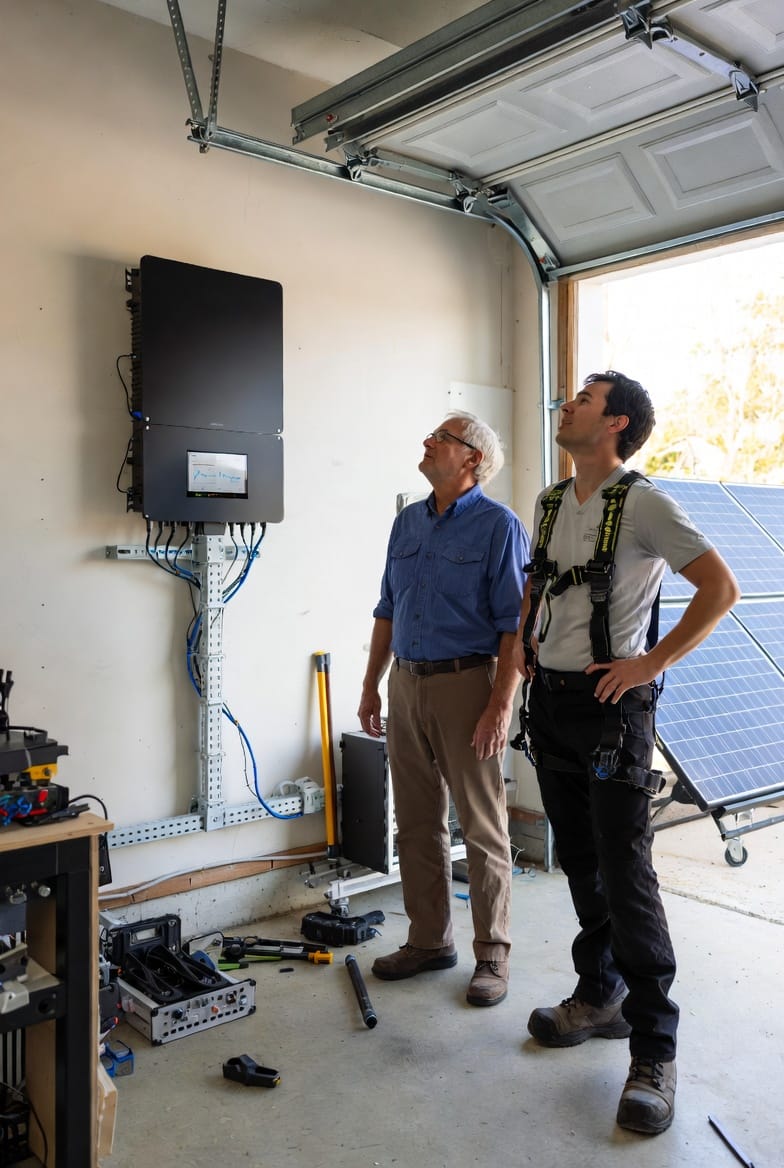
In today’s solar-powered world, solar battery chemistry stands as the silent hero behind true energy independence. Homeowners investing in solar panels quickly discover that storage is what turns intermittent sunshine into reliable, around-the-clock power. Yet not all batteries perform alike. Understanding the core differences between Lithium Iron Phosphate (LFP), Lithium Ion (NMC), and lead-acid chemistries empowers you to select the system that best matches your home’s needs, budget, and long-term goals.
Discover the Best Battery for Your Home – Call Now
This comprehensive guide breaks down each chemistry with clarity, highlights real-world performance in home solar storage applications, and equips you with the knowledge to decide confidently. Whether you prioritize safety, compactness, or upfront cost, the right solar battery chemistry can deliver decades of worry-free service.
Understanding Battery Chemistry Basics
Every battery stores energy through electrochemical reactions, but the materials inside—cathode, anode, and electrolyte—define its personality. Solar battery chemistry directly influences cycle life, depth of discharge (DoD), safety, efficiency, and total cost of ownership.
LFP and NMC fall under the lithium-ion family yet behave differently at the molecular level. Lead-acid, the veteran technology, relies on a completely distinct reaction. Choosing wisely means matching chemistry to your lifestyle: daily cycling for time-of-use savings, occasional backup during outages, or full off-grid resilience.
Lithium Iron Phosphate (LFP): The Safety Champion for Home Storage
Lithium Iron Phosphate (LFP) batteries have emerged as the gold standard for residential solar storage. Their chemistry uses iron phosphate as the cathode material, delivering exceptional thermal stability and eliminating the risk of thermal runaway that concerns other lithium technologies.
Homeowners rest easy knowing LFP systems can withstand extreme temperatures without compromising safety. With cycle life reaching up to 10,000 cycles and depth of discharge often hitting 90-100 percent, an LFP battery can power your home for 20 years or more with minimal capacity fade.
Key advantages of LFP chemistry include:
- Unmatched safety – No cobalt, no fire risk under normal use.
- Longest lifespan – Ideal for daily solar cycling.
- Environmentally responsible – Abundant, non-toxic materials.
- Excellent efficiency – Minimal energy lost as heat.
For families seeking dependable whole-home backup, LFP batteries for home storage provide peace of mind that lasts a generation.
Lithium-Ion (NMC): Compact Power with High Energy Density
Lithium Ion (NMC) batteries, specifically nickel-manganese-cobalt formulations, shine when space is at a premium. Their higher energy density means more kilowatt-hours packed into a smaller footprint—perfect for homes with limited installation areas.
While NMC offers approximately 5,000 cycles and strong performance, it trades some safety margin and longevity for compactness and slightly higher voltage output. These batteries excel in applications requiring rapid discharge, such as powering high-demand appliances during peak evening hours.
Consider NMC when:
- Garage or utility space is tight.
- You want maximum storage capacity per square foot.
- Budget allows for premium density without extreme cycle demands.
Professional installers often recommend NMC lithium ion for urban or condo-style solar setups where every inch counts.
Lead-Acid: The Trusted, Budget-Friendly Veteran
Lead-acid batteries have powered solar systems for decades and remain the most affordable entry point. Available in flooded, gel, and AGM variants, they deliver reliable service at a lower initial cost than lithium options.
However, their shorter cycle life—typically around 1,000 cycles—combined with a conservative 50 percent depth of discharge means you need a larger bank to achieve usable capacity. Regular maintenance on flooded models and sensitivity to temperature further shorten real-world lifespan.
Lead-acid strengths:
- Lowest upfront purchase price.
- Proven technology with widespread support.
- Suitable for occasional-use backup rather than daily cycling.
For budget-conscious homeowners with ample space and lower daily energy demands, lead-acid still holds a place—provided expectations align with its inherent limitations.
Head-to-Head Comparison: LFP vs. Lithium Ion vs. Lead-Acid
When evaluating solar battery chemistry options side by side, three metrics rise above the rest: cycle life, safety, and usable capacity.
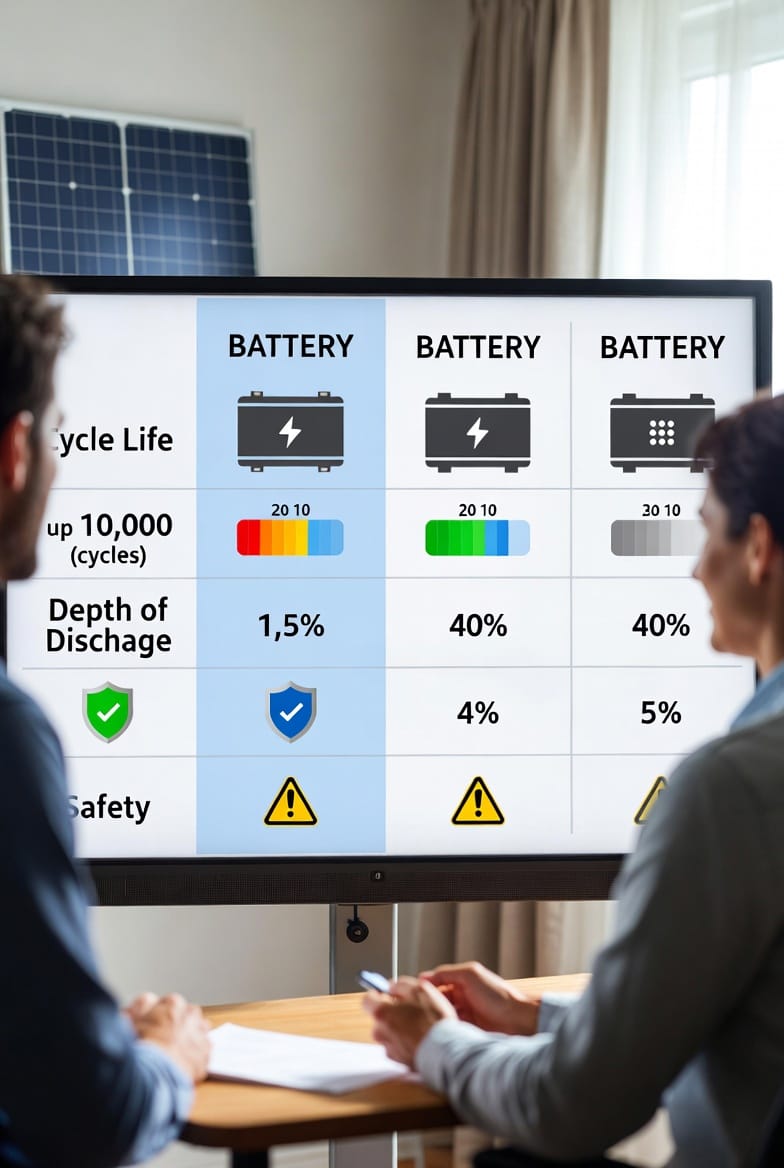
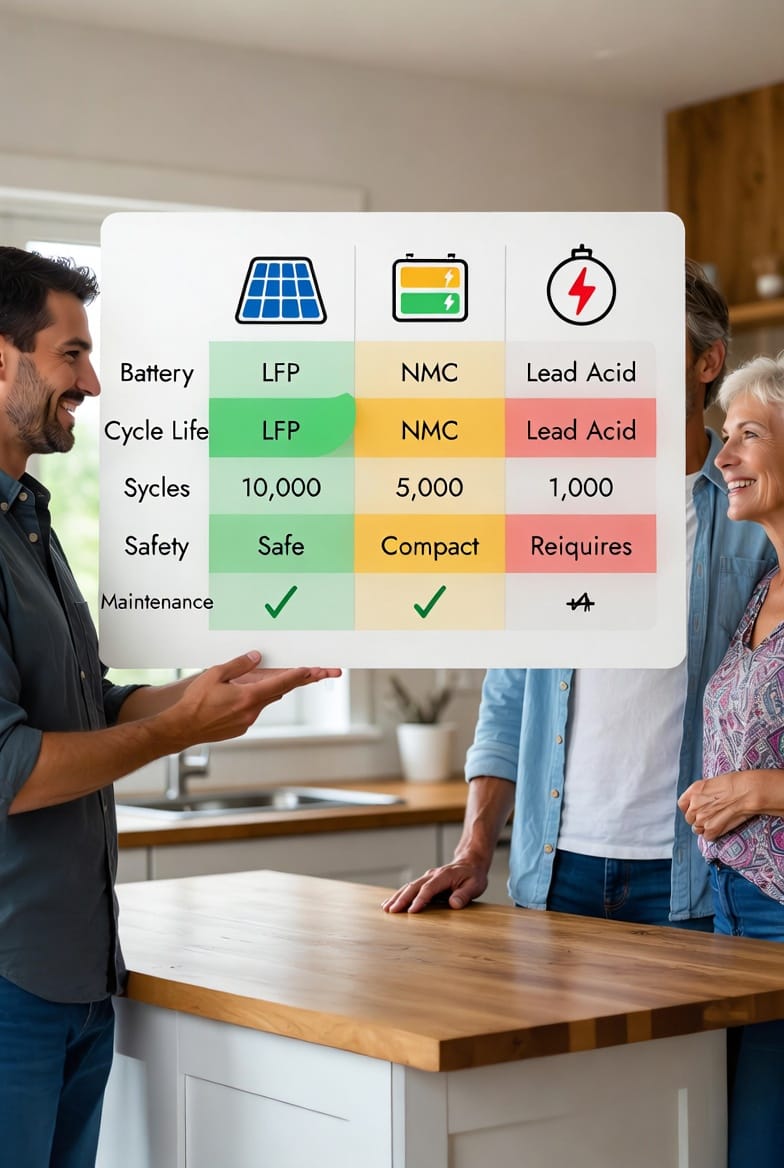
Lithium Iron Phosphate (LFP) leads with up to 10,000 cycles, near-complete depth of discharge, and top-tier safety ratings. Lithium Ion (NMC) follows closely with roughly 5,000 cycles and superior energy density, making it more compact yet slightly less forgiving on thermal events. Lead-acid brings up the rear at approximately 1,000 cycles, requiring careful depth management and routine upkeep.
Efficiency tells another story. LFP and NMC systems routinely exceed 95 percent round-trip efficiency, while lead-acid hovers around 80 percent. Weight and maintenance also favor lithium: LFP and NMC units are lighter and virtually maintenance-free, whereas lead-acid demands ventilation, watering (in flooded types), and periodic checks.
Over a 15-year horizon, the total cost of ownership often favors LFP despite higher initial investment. Fewer replacements and higher efficiency translate into meaningful savings on your electric bill and reduced hassle.
Real-World Applications for Home Solar Storage
Every home’s energy profile differs. LFP chemistry thrives in full-time solar homes that cycle batteries daily to offset peak utility rates. Families with electric vehicles or high summer air-conditioning loads appreciate the long-term durability and safety of LFP during frequent use.
NMC lithium ion suits compact installations where space constraints rule—think townhomes or garages already packed with tools and storage. Their high energy density ensures maximum backup power without sacrificing square footage.
Lead-acid finds its niche in seasonal cabins or supplemental backup systems where daily cycling is rare. When cost is the primary driver and maintenance is manageable, lead-acid still delivers dependable emergency power.
Factors to Consider When Choosing Your Solar Battery
Beyond chemistry, evaluate your daily energy consumption, local climate, available installation space, and future expansion plans. Solar battery chemistry must align with inverter compatibility and warranty expectations. Reputable installers assess these variables to recommend the optimal match.
Safety should never be compromised. Homes with children or pets benefit most from LFP’s inherent stability. Budget planning should focus on lifetime value rather than sticker price alone—cycle life and depth of discharge directly impact how many years of service you actually receive.
The Future of Home Battery Storage
Advancements in solar battery chemistry continue to improve energy density, charging speeds, and recyclability. LFP chemistry is rapidly becoming the default choice for new residential installations because manufacturers and utilities alike recognize its superior balance of safety, longevity, and cost-effectiveness over time.
Making the Smart Choice for Your Home
Selecting the correct solar battery chemistry transforms your solar investment from good to exceptional. Whether you lean toward the safest, longest-lasting LFP, the space-saving NMC lithium ion, or the economical lead-acid solution, professional guidance ensures your system performs exactly as promised for decades.
Choose the right battery for your storage needs. Your journey to reliable, worry-free solar storage starts with one informed conversation.
Find Your Perfect Solar Storage Solution – Call Now