The Grassy Weed Identification: Differentiating Crabgrass, Foxtail, and Quackgrass for Targeted Control
Grassy weeds pose one of the trickiest challenges for homeowners striving to maintain a pristine lawn. Unlike broadleaf weeds with obvious flowers or different leaf shapes, grassy weeds blend seamlessly with desirable turfgrass species. This mimicry makes casual observation deceptive, often leading to ineffective or damaging control attempts.
Stop Guessing – Send Photos & Get Pro Weed ID Now
Crabgrass, foxtail, and quackgrass rank among the most common culprits that masquerade as "just more grass." Misidentifying them can result in wasted products, stressed turf, or even permanent lawn damage from non-selective applications. Precise identification unlocks targeted control, ensuring selective herbicides work efficiently while preserving your lawn's integrity.
In this comprehensive guide, we break down the subtle differences in growth habit, seed heads, leaf structure, and key anatomical features. Armed with this knowledge, you can confidently address these invaders and achieve lasting results.
Why Precise Identification Matters for Grassy Weed Control
Selective herbicides designed for grassy weeds target specific physiological traits. Using the wrong product risks:
- Ineffective treatment — The weed survives and spreads further.
- Turf injury — Desirable grasses suffer yellowing, thinning, or dieback.
- Environmental impact — Over-application wastes resources and affects beneficial organisms.
Accurate identification before treatment is the cornerstone of successful, eco-conscious lawn care. It saves time, money, and frustration while delivering superior outcomes.
Understanding Crabgrass: The Low-Spreading Opportunist
Crabgrass (Digitaria species) thrives in thin, stressed, or compacted lawns, especially in full sun.
- Growth habit — Prostrate and spreading; stems root at nodes, forming dense mats close to the ground.
- Leaf structure — Light green, wide blades (up to 1/4 inch) with a prominent midrib; leaves often fold along the midvein.
- Seed heads — Finger-like spikes radiating from a central point, resembling a crab's claws—hence the name.
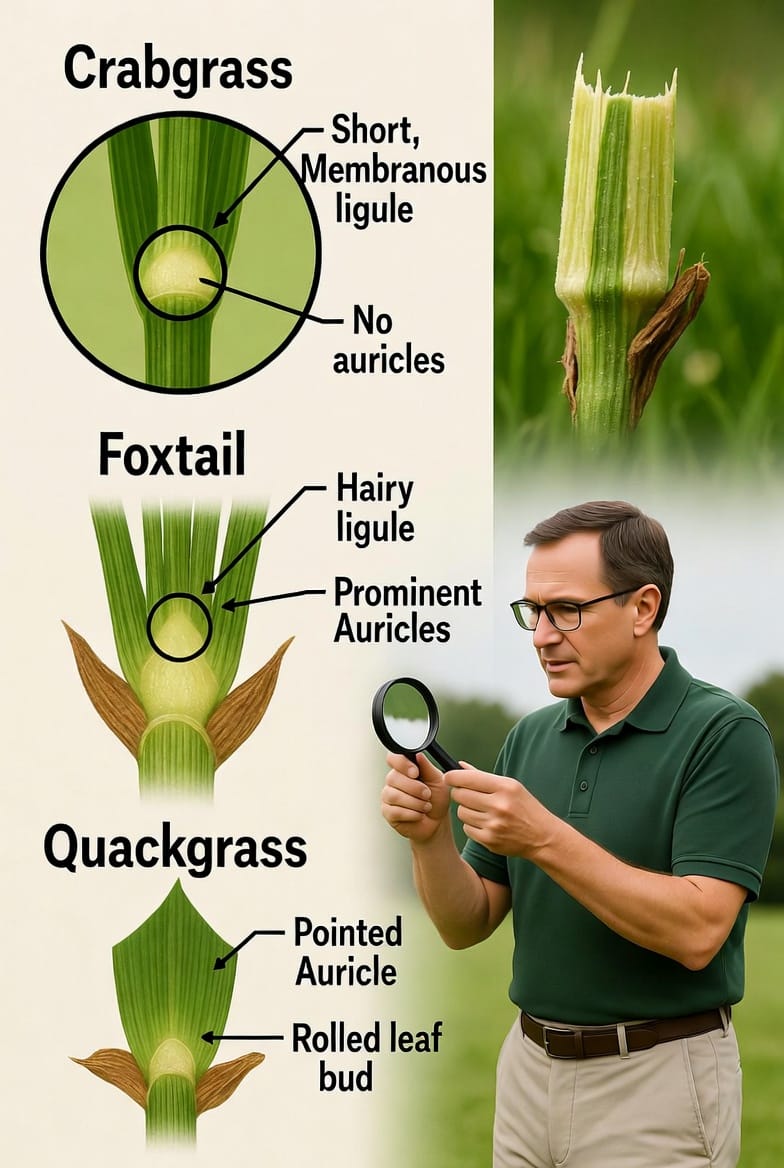
- Key identifier — No ligule or very short membranous ligule; auricles absent.
Crabgrass germinates late spring into summer when soil temperatures reach 55–65°F, explaining its sudden summer appearance.
Recognizing Foxtail: The Bushy Seed Head Invader
Foxtail (Setaria species) often emerges in disturbed areas or poorly maintained turf.
- Growth habit — Upright to somewhat spreading; forms clumps rather than mats.
- Leaf structure — Narrower than crabgrass, rough-textured edges; rolled in the bud.
- Seed heads — Distinctive dense, cylindrical, bushy spikes resembling a fox's tail—fuzzy and bristly with bristles surrounding each seed.
- Key identifier — Prominent membranous ligule with hairs; auricles absent or very small.
Foxtail prefers compacted soils and can produce thousands of seeds per plant, making early intervention essential.
Identifying Quackgrass: The Aggressive Rhizomatous Perennial
Quackgrass (Elymus repens, formerly Agropyron repens) stands out as a perennial grassy weed with an extensive underground network.
- Growth habit — Upright and vigorous; spreads rapidly via sharp-pointed rhizomes that penetrate deep.
- Leaf structure — Coarse, bluish-green blades; prominently veined and rough on upper surface.
- Seed heads — Narrow, spike-like with flattened spikelets arranged in two rows.
- Key identifier — Prominent clasping auricles that wrap around the stem; short, membranous ligule.
Quackgrass tolerates shade and drought better than many turfgrasses, explaining its persistence even in challenging conditions.
Key Anatomical Features: Collar, Ligule, and Auricle Breakdown
To differentiate at the base of the leaf:
- Collar region — The junction where leaf blade meets sheath.
- Ligule — Membranous or hairy projection at the top of the sheath.
- Auricles — Ear-like appendages at the collar.
Quick comparison:
- Crabgrass — Ligule absent/short; auricles absent; sheath often compressed.
- Foxtail — Ligule prominent, membranous with fringe of hairs; auricles absent.
- Quackgrass — Ligule short, membranous; large clasping auricles—a giveaway feature.
Examine several plants; variations occur, but these traits remain consistent.
Why Selective Herbicides Demand Accurate Targeting
Post-emergent selective herbicides exploit differences in plant metabolism:
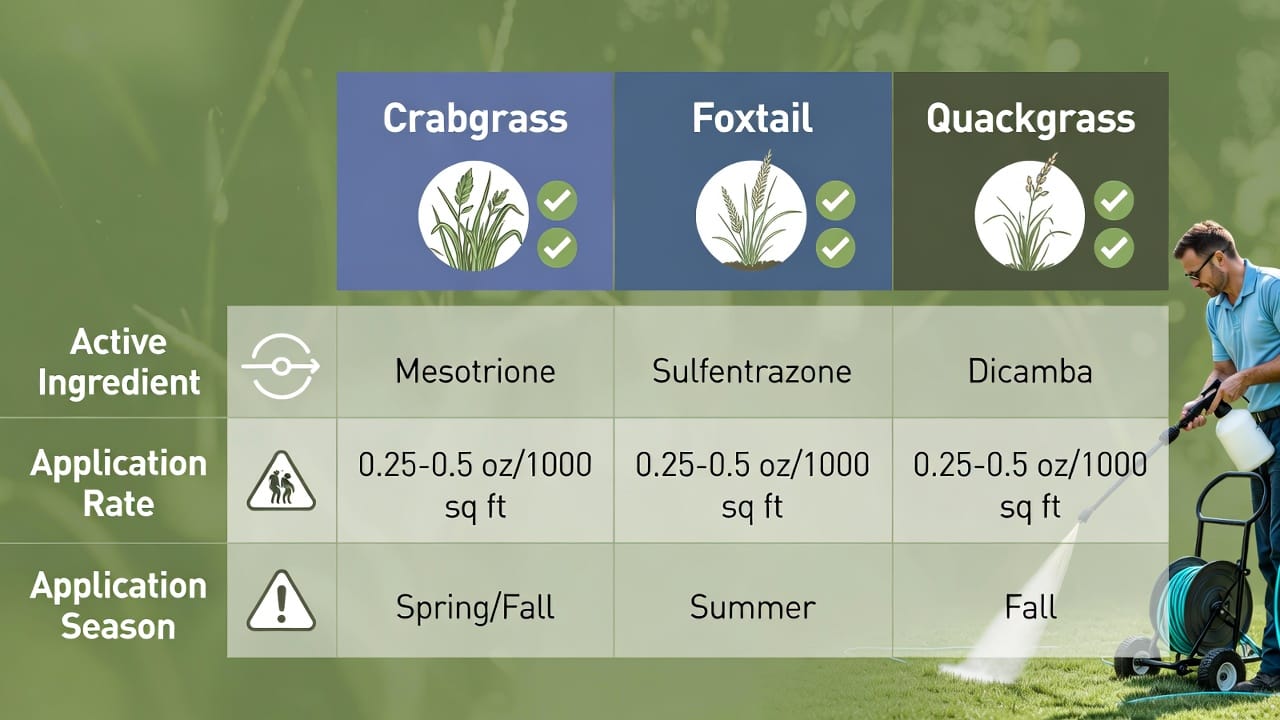
- Crabgrass responds well to quinclorac or mesotrione in tolerant turf.
- Foxtail often requires fenoxaprop or sethoxydim for grassy weed control.
- Quackgrass, being perennial, may need systemic options like glyphosate (non-selective) for spot treatment or repeated applications of selective graminicides.
Pre-emergent barriers (e.g., prodiamine) prevent germination but require timing based on weed life cycle.
Misapplication risks include resistance development or lawn discoloration. Targeted control minimizes these issues.
Prevention and Long-Term Management Strategies
Consistent lawn health deters grassy weeds:
- Mow at proper heights to shade soil and promote dense turf.
- Water deeply but infrequently to favor deep-rooted grasses.
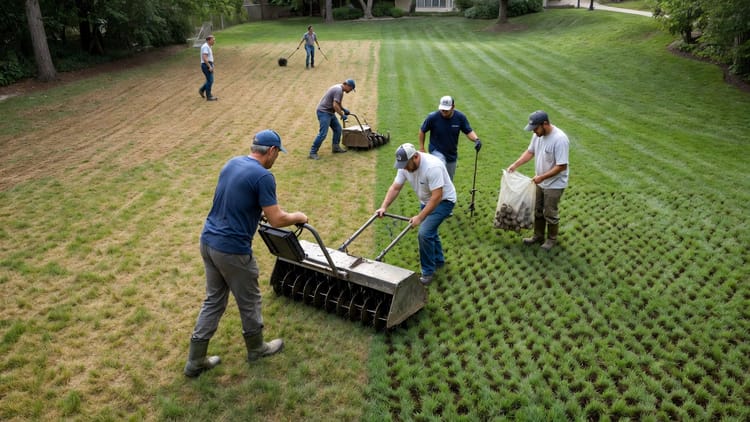
- Aerate and overseed thin areas to reduce bare spots.
- Fertilize appropriately to strengthen desirable turf competition.
Integrated approaches combining cultural practices with targeted treatments yield the best long-term results.
Take Action: Identify Before You Spray
Grassy weeds like crabgrass, foxtail, and quackgrass may look similar at first glance, but their differences in growth, structure, and anatomy are clear upon closer inspection. Mastering identification empowers you to choose the right control method at the right time.
Don't guess—get it right the first time.
Identify before you spray. We'll provide personalized identification and a tailored plan to restore your lawn's health and beauty.
Your perfect lawn is within reach—start with accurate identification.
Defeat Grassy Weeds the Right Way – Call Our Specialists Now