The Crane Operator's Calculus: How Load Charts, Radius, and Boom Angles Dictate Safe Lifts in Arboriculture
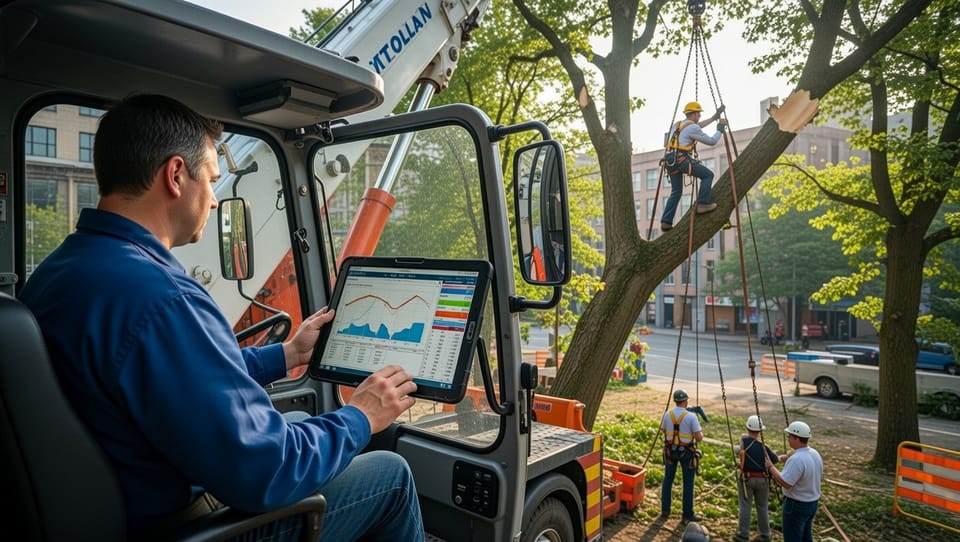
In the demanding field of tree removal, especially for large, hazardous, or hard-to-reach trees near homes, power lines, or structures, crane-assisted tree removal stands as one of the safest and most efficient methods available. Unlike traditional climbing or bucket truck techniques alone, cranes allow arborists to dismantle towering trees section by section from a stable distance. However, this precision engineering demands rigorous adherence to physics principles governed by load charts, radius, and boom angles.
Remove Dangerous Trees Safely – Call for Free Estimate!
Our expert operators treat every lift as a calculated operation, ensuring each pick is planned to the pound. This approach minimizes risks and protects property, crews, and the environment. By revealing the engineering behind these operations, homeowners and property managers can appreciate why professional crane services deliver superior results in challenging tree removal scenarios.
The Role of Cranes in Modern Arboriculture
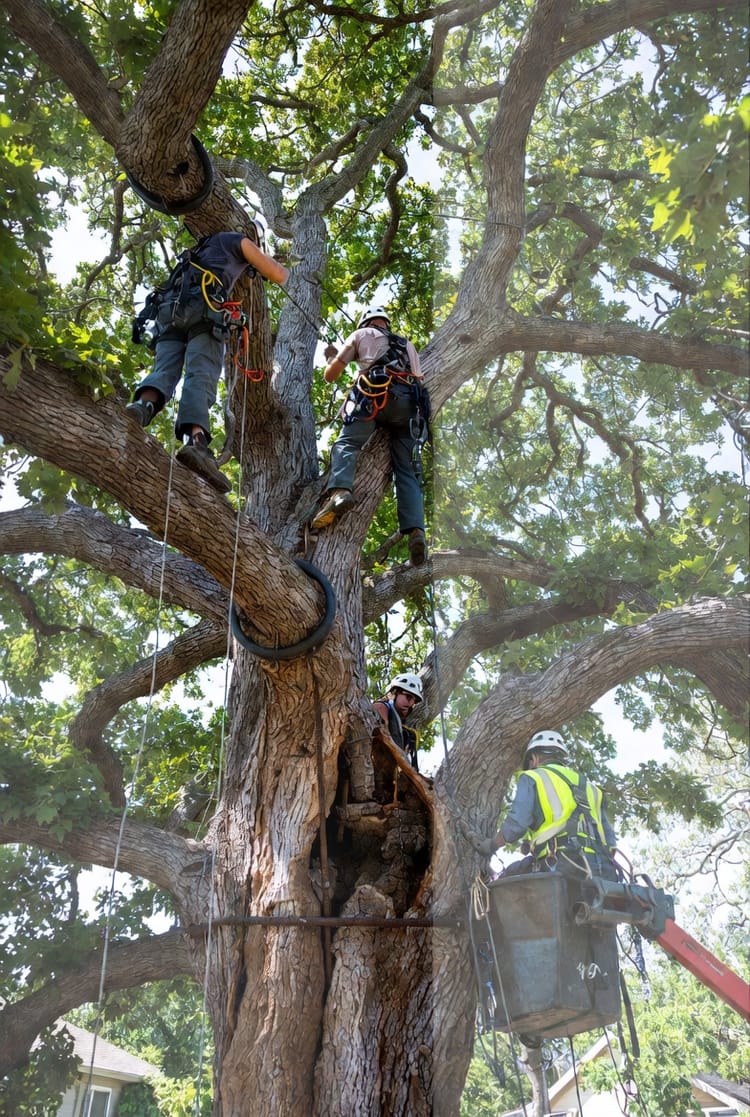
Crane-assisted tree removal transforms complex jobs into controlled, efficient processes. Cranes excel when trees exceed 60-80 feet, lean dangerously, or sit in confined spaces. Arborists rig limbs or sections, while the crane lifts them away from obstacles to a safe drop zone.
This method reduces time on-site, limits climber exposure to heights, and prevents damage from falling debris. Yet success hinges on understanding the crane's capabilities under varying conditions. Operators consult manufacturer-specific load charts to verify that the planned lift stays well within safe parameters.
Key benefits include enhanced safety for crews and bystanders, precise control over heavy sections, and the ability to handle jobs impossible with ground-based equipment alone. When executed correctly, these lifts exemplify engineering excellence in arboriculture.
Demystifying Load Charts: The Operator's Essential Tool
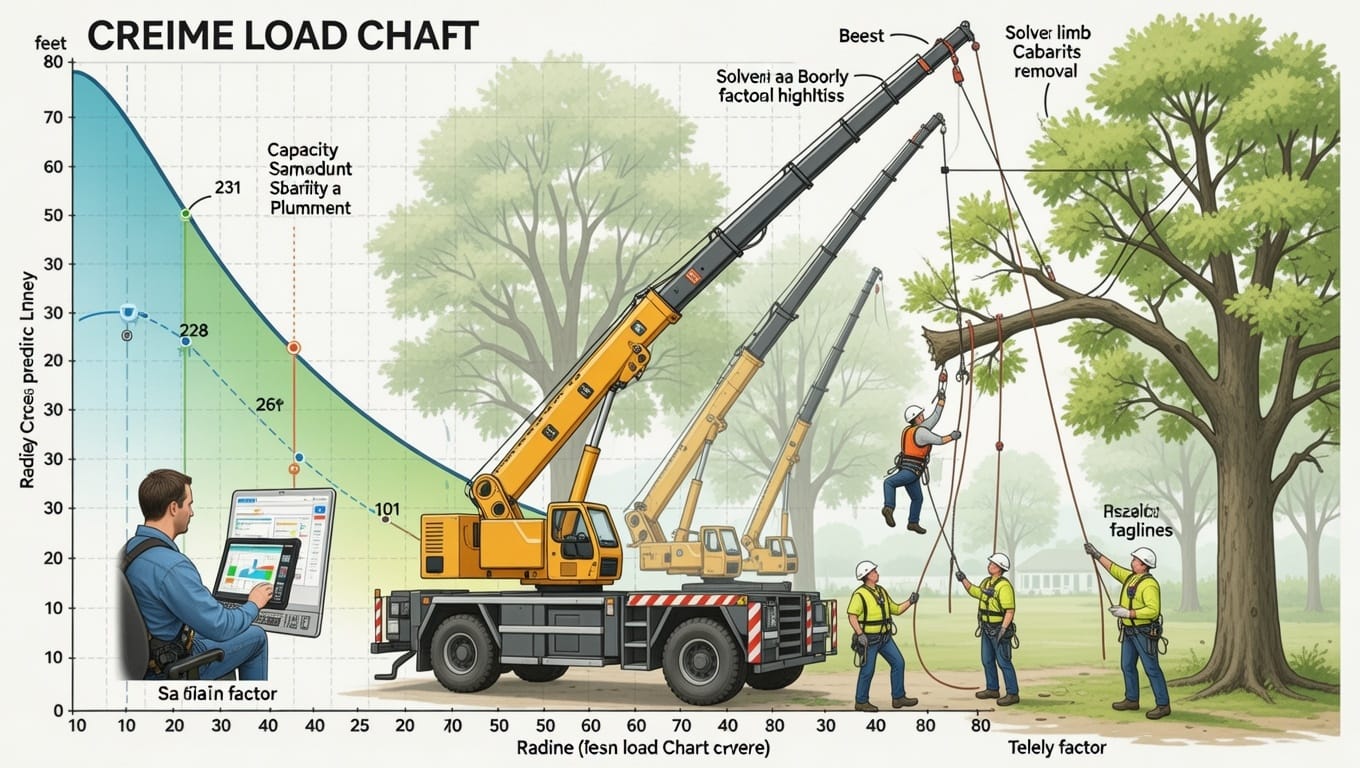
Load charts are the cornerstone of safe crane operations in tree removal. Each crane model comes with its own detailed chart, customized for configurations including boom length, counterweight, outrigger setup, and terrain. These charts graphically display the maximum safe lift capacity at different radii and boom angles.
A typical load chart features curves or tables plotting capacity (in pounds or tons) against radius (the horizontal distance from the crane's center of rotation to the load). Capacity deductions account for rigging gear, hooks, and slings—operators subtract these to calculate net capacity.
For example, a rough-terrain crane might rate 12,000 pounds at a 25-foot radius with a 70-degree boom angle, but only 4,500 pounds at 55 feet. Operators cross-reference the exact setup, confirming the load weight (estimated via species density, section dimensions, and charts) falls below the rated value, often with a generous safety margin.
This "calculus" ensures no guesswork. Every lift is verified against the chart, preventing overload that could cause tipping, boom stress, or failure. In arboriculture, where loads include unpredictable wood density and moisture, this precision is non-negotiable.
The Critical Role of Radius in Safe Lifting
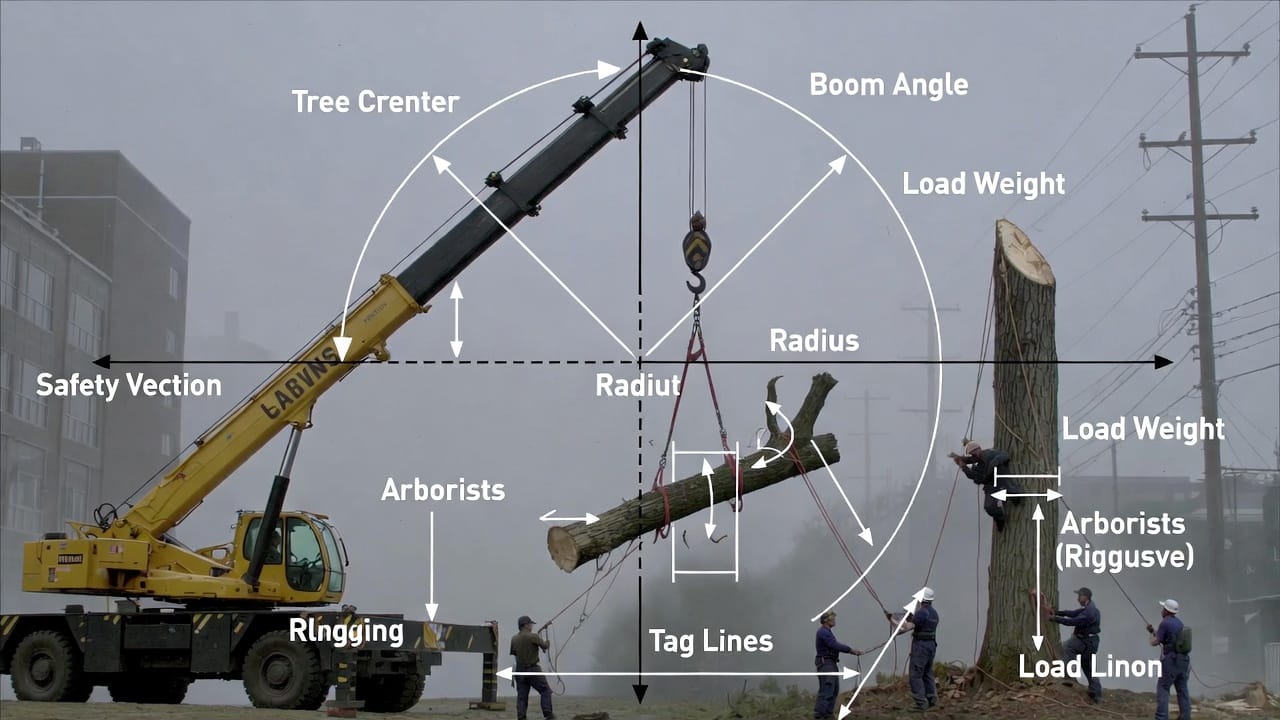
Radius represents the horizontal distance from the crane's rotation point to the center of the suspended load. As radius increases, the leverage (tipping moment) grows dramatically, reducing the crane's safe lift capacity—often exponentially.
Physics dictates this: the moment arm lengthens with greater radius, amplifying forces on the crane's base and boom. A modest increase from 30 to 50 feet can halve capacity on many models. Operators minimize radius by positioning the crane as close as safely possible to the tree, using outriggers for stability.
In crane-assisted tree removal, calculating radius involves measuring to the rigging point on the limb. Crews plan picks so the load swings clear without exceeding chart limits. Accurate radius assessment, combined with real-time monitoring, ensures each section is lifted securely without swinging into hazards.
Boom Angles and Their Impact on Capacity
Boom angle—the elevation of the boom relative to horizontal—directly influences stability and safe lift capacity. Steeper angles (closer to vertical, e.g., 70-80 degrees) direct force downward through the crane's strong central structure, allowing heavier lifts. Shallower angles (45-60 degrees) increase horizontal leverage, lowering capacity significantly.
Load charts specify capacities for various boom angles at given radii. For instance, the same crane might handle 10,000 pounds at 75 degrees and 20-foot radius, but only 6,000 pounds at 50 degrees under identical reach. Operators adjust boom angle strategically, balancing reach needs with capacity demands during tree section removal.
This interplay between radius and boom angle forms the operator's calculus, guiding every decision in arboriculture lifts.
Step-by-Step: Planning a Safe Lift to the Pound
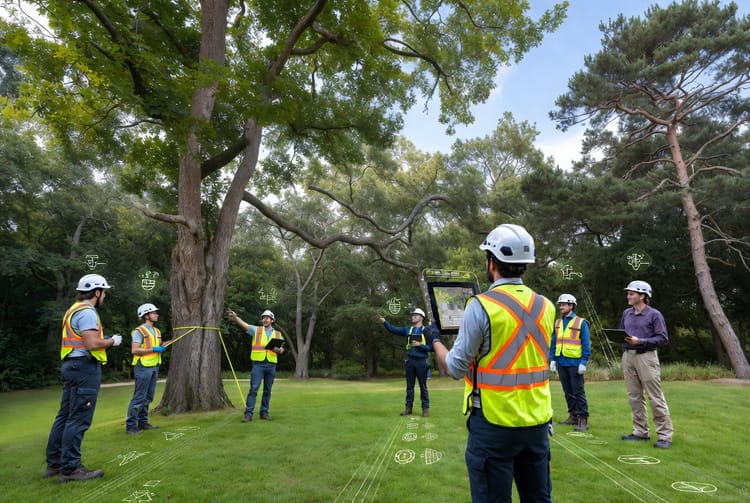
Precision planning separates professional crane-assisted tree removal from risky attempts. Here's how our teams ensure safety:
- Assess the tree and site: Identify target sections, estimate weights using diameter, length, species-specific density charts, and moisture factors. Apply safety margins (often 50% or more for novices).
- Position the crane: Select a stable, level spot with adequate ground bearing pressure. Deploy outriggers fully, crib if needed, and verify levelness within 1 degree.
- Determine configuration: Confirm boom length, counterweights, and attachments. Consult the exact load chart for the planned radius and boom angle.
- Calculate net capacity: Start with gross rating from the chart, subtract rigging weight, hook block, and other deductions. Ensure estimated limb weight (to the pound) + dynamic factors stays below 75-80% of net capacity typically.
- Rig securely: Arborists select strong attachment points, use appropriate slings/chains rated higher than the load, and attach taglines for control.
- Execute and monitor: Lift slowly, watch for swing or wind effects, maintain communication, and lower to designated zone.
This methodical process guarantees controlled, damage-free removals.
Common Risks and Mitigation Strategies
Even with charts, risks exist in crane-assisted tree removal:
- Tip-over from exceeding radius limits or soft ground—mitigated by pre-job soil analysis and cribbing.
- Boom overload or structural stress—prevented by strict chart adherence and deductions.
- Load swing or drop due to poor rigging—addressed with certified gear and taglines.
- Electrical hazards or property damage—avoided via clearance planning and spotters.
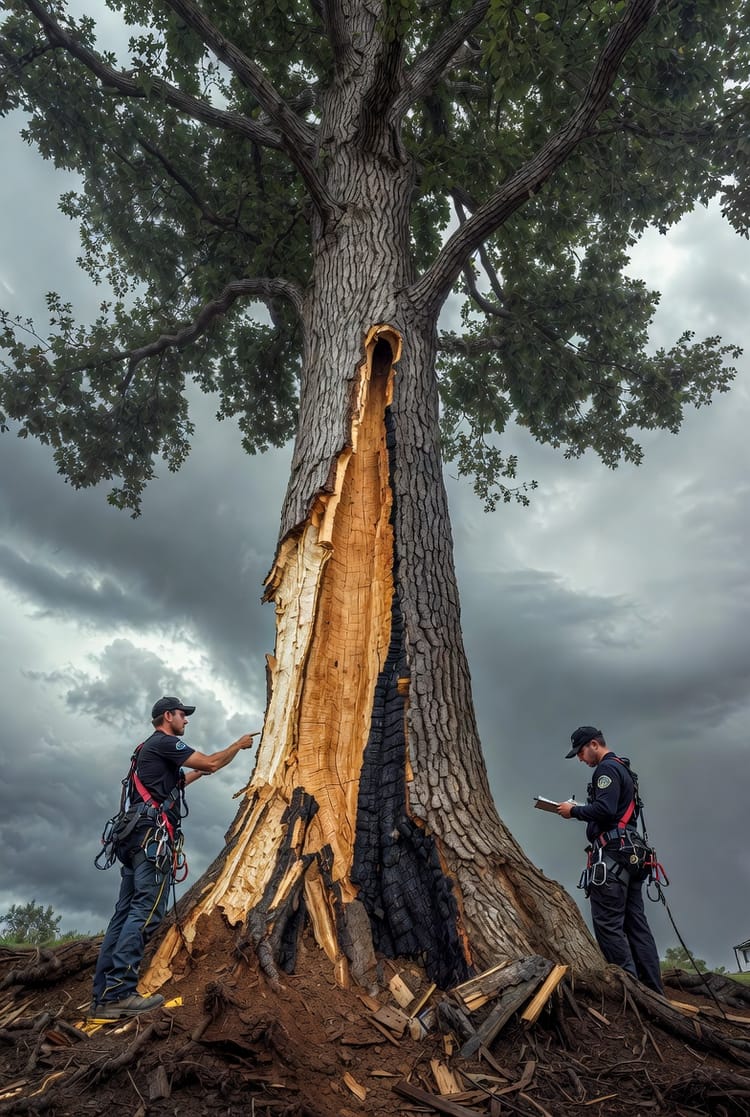
Our teams conduct thorough risk assessments, ensuring every variable is controlled.
Why Choose Professional Crane-Assisted Tree Removal
Relying on experienced operators with proper equipment delivers peace of mind. They navigate regulations, use advanced tools, and prioritize safety above all. DIY or unqualified attempts often lead to costly accidents or incomplete work.
When cranes are involved, precision is physics. Trust our engineered removals at
Safe, Professional Tree Removal Starts Here – Call Now!