The Bathroom Vanity Height: Standard vs. Comfort vs. Custom Options
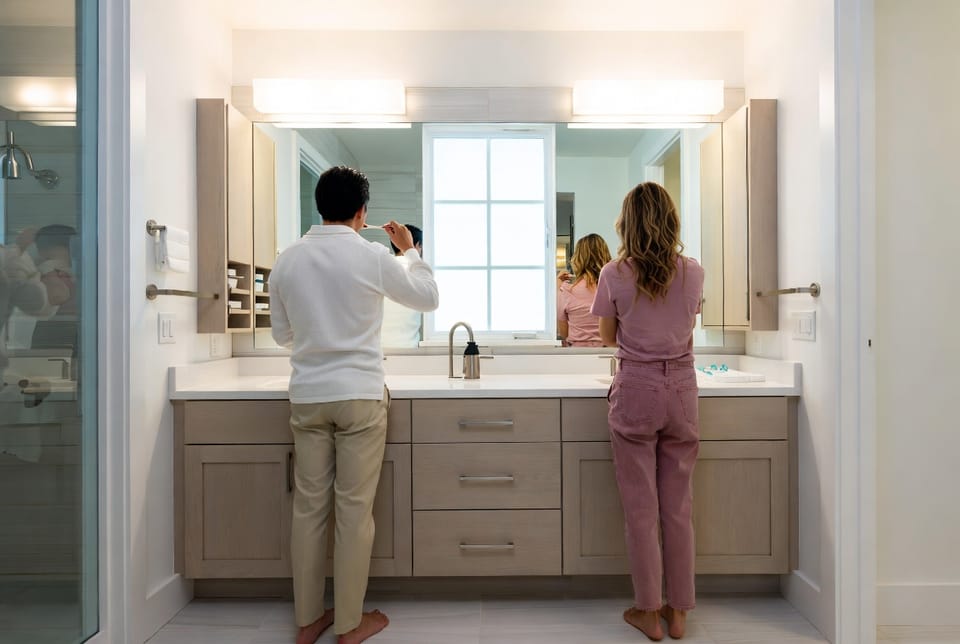
When planning a bathroom remodel, few decisions impact daily comfort as much as vanity height. Too low, and you’ll find yourself hunching over each morning. Too high, and children or shorter family members may struggle. Yet many homeowners accept whatever the builder installed decades ago.
Find Your Perfect Vanity Height – Call Now!
The truth? Standard vanity heights have changed—and for good reason. Modern ergonomics, aging-in-place needs, and personalized design now offer three distinct paths: standard, comfort, and fully custom. Understanding the differences protects your posture, safety, and long-term satisfaction.
This guide walks you through every option, from the outdated 30-inch standard to today’s preferred 36-inch comfort height, plus bespoke solutions for unique bodies and households. By the end, you’ll know exactly which height serves your family best.
Why Vanity Height Matters More Than You Think
Most people don’t realize they’re straining their lower back every time they brush their teeth or wash their face. A poorly matched vanity forces:
- Neck and shoulder tension from leaning forward
- Lower back fatigue from prolonged stooping
- Risk of slips when bending too far toward the sink
- Accessibility barriers for wheelchair users or those with limited mobility
Ergonomics research shows that a neutral spine position—where your elbows rest at roughly 90 degrees while washing hands—reduces daily physical stress by over 40%. Your vanity height directly controls this angle.
The right height isn’t a luxury. It’s a health necessity.
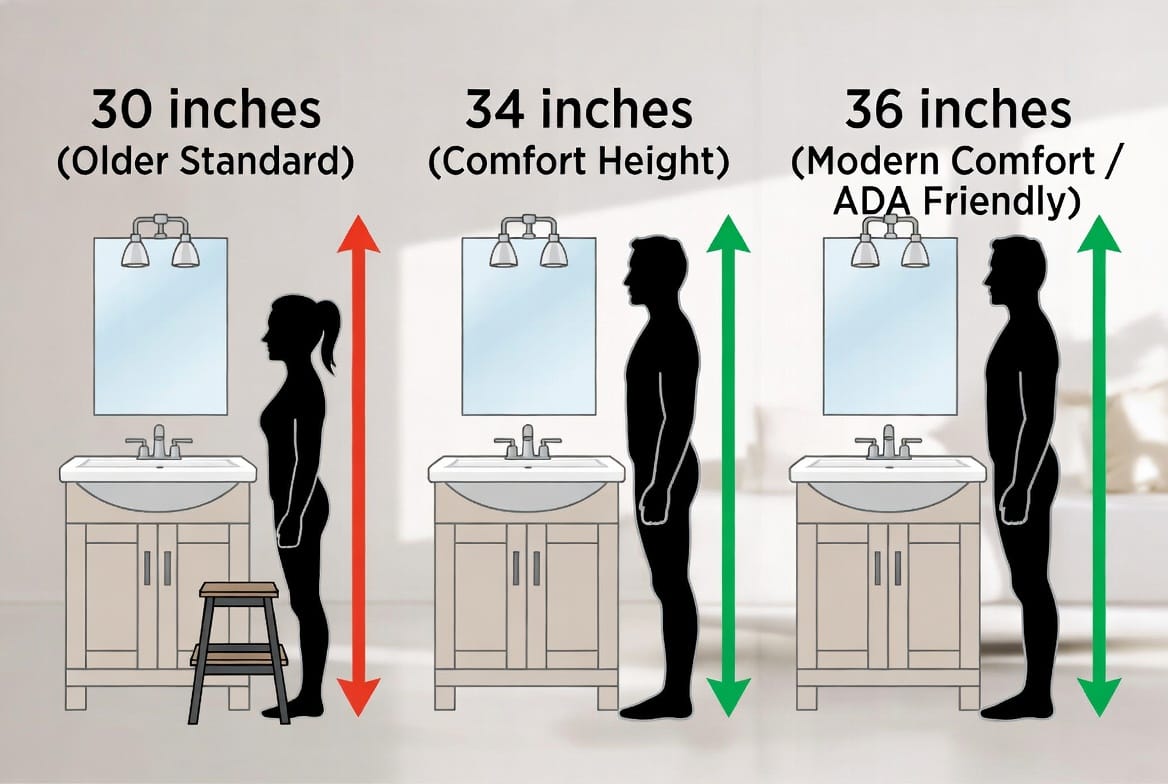
Standard Vanity Height: The 30-Inch Legacy
For decades, 30 inches served as the default bathroom vanity height. This measurement—from floor to the top of the counter—originated from dining table standards in the mid-20th century. But human bodies haven’t changed. So why did this become outdated?
Who Still Uses 30-Inch Vanities?
- Older homes built before 2000
- Budget-friendly builder-grade bathrooms
- Pedestal sinks without storage below
- Children’s bathrooms in some designs
The Hidden Downsides
- Forces a forward hip hinge (like touching your toes)
- Creates splashing because the sink basin sits too low
- Wastes under-vanity storage (shorter cabinet boxes hold less)
- Difficult for tall individuals (over 5’9”) to use without back pain
When 30 Inches Might Work
- Guest half-baths used only occasionally
- Homes with exclusively shorter adults (under 5’4”)
- Retro or period-specific designs where authenticity matters
Verdict: For most modern households, 30 inches is obsolete. Unless you’re preserving a historic home or accommodating very short adults exclusively, skip this height.
Comfort Height: The 34–36 Inch Sweet Spot
Also called “universal design height” or “ADA-inspired height,” comfort height typically lands between 34 and 36 inches. This range emerged from accessibility guidelines and ergonomic studies showing that most adults between 5’4” and 6’0” stand naturally at a 34–36 inch counter.
Why 36 Inches Has Become the New Standard
- Matches kitchen counter height (consistent ergonomics throughout the home)
- Reduces back strain by 50–70% for average-height users
- Accommodates taller individuals (up to 6’4” comfortably)
- Allows deeper under-vanity drawers (more storage capacity)
- Works with vessel sinks (which add 2–4 inches of extra height)
The Accessibility Advantage
The Americans with Disabilities Act (ADA) recommends wheelchair-accessible vanities at 34 inches maximum knee clearance. But for standing users, 36 inches hits the ergonomic bullseye. Many homeowners now split the difference at 34–35 inches to serve both standing and seated family members.
Potential Drawbacks
- Children under age 10 will need a step stool
- Very short adults (under 5’2”) may still feel slightly elevated
- Requires taller faucets to maintain proper spout clearance
Risk Alert: Pairing a 36-inch vanity with a vessel sink (adds ~4 inches) creates a 40-inch total height—too tall for most users. Always calculate total height: vanity + sink + faucet clearance.
Who Should Choose Comfort Height?
- Most families with teenagers or adults
- Aging-in-place plans (prevents future back issues)
- Rental properties (appeals to the widest range of tenants)
- Master bathrooms where daily use is high
Custom Vanity Heights: When One Size Fits Nobody
Sometimes standard and comfort both miss the mark. Custom vanity heights solve specific scenarios that off-the-shelf cabinets cannot.
Situations Demanding Custom Heights
| User Profile | Recommended Height | Why |
|---|---|---|
| Tall family (over 6’2”) | 38–40 inches | Prevents lower back rounding during handwashing |
| Wheelchair user | 32–34 inches (clear knee space) | Allows lap clearance and forward approach |
| Multi-generational home | 34 inches with adjustable stool | Compromises between seniors and children |
| Very short adult (under 5’0”) | 30–32 inches | Avoids shoulder elevation and water drip down arms |
| Barrier-free bathroom | 32 inches + open base | Supports roll-under access |
The Process of Going Custom
- Measure your primary user’s elbow height while standing relaxed (elbow to floor minus 4–6 inches = ideal vanity top height)
- Test with temporary platforms (stack plywood on an existing vanity to simulate heights)
- Order custom cabinet boxes (typically 2–4 week lead time)
- Adjust plumbing rough-ins (drain height may need relocation)
Cost Considerations
- Custom vanity base: $800–$2,500 (versus $300–$1,000 for standard)
- Plumbing relocation: $200–$600 per sink
- Countertop modifications: Minimal if slab is cut fresh
Bottom Line: Custom costs 50–100% more than stock, but for medical needs or extreme height differences, it’s money well spent.
Key Factors to Weigh Before Deciding
1. User Heights (Current & Future)
List everyone who uses the bathroom daily. If heights vary by more than 10 inches, lean toward 34 inches with a rollable step stool. If all users are over 5’8”, 36 inches or higher works beautifully.
2. Accessibility Needs
Even if no one currently uses a wheelchair or walker, aging in place suggests planning ahead. A 34-inch vanity with removable lower panel allows future roll-under access without full remodel.
Risk Alert: Installing a 36-inch vanity with a solid toe kick (no open space below) blocks wheelchair access entirely. If there’s any chance of future mobility aids, specify an open-front vanity during design.
3. Children in the Home
For shared family bathrooms, consider:
- Dual-height vanities (rare but possible in large bathrooms)
- Pull-out step stools built into the toe kick
- Freestanding step stools stored nearby
Never lower the whole vanity for children—they grow, but your back won’t get younger.
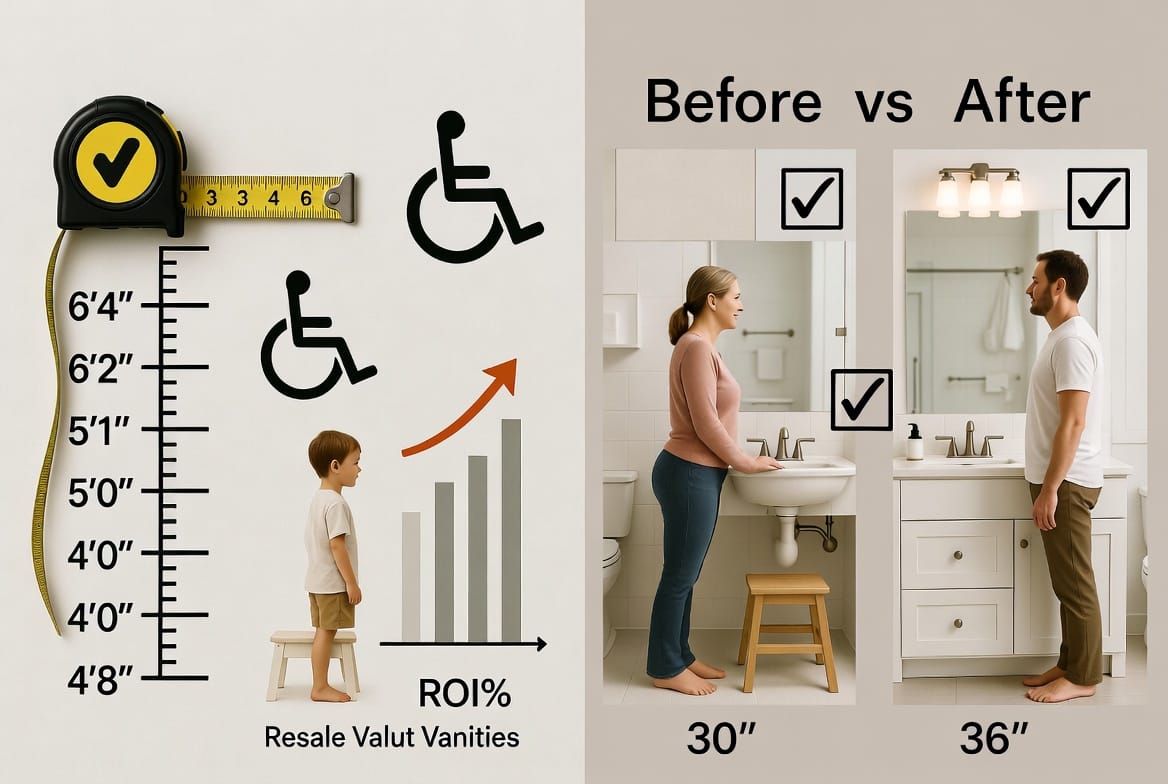
4. Resale Value
Real estate data from National Kitchen & Bath Association (NKBA) shows:
- 36-inch comfort height adds 3–5% buyer preference over 30-inch
- Custom heights outside 34–36 inches can deter average buyers
- Accessibility-friendly features boost appeal in retirement-heavy markets
If selling within 5 years, stick to 34–36 inches. Extreme custom heights may require converting back before listing.
5. Sink Type & Faucet Height
Critical calculation: Vanity height + sink height + faucet clearance = usable space.
| Sink Type | Added Height Above Vanity | Minimum Faucet Height Needed |
|---|---|---|
| Undermount | 0 inches (flush) | 4–6 inches |
| Drop-in | 0.5–1 inch | 5–7 inches |
| Vessel (on top) | 3–5 inches | 8–12 inches |
Example: 36-inch vanity + 4-inch vessel sink = 40-inch total. A standard 6-inch faucet will splash—you need 10+ inches.
Step-by-Step: How to Choose Your Perfect Height
Step 1: Measure the tallest regular user’s elbow height.
Stand naturally, bend elbow to 90 degrees, measure from floor to elbow crease. Subtract 4 inches. That’s your ideal vanity top height.
Step 2: Measure the shortest regular user’s elbow height.
Same method. If the difference exceeds 6 inches, plan for a step stool or dual-zone bathroom.
Step 3: Decide on sink style first.
Vessel sinks raise total height significantly. Undermount sinks keep things lower.
Step 4: Check your plumbing rough-in.
Existing drain height may limit how much you can raise the vanity. Moving a drain costs extra but is usually possible.
Step 5: Test before buying.
Visit a showroom. Bring a family member. Stand at 34 inches, 36 inches, and 38 inches (use stacked plywood if needed). Brush your teeth. Wash your face. Feel the difference.
Pro Tip: Take a video of each family member using different heights. Watching yourself stoop or stretch is more convincing than memory alone.
Common Mistakes to Avoid
❌ Assuming “standard” means “right for me.” Builder-grade is about cost, not ergonomics.
❌ Choosing vanity height before picking the sink. A last-minute vessel sink can ruin a carefully chosen height.
❌ Forgetting mirror and lighting placement. Raising the vanity means raising the mirror center to 66–72 inches from floor.
❌ Ignoring children entirely. They do grow, but a 4-year-old can’t safely use a 36-inch vanity for years. Plan interim solutions.
❌ Going custom without testing. Your “guess” of 38 inches might feel perfect in theory but awkward in practice. Test first.
Final Recommendation by Household Type
| Household | Recommended Height | Rationale |
|---|---|---|
| Couple, both 5’6”–5’10” | 36 inches | Perfect ergonomic match |
| Family with young kids + tall parents | 34 inches + step stool | Balances all needs |
| Single person over 6’0” | 38 inches (custom) | Prevents lifelong back strain |
| Seniors with walkers | 34 inches (open base) | Supports leaning without stooping |
| Rental property | 35 inches | Safest for unknown future tenants |
| Wheelchair user | 32–34 inches with knee space | ADA compliance + independence |
Your Next Step: Make It Happen
You now know that 30 inches belongs in the past, 36 inches serves most modern households, and custom heights solve specific challenges. The wrong vanity height causes daily, avoidable pain. The right height feels invisible—you simply stand, wash, and go about your day without thinking about your back.
Don’t leave this decision to chance or builder defaults.
Choose the right height for your family.
Call today for a free ergonomic consultation. Our designers will help you test heights, select sink styles, and plan a bathroom that serves everyone—without compromise.
Stop Back Pain at the Sink – Call for a Quote!