Solar Panel Degradation: Understanding the Lifespan, Output Warranty, and Long-Term Performance of Your Array
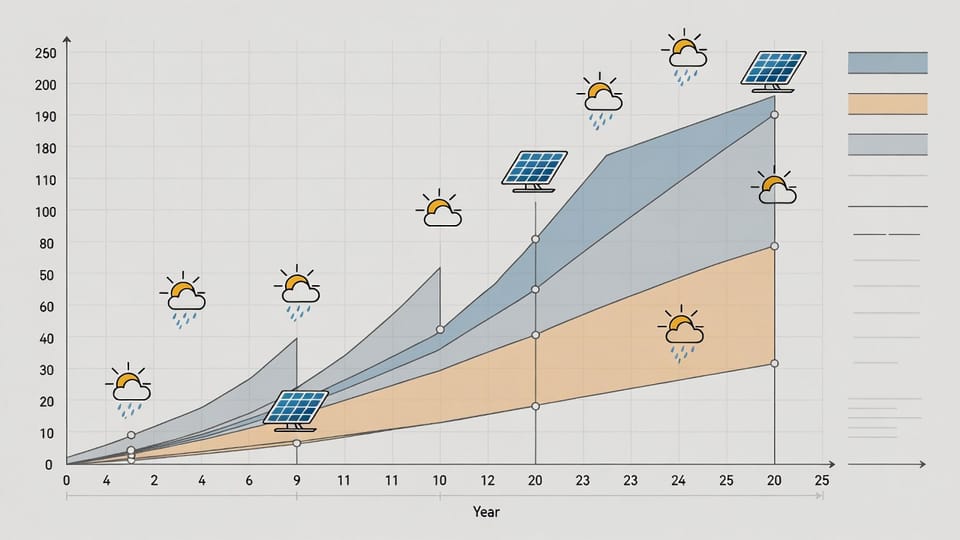
As homeowners and businesses increasingly turn to solar energy for sustainable power solutions, one lingering question often arises: How long will my solar panels truly last? Solar panel degradation is a natural process, but understanding it empowers you to make informed decisions. Rest assured, with advancements in technology and robust warranties, your investment in solar can deliver reliable performance for decades. In this comprehensive guide, we'll delve into the typical degradation rates, demystify output warranties, and explore factors influencing long-term performance. By the end, you'll feel confident in the enduring value of your solar array.
Maximize Your Solar Lifespan – Free Consultation
What Is Solar Panel Degradation?
Solar panels, like any technology exposed to the elements, experience a gradual decline in efficiency over time. This phenomenon, known as degradation, refers to the reduction in a panel's ability to convert sunlight into electricity. It's not a sudden failure but a slow, predictable process that manufacturers account for in their designs.
The industry standard for annual degradation hovers between 0.5% to 1%. This means that after the first year, your panels might produce 99% to 99.5% of their original output, and this compounds annually. For a typical 400-watt panel, that's a loss of just 2 to 4 watts per year—barely noticeable in daily operation but important for long-term planning.
Why does this happen? Degradation stems from several microscopic changes within the panel's cells:
- Light-Induced Degradation (LID): Occurs in the first few hours of exposure, stabilizing quickly.
- Potential-Induced Degradation (PID): Caused by voltage differences, mitigated in modern panels.
- Thermal Cycling: Repeated heating and cooling stresses materials.
- UV Exposure: Breaks down encapsulants over time.
Fortunately, these rates are based on rigorous testing under standards like IEC 61215, ensuring panels are built to withstand real-world conditions. High-quality panels from reputable manufacturers often degrade at the lower end of this spectrum, providing peace of mind for your energy independence.
The Role of Lifespan in Solar Investments
When we talk about solar panel lifespan, we're not just referring to how long they physically last—most can endure 30 to 40 years or more—but their productive output. A panel doesn't "die" at 25 years; it simply produces less power. This distinction is crucial for calculating your return on investment (ROI).
Consider a 10 kW system: At installation, it might generate 15,000 kWh annually. With 0.7% average degradation, after 25 years, output could drop to about 82-85% of initial capacity, still yielding around 12,300-12,750 kWh. That's substantial energy savings over utility bills, often offsetting the initial cost multiple times.
To illustrate, let's break down a hypothetical scenario:
- Year 1: 100% output.
- Year 10: Approximately 93-95% output.
- Year 25: 80-88% output, depending on the exact rate.
This gradual decline allows for predictable financial modeling. Tools like the National Renewable Energy Laboratory's (NREL) PVWatts calculator incorporate degradation to forecast production, helping you plan for future needs, such as adding batteries or expanding your array.
Demystifying the 25-Year Linear Power Output Warranty
One of the most reassuring aspects of solar investments is the power output warranty. Most tier-1 manufacturers offer a 25-year linear warranty, but what does this really mean?
A linear power output warranty guarantees that your panels will produce at least a certain percentage of their rated power each year. Typically, it starts at 97-98% in year one and declines linearly to 80-85% by year 25. If your panels fall below this threshold, the manufacturer will repair, replace, or compensate you—often at no cost.
Here's what it doesn't cover:
- Normal Wear: The warranty accounts for expected degradation.
- External Damage: Issues from hail, animals, or improper maintenance aren't included.
- Installation Errors: These fall under separate workmanship warranties.
This warranty is "linear" because the guaranteed output decreases steadily, mirroring natural degradation. For example, a panel with a 25-year warranty at 0.5% annual decline might promise 98% in year 1, dropping by 0.5% each subsequent year to 82.5% in year 25.
Why is this guarantee so valuable? It shifts risk from you to the manufacturer, ensuring your system's financial viability. In practice, many panels exceed these guarantees, with studies from NREL showing real-world degradation often below 0.5% for premium models.
Factors Influencing Real-World Degradation
While lab-tested degradation rates provide a baseline, real-world performance varies based on several factors. Understanding these helps you optimize your array's longevity.
- Climate and Environmental Conditions: Harsh weather accelerates wear. In hot, arid regions like the Southwest U.S., high temperatures can increase degradation by up to 0.2% annually due to thermal stress. Conversely, cooler, temperate climates preserve efficiency better. Humidity and pollution also play roles—coastal areas might see salt-induced corrosion, while urban smog can reduce light penetration.
- Panel Quality and Materials: Not all panels are equal. Tier-1 manufacturers like SunPower, LG, or Q CELLS use superior monocrystalline silicon and anti-reflective coatings, resulting in lower degradation (often 0.3-0.5%). Cheaper polycrystalline options might degrade faster, emphasizing the importance of investing in quality.
- Installation Practices: Proper mounting and wiring minimize issues. Angled installations for optimal sun exposure reduce soiling, while professional inverters ensure efficient power conversion. Poor installation, such as shading from nearby trees, can mimic degradation by lowering output.
- Maintenance Routines: Regular cleaning removes dust and debris, preventing up to 5-10% efficiency loss. Monitoring systems like those from Enphase or SolarEdge alert you to anomalies early.
By addressing these, you can often achieve degradation rates closer to 0.4%, extending your array's effective lifespan beyond 30 years.
Comparing Warranties: What to Look For
When selecting panels, warranties are your safety net. Beyond the power output guarantee, consider product and workmanship coverage.
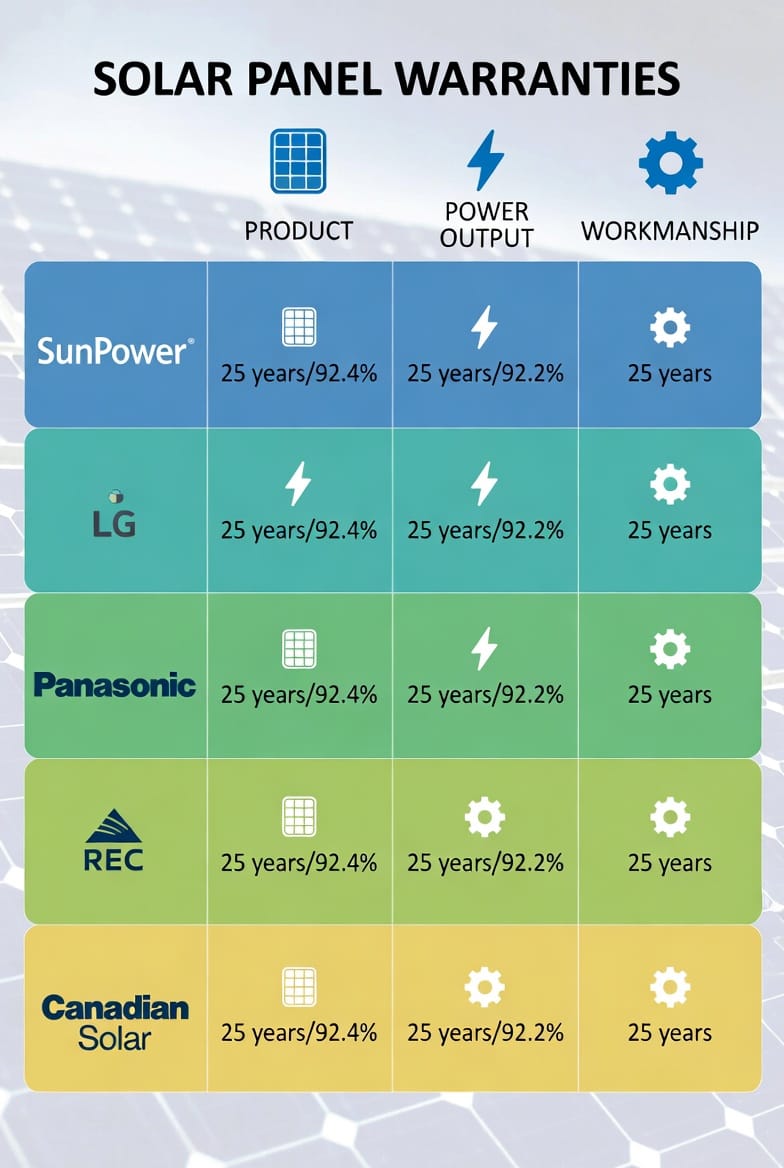
A strong warranty package includes:
- Product Warranty: Covers defects in materials, typically 10-25 years.
- Power Output Warranty: As discussed, 25-30 years linear.
- Workmanship Warranty: Ensures installation quality, often 10-25 years.
For instance:
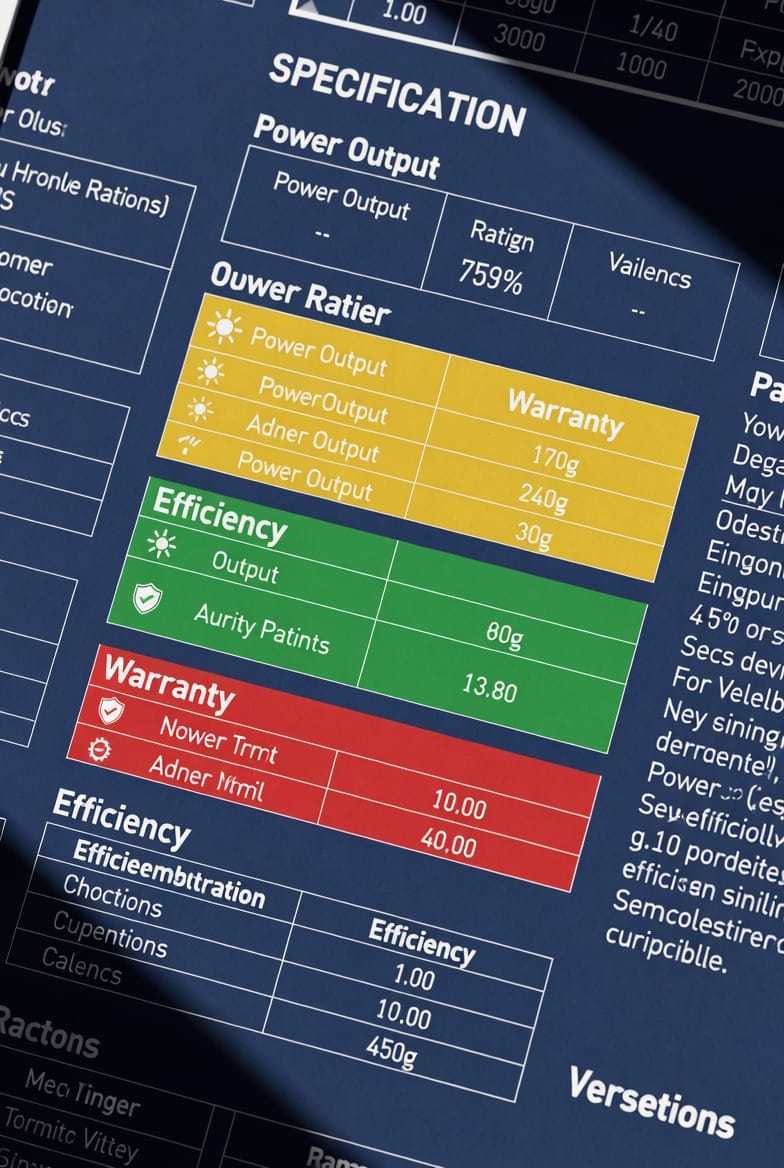
- SunPower: 25-year product, 25-year 92% output, 25-year workmanship.
- LG: 25-year product, 25-year 90.8% output, 25-year workmanship.
- Panasonic: 25-year product, 25-year 90.76% output, 25-year workmanship.
These variations highlight why comparing specs matters—higher output guarantees mean better long-term yields.
Maximizing Long-Term Performance
To ensure your solar array thrives, adopt proactive strategies. Start with site assessments to mitigate environmental risks, then choose panels certified by bodies like the California Energy Commission for proven durability.
Incorporate monitoring technology for real-time insights. Apps can track output drops, allowing timely interventions. Additionally, consider extended warranties or insurance for added protection against unforeseen events.
Case studies abound: A 2019 NREL report analyzed over 2,000 systems, finding average degradation at 0.8%, with well-maintained arrays at 0.5%. This underscores that informed ownership leads to superior performance.
Debunking Myths About Solar Longevity
Common misconceptions can deter potential adopters. Myth: Panels fail after 25 years. Reality: They continue producing, often at 70-80% capacity into year 40.
Another: Degradation makes solar uneconomical. Fact: Even with 1% annual loss, payback periods remain 7-12 years, with decades of free energy afterward.
By focusing on facts, you can appreciate solar's resilience.
The Future of Solar Durability
Innovations like bifacial panels and perovskite cells promise even lower degradation—potentially 0.2-0.3%. As the industry evolves, expect warranties extending to 30-40 years.
In summary, solar panel degradation is manageable and predictable. With typical rates of 0.5-1%, robust 25-year linear warranties, and attention to factors like climate and quality, your array will deliver dependable performance.
Ready to invest in solar with confidence in its long-term yield?
Learn Which Panels Degrade Least – Call Today