Crane-Assisted Tree Removal: The Engineering Marvel for Impossible Spaces and Hazardous Specimens
In the demanding field of modern arboriculture, crane-assisted tree removal stands as a true engineering marvel designed specifically for the most challenging environments. This sophisticated technique combines powerful heavy-lift machinery with the specialized knowledge of certified arborists to deliver safe, efficient, and damage-free results where traditional methods simply cannot succeed. Whether facing towering trees suspended directly over rooftops, unstable specimens in severely confined backyards, or dead and dangerous trees that defy safe climbing, crane tree removal provides the controlled power and precision necessary to resolve the situation completely.
Precision Crane Tree Removal Experts – Call for Free Quote
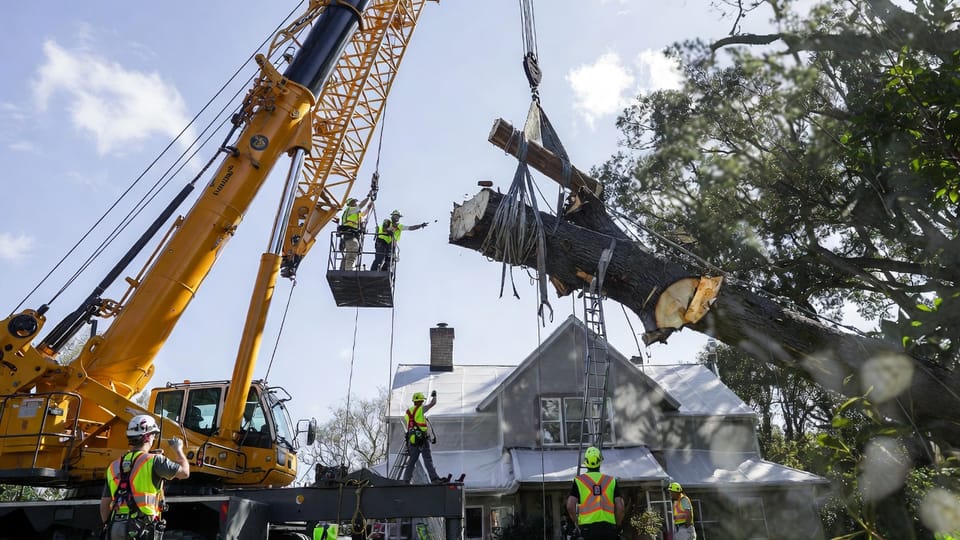
Homeowners and property managers across urban and suburban areas increasingly turn to crane-assisted tree removal because it eliminates the guesswork and high-risk elements inherent in rope-and-climb operations. Large mobile cranes, often with boom reaches exceeding 150 feet and lifting capacities well over 80 tons, allow entire tree sections to be rigged, severed, lifted vertically, and lowered to waiting transport vehicles without ever swinging freely near structures or people. The result is a dramatically reduced timeline, minimized site disturbance, and unparalleled protection for both property and personnel.
This article explores every facet of crane-assisted tree removal — from identifying the precise scenarios that demand its use to the rigorous planning, execution steps, safety protocols, and long-term benefits that make it the authoritative choice for impossible spaces and hazardous specimens. With expert coordination and advanced engineering principles guiding every lift, clients can trust that even the most daunting tree removal project will conclude successfully and restore peace of mind to the property.
When Traditional Tree Removal Methods Reach Their Limits
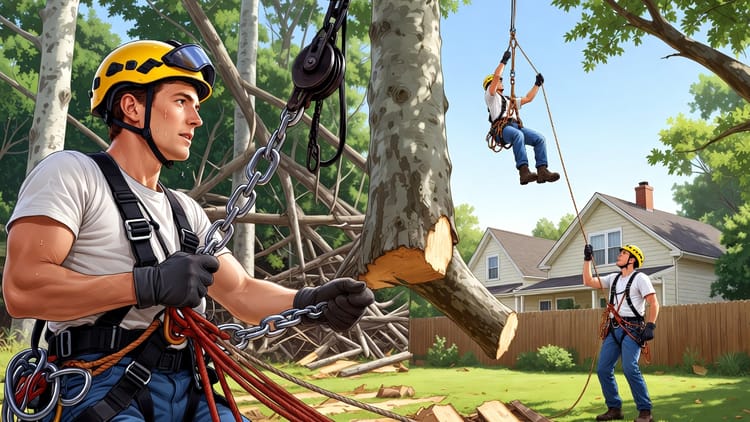
Conventional tree removal relies on arborists ascending the trunk with ropes, harnesses, and spikes, making sequential cuts and lowering pieces by hand or friction devices. While effective in open fields or spacious lots, these methods quickly become inadequate — and frankly unsafe — in today’s built environments. Limited felling corridors, overhead obstructions, and compromised tree structure introduce unacceptable levels of property damage risk and personal injury potential.
A leaning tree positioned above a two-story home, for instance, leaves no safe direction for directional felling. Even small branches can gain dangerous momentum during descent, striking roofs, vehicles, or power lines and generating repair costs that far exceed the removal itself. In tight residential backyards surrounded by six-foot fences, swimming pools, and meticulously maintained gardens, there is literally no room to maneuver cut sections without causing collateral harm to landscaping or neighboring properties.
Hazardous specimens present an even greater challenge. Trees killed by disease, infested with borers, or structurally weakened by lightning or wind events often contain hidden decay that makes climbing a violation of safety standards. A single rotten limb failure during ascent can result in catastrophic falls or uncontrolled drops. Weather conditions compound these issues; wet bark becomes slippery, and gusty winds turn every suspended section into a pendulum.
Crane-assisted tree removal directly overcomes these limitations by keeping the majority of the work on the ground or at minimal height. The crane operator maintains full control from a stable cab while ground crews use tag lines to guide loads with surgical accuracy. This shift from human-powered to machine-powered extraction transforms high-risk jobs into routine, predictable operations completed in a fraction of the time.
Key Scenarios That Demand Crane Assistance
Certain conditions make crane-assisted tree removal not merely preferable but absolutely essential. Recognizing these scenarios early allows property owners to avoid costly delays or emergency situations later.
- Trees Overhanging StructuresWhen mature trees extend canopies directly above roofs, garages, or patios, gravity becomes the enemy. Any cut section released from height can pivot unpredictably toward the building. Cranes lift sections straight upward and clear of the structure before swinging them to the drop zone, eliminating impact risk entirely. This approach has repeatedly proven invaluable for protecting historic homes and modern additions alike.
- Tight Urban Backyards and Confined AccessNarrow side yards, high privacy fences, and dense neighboring development often block all ground-level access routes. A crane positioned on the street or adjacent driveway extends its boom over obstacles, extracting the tree vertically piece by piece while leaving fences, patios, and plantings untouched. The method preserves property aesthetics and avoids expensive temporary removals of barriers.
- Dead, Diseased, or Storm-Damaged Trees That Cannot Be ClimbedVisible lean, extensive fungal growth, or hollow trunks signal internal instability that prohibits safe ascent. Crane tree removal enables rigging from ground level or minimal bucket access, followed by controlled severance and immediate lift. This technique prevents the tree from becoming a liability that could fail during the next storm and damage adjacent homes or vehicles.
- Proximity to Power Lines, Utilities, or Sensitive FeaturesTrees growing near overhead lines or underground infrastructure require specialized handling to maintain clearance and avoid service interruptions. Cranes allow precise maneuvering within tight tolerances that manual lowering cannot guarantee.
In each of these situations, crane-assisted tree removal delivers a reassuring outcome: the hazard is eliminated quickly, cleanly, and with zero tolerance for error.
The Meticulous Planning Process Behind Every Successful Lift
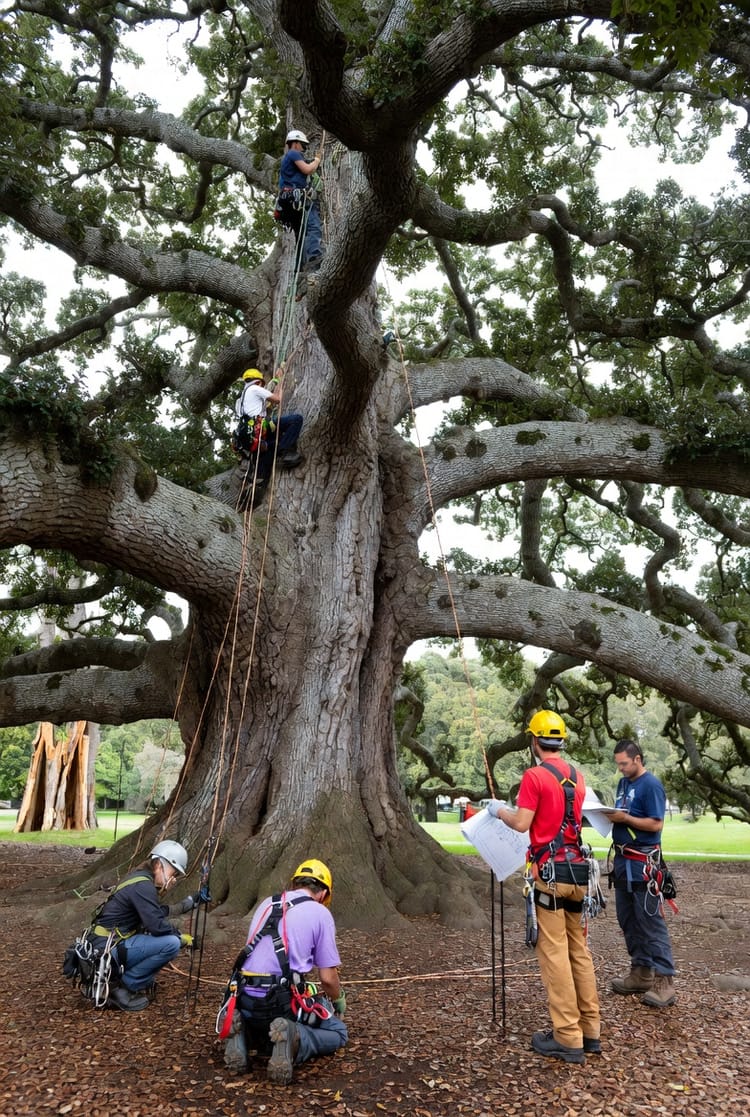
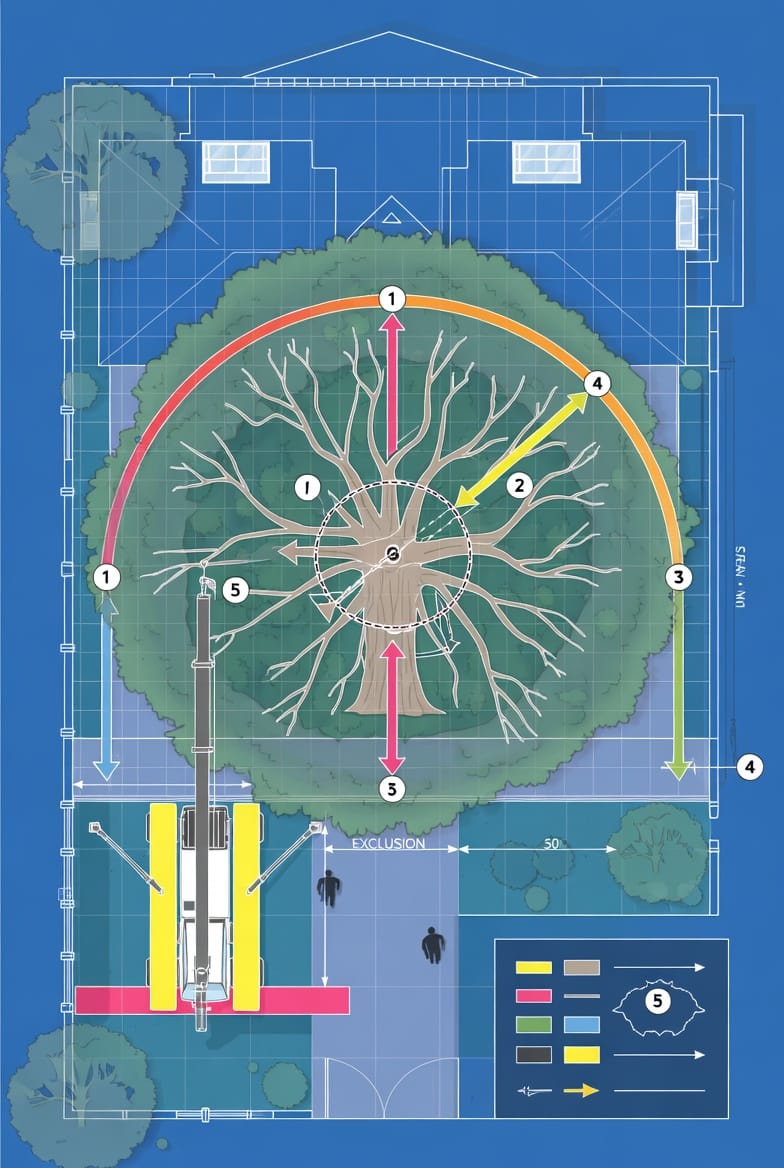
No crane-assisted tree removal begins with the crane arriving on site. Success starts days earlier with exhaustive preparation that blends arboricultural expertise and civil engineering principles. Certified teams first conduct a full site survey, measuring tree height, diameter at breast height, lean angle, and canopy spread. They assess soil bearing capacity to confirm the crane will remain stable under full load and identify the ideal positioning that maximizes reach while minimizing swing radius.
Weight calculations for each proposed section use species-specific density data and volume formulas, ensuring the chosen crane maintains at least a 50% safety margin. Rigging points are mapped to achieve balanced loads that resist twisting or spinning during lift. Weather windows are locked in, permits obtained, and utility locate services called to mark all underground lines.
Advanced operations employ 3D modeling software to simulate every lift sequence in virtual space, highlighting potential boom-to-structure conflicts before any equipment moves. Communication protocols, emergency stop signals, and exclusion zone boundaries are documented and briefed to every team member. This level of foresight transforms what could be a chaotic operation into a choreographed display of professional competence.
Property owners appreciate this thoroughness because it demonstrates respect for their investment and delivers predictable timelines. When the crane finally rolls in, every variable has already been addressed, allowing the crew to focus entirely on flawless execution.
Executing the Removal with Precision Engineering
With planning complete, the on-site process unfolds in a carefully sequenced manner that showcases the synergy between human skill and mechanical power.
Site preparation includes placing steel mats or timber cribbing beneath outriggers for load distribution, erecting safety barriers, and staging chipper trucks or debris containers. The crane is positioned, leveled, and tested for smooth operation.
Rigging begins as arborists secure high-strength synthetic slings or wire rope chokers around the target section at pre-calculated balance points. These connections are inspected twice before any tension is applied.
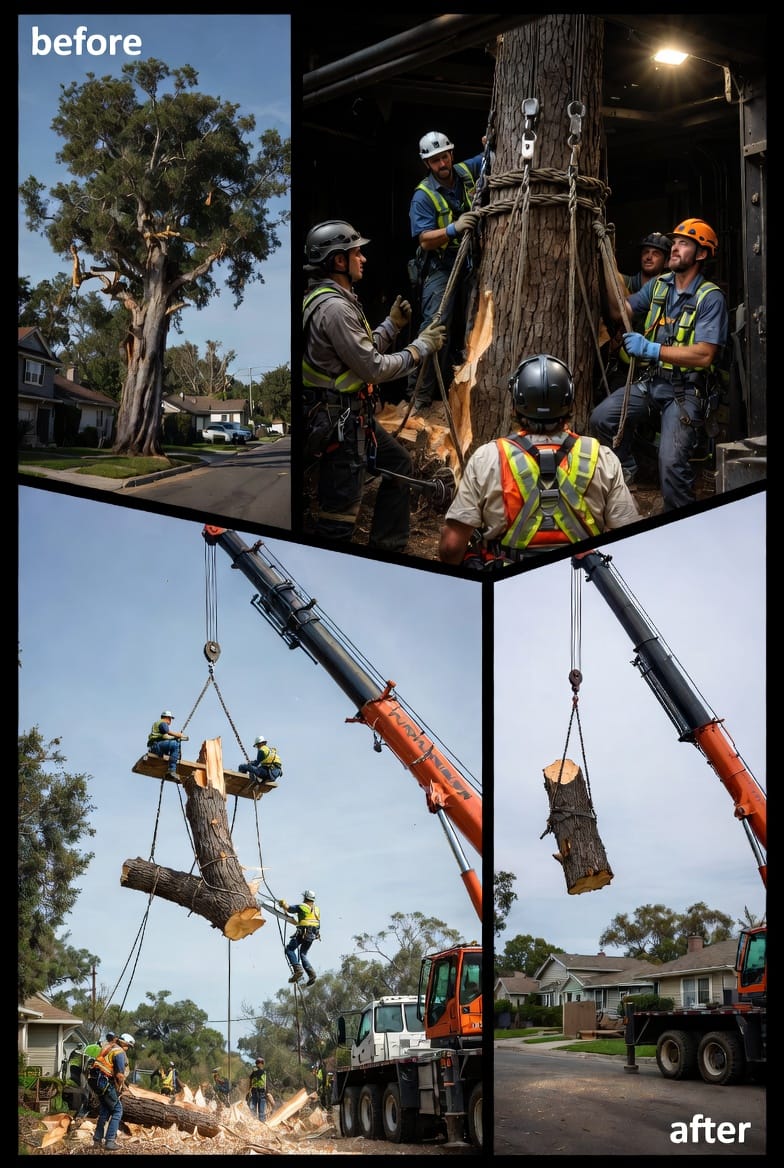
A certified arborist makes the precise cut using a chainsaw or hydraulic pole saw while the crane gradually takes the full weight, preventing sudden drops or barber-chair splits. Once severed, the section is lifted slowly and deliberately. Ground crew members maintain tension on tag lines to counteract any pendulum motion, guiding the load along its predetermined path with radio-directed commands.
Upon reaching the landing zone, the section is lowered gently onto the truck bed or processing area. The cycle repeats for remaining sections until only the stump remains. Throughout the operation, spotters monitor clearances, wind conditions, and load stability, ready to halt activity instantly if anything deviates from plan.
This methodical approach ensures that even 5,000-pound sections move through the air as predictably as clockwork, never threatening the surrounding environment.
Safety Protocols and Risk Mitigation That Define the Standard
Safety is never an afterthought in crane-assisted tree removal; it is the foundation. All personnel hold current certifications, equipment undergoes daily inspections, and operations strictly follow ANSI Z133 and ISA BMP guidelines. Hard hats, high-visibility clothing, steel-toe boots, and fall-arrest systems are mandatory. Radio discipline and clear hand signals eliminate miscommunication.
By drastically reducing time spent aloft and eliminating uncontrolled drops, the method cuts accident probability to a minimum. Clients receive detailed pre-job briefings and are encouraged to maintain a safe viewing distance, further reinforcing the professional, controlled atmosphere.
Additional Benefits That Extend Beyond the Job Site
Beyond immediate hazard removal, crane-assisted tree removal delivers lasting value through speed, cleanliness, and minimal environmental footprint. Projects that once required multiple days of climbing and hauling are routinely completed in one day, allowing families to reclaim their yards quickly. Less foot traffic means healthier lawns and gardens, while careful wood handling often permits salvage for milling or firewood rather than total chipping.
Property values remain protected because the job concludes without visible scarring or lingering debris. Many clients report that the professional appearance of the crew and equipment actually enhances confidence in the entire service experience.
Choosing Experienced Providers for Optimal Results
Selecting the right team ensures every advantage of crane-assisted tree removal is realized. Look for companies with documented crane experience, fully insured operations, ISA-certified arborists on staff, and a transparent safety record. Detailed written estimates, clear timelines, and willingness to answer questions signal a provider that values client partnership.
When Space or Danger Limits Options, Engineering Provides the Solution
Crane-assisted tree removal has proven time and again that even the most impossible spaces and hazardous specimens can be addressed safely, efficiently, and beautifully when the right engineering approach is applied. The combination of meticulous planning, powerful equipment, and skilled professionals delivers results that traditional methods cannot match.
When your property faces a tree that defies conventional removal, trust the engineering marvel designed precisely for these challenges.
Expert Crane-Assisted Tree Removal – Call for Professional Help