The Soil's Role: How Root Structure, Soil Type, and Drainage Influence Tree Stability and Removal Strategy
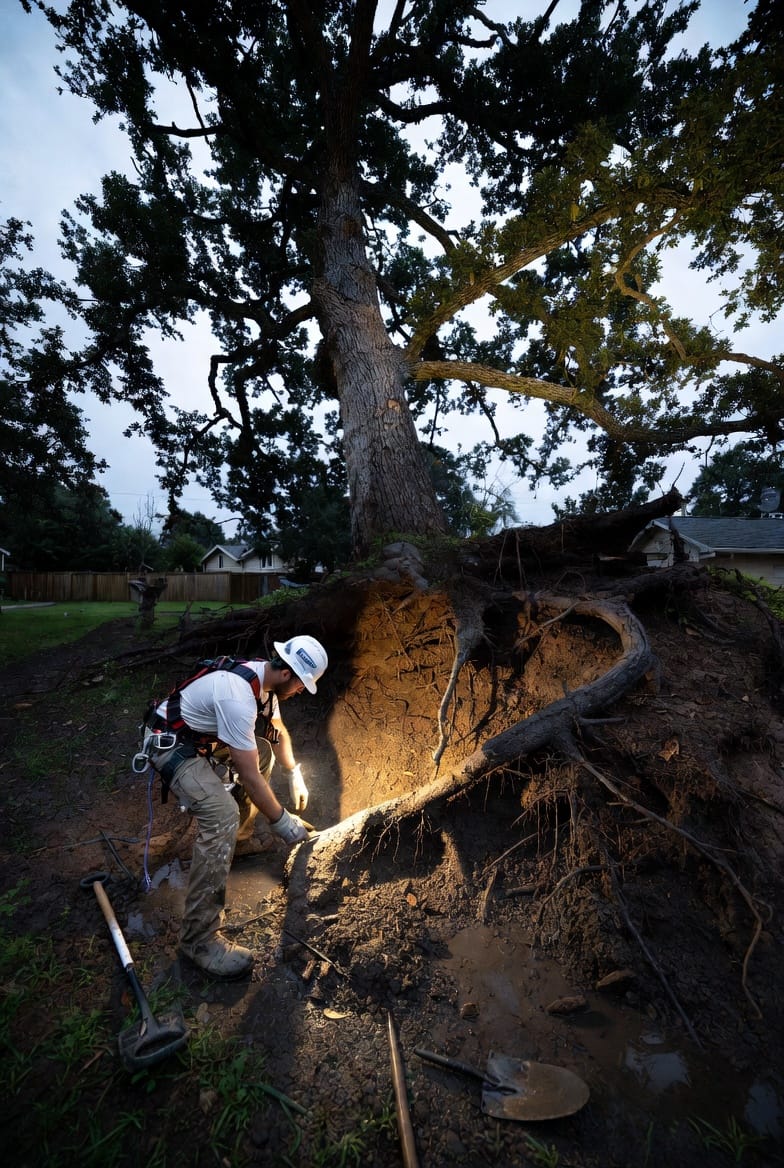
Trees are living anchors in our landscapes, but their long-term stability depends far more on what's happening below ground than above. In arboriculture, experienced professionals integrate soil science principles to evaluate risk and develop safe, efficient tree removal strategies. Understanding root architecture, soil composition, and drainage dynamics transforms guesswork into precise planning—protecting property, people, and the crew.
Protect Your Home from Root Failure – Call Today
Root Architecture: Nature's Anchoring System
Tree roots are not random; they follow distinct patterns shaped by genetics and environment.
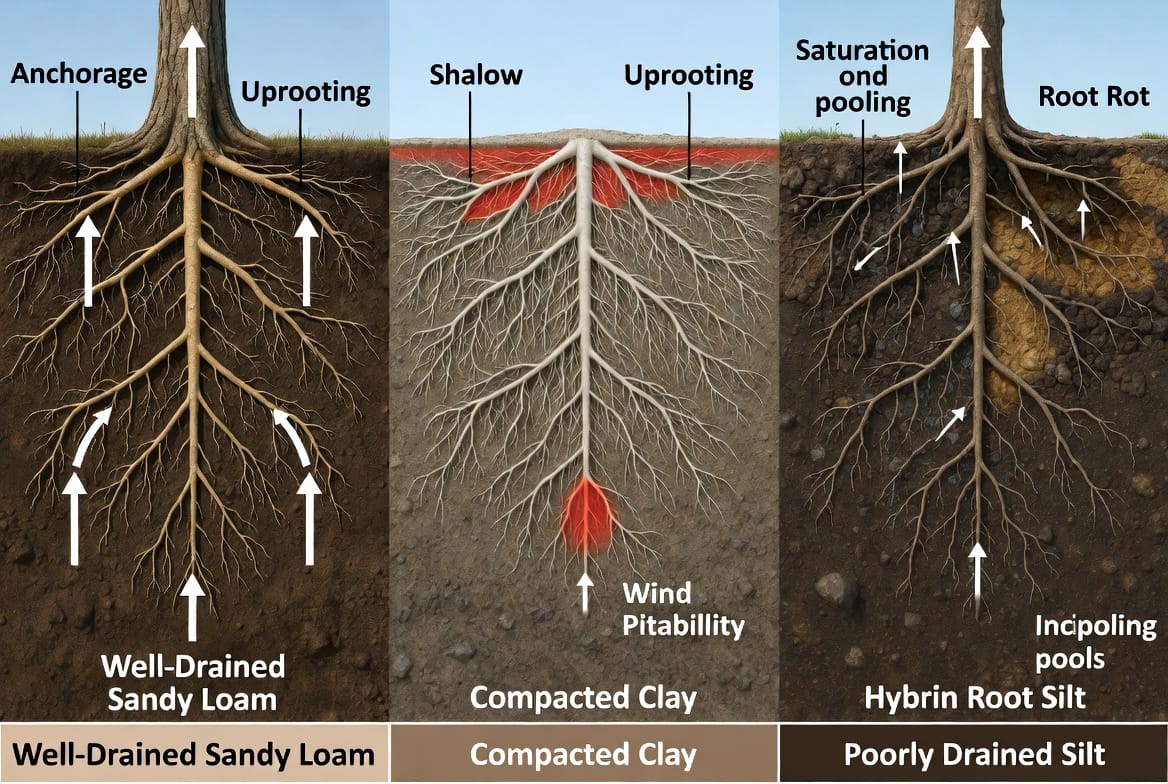
- Taproot systems — Common in oaks, pines, and hickories — feature a dominant central root penetrating deeply for anchorage and drought resistance. In well-drained sandy or loamy soils, this structure provides exceptional lateral stability.
- Fibrous root systems — Typical of maples, birches, and many urban-tolerant species — spread shallowly and widely in a dense mat. These excel in nutrient uptake but offer less resistance to uprooting forces in loose or saturated conditions.
Hybrid architectures often emerge in mixed soils, blending elements of both. When assessing a tree for removal, identifying the dominant root type guides rigging decisions — deep taproots may allow heavier cantilever loads, while shallow fibrous systems demand conservative sectional dismantling to minimize leverage on weakened anchors.
Soil Type and Its Direct Impact on Stability
Soil isn't just "dirt"—it's a dynamic medium influencing how roots grip and how trees respond to wind, weight, and weather.
- Sandy soils drain quickly but provide lower cohesion, increasing the risk of root slippage during high winds for shallow-rooted species.
- Clay soils hold water tightly, leading to poor aeration and compaction over time. Compacted clay restricts root expansion, creating shallow, plate-like root plates prone to failure.
- Loamy soils strike an ideal balance—good drainage combined with nutrient retention and structure—often supporting the most stable specimens.
Compaction from foot traffic, vehicles, or construction dramatically reduces pore space, starving roots of oxygen and limiting growth. Trees in chronically compacted zones exhibit decline symptoms long before visible lean appears, making proactive soil assessment essential.
The Critical Role of Drainage and Saturation
Poor drainage ranks among the top contributors to tree failure. When water saturates the root zone:
- Soil particles lose cohesion → shear strength plummets.
- Roots rot or suffocate → anchorage weakens rapidly.
- Hydrostatic pressure builds → heaving and leaning accelerate.
In heavy clay or high-water-table sites, even moderate storms can trigger windthrow or stem failure at the base. Conversely, excessively dry, drought-prone soils cause fine root dieback, reducing overall grip.
During removal planning, soil moisture profiling reveals whether the site allows safe crane access or demands roped rigging from afar. Saturated conditions often necessitate dewatering strategies or phased removal to restore stability temporarily.
Translating Soil Insights into Safe Removal Strategy
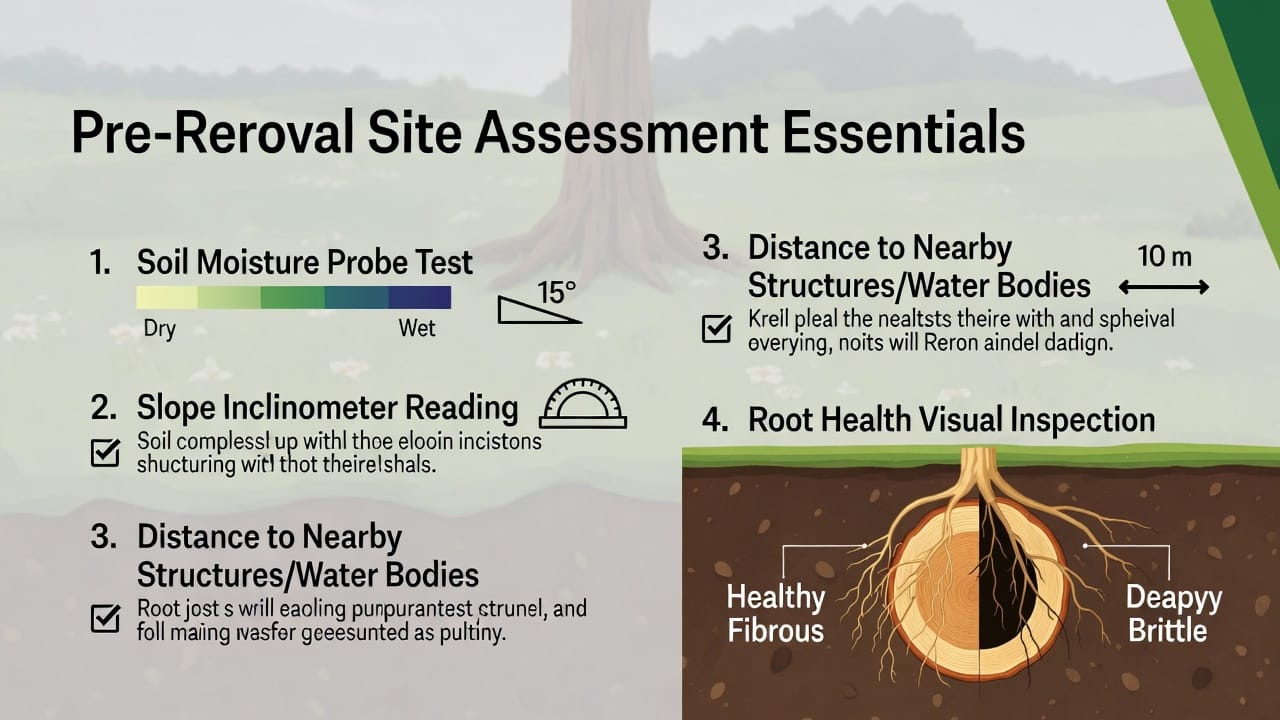
A thorough pre-removal site evaluation connects soil conditions directly to operational choices.
- Probe soil moisture at multiple depths and radii from the trunk.
- Examine root flare exposure and visible decay.
- Measure slope gradient — steeper inclines amplify failure forces.
- Identify proximity to structures, utilities, or water features.
- Document compaction signs (standing water, sparse undergrowth).
These observations shape the rigging plan:
- High-risk saturated sites → Use lighter sections, negative rigging, or crane support to reduce ground pressure.
- Compacted zones → Anticipate limited root plate mass, favoring directional felling or pie-cut techniques when feasible.
- Stable, well-drained profiles → Permit more aggressive top-down removal with confidence.
Safety always overrides speed. Ignoring soil signals can turn a routine job into a hazardous incident. Certified arborists prioritize load path analysis—tracing how forces transfer from crown through stem to roots and soil.
Common Warning Signs Rooted in Soil Conditions
Be alert for these indicators during inspections:
- Leaning or heaving root plates — Often tied to saturation or shallow rooting.
- Cracked or mounded soil near base — Signals root movement under stress.
- Dieback in outer crown — Linked to oxygen-starved roots in compacted or flooded zones.
- Fungal fruiting bodies at soil line — Evidence of root decay accelerated by poor drainage.
Early recognition allows targeted interventions or timely removal before escalation.
Holistic Perspective for Lasting Tree Management
Trees exist as integrated systems: roots interact with soil, soil supports the trunk, and the crown drives growth. Disrupt one element—especially below ground—and the entire structure becomes vulnerable.
Professional arborists bridge arboriculture and soil science to deliver evidence-based decisions. Whether preserving a valued specimen or executing a necessary removal, understanding root structure, soil type, and drainage ensures strategies that are safe, efficient, and environmentally responsible.
Understand the whole system, from roots to crown.
Secure Your Property Before the Next Storm – Call Now