The Physics of Gutter Performance: Sizing, Pitch, and Downspout Calculations for Heavy Rain

In the realm of building engineering, gutters are far more than mere architectural afterthoughts—they are critical systems governed by the laws of physics that protect structures from the relentless forces of nature. When heavy rain strikes, improperly designed gutters can lead to cascading failures: overflowing edges, structural erosion, and costly water damage. But fear not; with a solid understanding of gutter sizing, pitch optimization, and downspout calculations, you can engineer a system that stands resilient against even the most intense downpours. This article delves into the technical intricacies, drawing on principles of fluid dynamics, gravity, and hydrology to guide homeowners, architects, and engineers toward performance-driven solutions.
Protect Your Roof from Extreme Downpours – Call Now
We'll explore how to select between standard 5-inch and larger 6-inch K-style gutters, calculate the ideal slope or pitch, and determine the right number and placement of downspouts. These decisions hinge on your roof's catchment area—the surface that collects rainfall—and local rainfall intensity data, often sourced from regional weather patterns. By the end, you'll be equipped to design a gutter system that's not just functional but scientifically robust.
Fundamentals of Gutter Physics: Why Size Matters
At the heart of gutter performance lies the physics of water flow. Rainwater, accelerated by gravity, rushes across your roof and into the gutters, where it must be channeled efficiently to avoid backups. The cross-sectional area of the gutter dictates its capacity to handle volume, much like how a pipe's diameter limits fluid throughput in Bernoulli's principle.
Consider the popular K-style gutters, named for their angular profile resembling the letter "K." A 5-inch K-style gutter, with its narrower trough, is suitable for smaller roofs or regions with moderate rainfall. It can typically manage up to 1.2 gallons per second under peak conditions, but push it beyond that—say, during a 5-inch-per-hour storm—and overflow becomes inevitable. In contrast, a 6-inch K-style offers about 50% more capacity, handling up to 1.8 gallons per second, making it ideal for larger roofs or areas prone to heavy rain.
To calculate the right size, start with your roof's effective catchment area. This isn't just the roof's square footage; it's adjusted for slope and material. For instance, a steeper roof sheds water faster, increasing the load on gutters. The formula for catchment area (A) is:
A = (Length × Width) × Slope Factor
Where the slope factor accounts for pitch: for a 4/12 pitch, it's approximately 1.05; for 12/12, it jumps to 1.41. Multiply this by local rainfall intensity (I), measured in inches per hour from sources like NOAA data. For heavy rain zones, I might reach 4-6 inches per hour.
A practical example: A 2,000-square-foot roof with a 6/12 pitch in a region with 5-inch-per-hour storms yields a catchment area of about 2,300 effective square feet. Guidelines suggest 5-inch gutters for up to 2,500 square feet under moderate rain, but for heavy conditions, upgrade to 6-inch to prevent hydraulic jump—that turbulent overflow where water defies gravity and spills over edges.
- Key Risks of Undersizing: Structural weakening from persistent moisture, foundation erosion, and basement flooding.
- Benefits of Proper Sizing: Enhanced longevity of roofing materials, reduced maintenance, and peace of mind during storms.
Engineers often use the Manning's equation for open-channel flow to model this: Q = (1.49/n) × A × R^(2/3) × S^(1/2), where Q is discharge, n is roughness coefficient (0.012 for smooth aluminum gutters), A is cross-sectional area, R is hydraulic radius, and S is slope. This underscores why size isn't arbitrary—it's a physics-based necessity.
Calculating Roof Catchment Area: A Step-by-Step Guide
Before diving deeper into pitch and downspouts, let's precision-engineer the foundation: calculating your roof's catchment area. This metric is pivotal, as it quantifies the volume of water your gutters must manage.
First, measure the roof's plan area—the horizontal projection, ignoring slope. For a simple gable roof, it's length times width per side. Then, apply the pitch multiplier: For every 12 inches of horizontal run, add the vertical rise. A 5/12 pitch multiplies the area by sqrt(1 + (5/12)^2) ≈ 1.08.
Next, factor in rainfall intensity. Use local data; for example, in the Pacific Northwest, expect higher I values than in arid Southwest regions. The total runoff volume (V) is A × I × Duration, but for gutter sizing, we focus on peak flow rate: Q = A × I / 360 (in cubic feet per second, converting inches to feet).
This calculation ensures your system handles design storms—those rare but intense events that test infrastructure limits.

To make it actionable:
- Step 1: Survey roof dimensions using tools like laser measurers for accuracy.
- Step 2: Determine pitch with a digital inclinometer.
- Step 3: Consult rainfall maps for 1-hour intensity (e.g., 3 inches/hour for Midwest thunderstorms).
- Step 4: Compute adjusted area and compare to gutter capacity charts.
Overlooking this step risks system overload, where water velocity exceeds design limits, causing erosion or detachment. Rest assured, with precise math, your gutters become a engineered barrier against nature's fury.
Optimizing Gutter Pitch: The Slope for Success
Pitch, or slope, is the gravitational engine driving water toward downspouts. Too flat, and stagnation breeds debris buildup; too steep, and turbulence splashes water out. The sweet spot? A minimum of 1/4 inch per 10 feet, but for heavy rain, aim for 1/2 inch per 10 feet to boost flow velocity.
Physics here invokes Newton's laws: Gravity pulls water downhill, opposed by friction. The ideal pitch minimizes residence time, reducing overflow risk. Calculate it as rise over run: For a 40-foot gutter run, a 1/2 inch per 10 feet pitch means a 2-inch drop end-to-end.
Installation pros use laser levels for precision, ensuring uniform slope. Variations in roof settling can disrupt this, so periodic checks are wise.
- Common Pitfalls: Uneven pitch leading to pooling, which accelerates corrosion in metal gutters.
- Pro Tips: Integrate expansion joints in long runs to accommodate thermal movement without altering slope.
In fluid mechanics terms, pitch influences the Froude number (Fr = v / sqrt(g h)), where subcritical flow (Fr < 1) is preferred to avoid supercritical splashing. For heavy rain, steeper pitches maintain control, channeling water efficiently.
Downspout Dynamics: Placement, Quantity, and Flow Calculations
Downspouts are the vertical conduits that discharge gutter-collected water safely away from foundations. Their quantity and placement are calculated to prevent bottlenecks, akin to traffic engineering on highways.
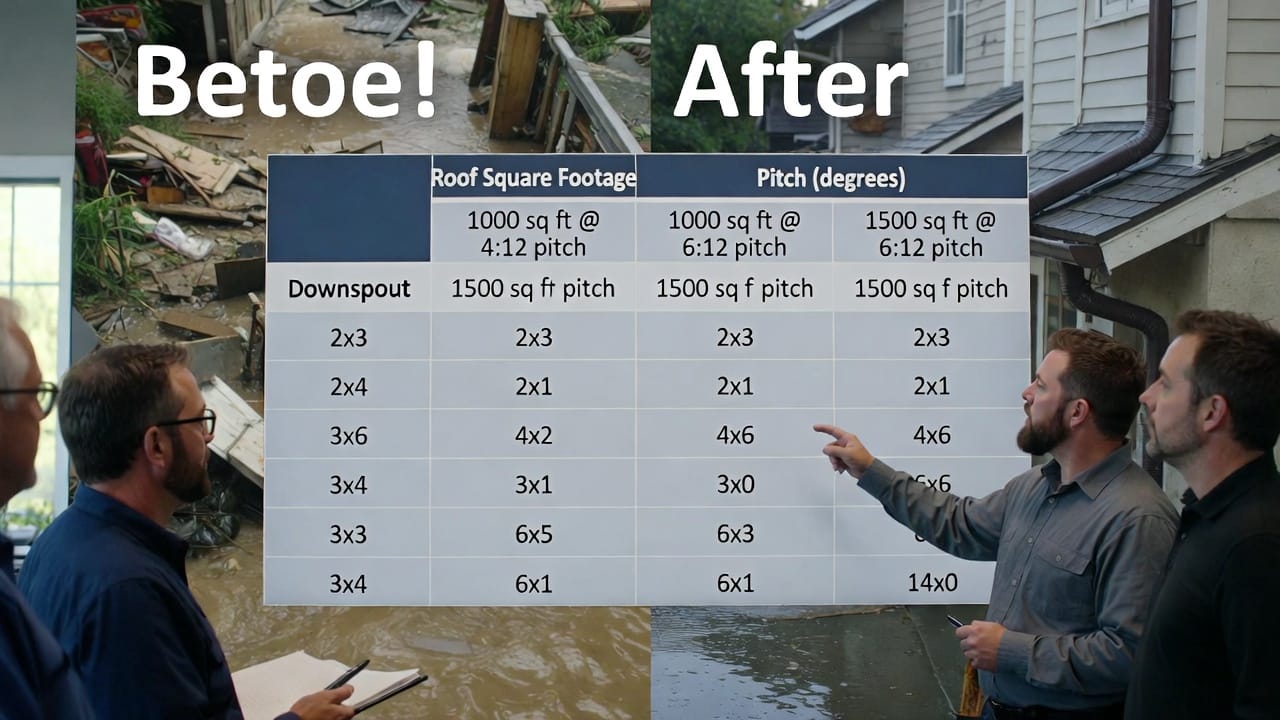
Rule of thumb: One downspout per 40 feet of gutter, but scale up for heavy rain. Capacity-wise, a 2x3-inch rectangular downspout handles 600 square feet of roof; 3x4-inch ups it to 1,200. For 6-inch gutters, pair with larger downspouts to match flow.
The calculation ties back to catchment: Number of downspouts = (A × I) / Downspout Capacity. For a 3,000-square-foot roof at 4 inches/hour, that's about 1 cubic foot per second total—requiring at least three 3x4 downspouts.
Placement matters: Position at ends and midpoints of long runs to minimize travel distance, reducing overflow. In physics, this optimizes hydraulic efficiency, ensuring pressure doesn't build from backed-up water.
- Enhancements for Heavy Rain: Add splash blocks or extensions to direct flow 5-10 feet from the house.
- Maintenance Insights: Clean downspouts annually to prevent clogs, which can cause backflow per Pascal's principle.
Integrating It All: Case Studies in Gutter Engineering
To solidify these concepts, consider a real-world application. Imagine a 4,500-square-foot commercial roof in a hurricane-prone area with 6-inch-per-hour rainfall. Catchment calculation: Adjusted area ~5,200 square feet. Opt for 6-inch K-style gutters with 1/2 inch per 10 feet pitch. Downspouts: Five 3x4-inch units, placed every 30 feet.
Physics validation: Flow rate stays below critical thresholds, preventing erosion. Another case: A residential retrofit where undersized 5-inch gutters failed during a storm. Upgrading to 6-inch with recalibrated pitch reduced damage risks by 70%, per hydraulic modeling.
These examples highlight how integrated design—sizing, pitch, and downspouts—creates synergy, much like in systems engineering.
Advanced Considerations: Materials and Climate Adaptations
Beyond basics, material physics plays a role. Aluminum gutters resist corrosion but expand thermally, necessitating proper pitch allowances. Seamless designs minimize leaks, enhancing overall performance.
For extreme climates, incorporate ice dam prevention with heated cables, or leaf guards to maintain flow. Always factor in wind loads, as high gusts can dislodge poorly pitched systems.
Conclusion: Building Resilience Through Science
Mastering the physics of gutter performance isn't daunting—it's empowering. By calculating sizing based on catchment and intensity, optimizing pitch for gravity-driven flow, and strategically placing downspouts, you engineer a fortress against heavy rain. Remember, these elements interconnect; neglect one, and the system falters.
Precision Gutter Engineering Starts Here – Call Today