The Concrete Curing Science: Why the First 28 Days Determine Your Slab's Lifelong Strength
When you watch a concrete slab being poured, it looks like the job is nearly finished. Trucks rumble away, finishers polish the surface, and the crew packs up. Yet the real work – the science that decides whether your driveway, patio, warehouse floor, or foundation will last 20 years or crack within two – has only just begun.
Professional Curing Starts Here – Schedule Your Pour Now
Proper concrete curing is not an optional step. It is the controlled process that allows cement hydration to reach its full potential during the first 28 days. This period is when your concrete gains approximately 90–95% of its design strength. Rush it or ignore it, and you risk permanent weakness no matter how strong the mix design was.
At Concrete Service, we treat every pour as a living system that demands precise care from minute one. Our teams are trained in the chemistry, the timing, and the proven techniques that turn good concrete into exceptional, long-lasting concrete. In this comprehensive guide, we explain exactly why those first 28 days matter, how hydration actually works, which curing methods deliver results, and what happens when moisture is lost too soon.
The Chemistry of Hydration: Concrete’s Hidden Transformation
Concrete is not simply “drying out.” It is undergoing a complex chemical reaction called hydration. Portland cement contains four main compounds – tricalcium silicate (C3S), dicalcium silicate (C2S), tricalcium aluminate (C3A), and tetracalcium aluminoferrite (C4AF). When mixed with water, these compounds dissolve and form new crystals:
- Calcium silicate hydrate (CSH) gel – the primary binding agent that gives concrete its strength and density.
- Calcium hydroxide – a byproduct that helps protect reinforcing steel from corrosion.
This reaction is exothermic (it releases heat) and continues as long as sufficient moisture and favorable temperatures are present. Without continuous water, the cement particles on the surface hydrate only partially, leaving a porous, weak outer layer.
Think of it like a chain reaction inside millions of microscopic factories. Each factory needs raw material (water) delivered constantly for the first four weeks. Cut off the supply early, and many factories shut down forever – resulting in lower compressive strength, higher permeability, and reduced durability.
Laboratory tests consistently show that concrete cured under ideal moist conditions for 28 days can achieve 4,000–5,000 psi or more, while the same mix exposed to rapid drying may reach only 2,500–3,000 psi. That 30–40% strength loss is permanent.
Key fact: Hydration never truly stops, but the rate slows dramatically after 28 days. The foundation of lifelong performance is built in that critical window.
Why the First 28 Days Are Non-Negotiable
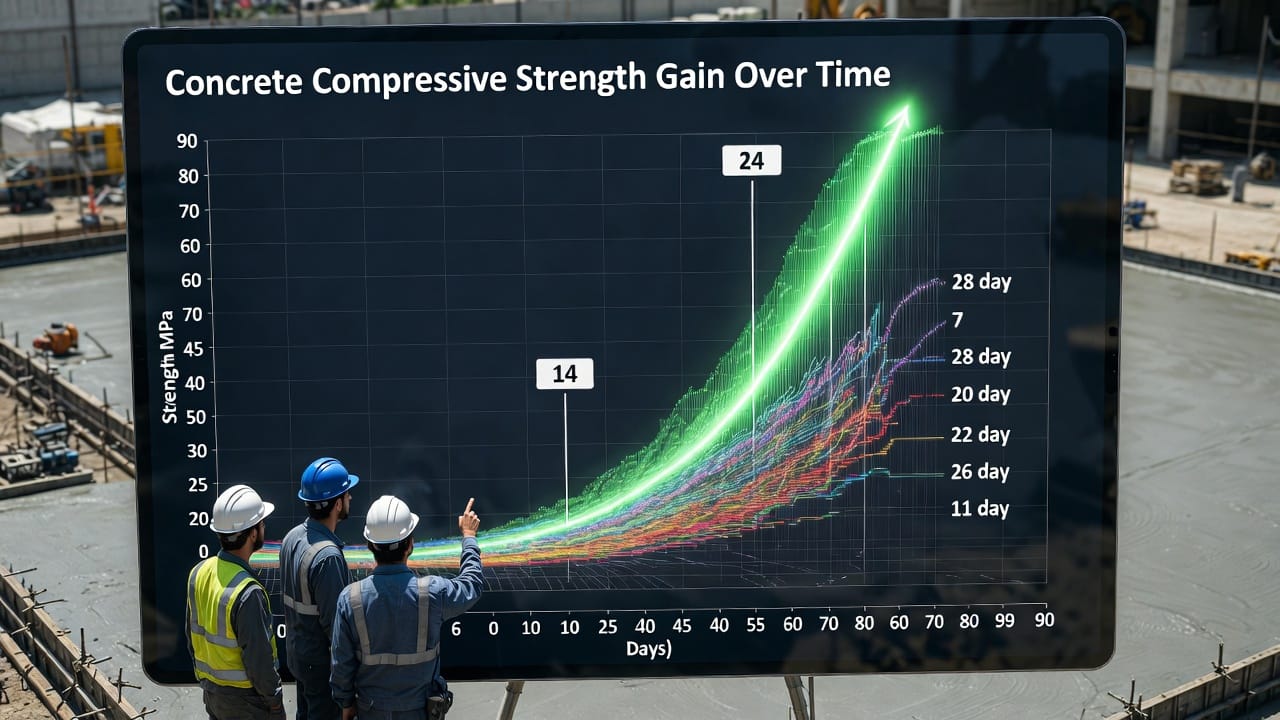
Concrete strength development follows a logarithmic curve. Roughly:
- 50–60% of ultimate strength is reached in the first 7 days
- 80–90% by day 14
- 95%+ by day 28
During this time the slab is highly vulnerable. Surface evaporation rates can exceed 0.2 lb/ft²/hour in hot, windy, or low-humidity conditions – fast enough to cause plastic shrinkage cracking within the first few hours.
Temperature also plays a major role. Ideal curing temperature is 50–70°F (10–21°C). Below 40°F hydration slows dramatically; above 90°F it accelerates too quickly and can cause thermal cracking.
By maintaining moisture and stable temperature for the full 28 days, you allow the CSH crystals to interlock fully, reduce capillary pores, and create a dense, impermeable matrix. The result is a slab that resists:
- Freeze-thaw damage
- De-icing salt penetration
- Abrasion and wear
- Chemical attack
Moisture Retention: The Single Most Important Factor
Water is not just a mixing ingredient – it is the lifeblood of curing. Once the slab is placed, internal water must remain available for hydration while external evaporation is prevented.
If the surface dries too quickly, three problems occur simultaneously:
- Plastic shrinkage cracks appear as the top layer contracts while the interior is still plastic.
- Surface laitance forms – a weak, dusty layer of cement particles that never fully bonded.
- Internal moisture gradient develops, causing differential shrinkage and warping.
Moisture retention keeps the relative humidity inside the concrete above 90% for the full curing period. This single practice can increase final strength by 20–30% and slash long-term maintenance costs.
Proven Concrete Curing Methods That Deliver Results
Different projects require different approaches. Here are the methods we rely on at Concrete Service, ranked by effectiveness and site conditions:
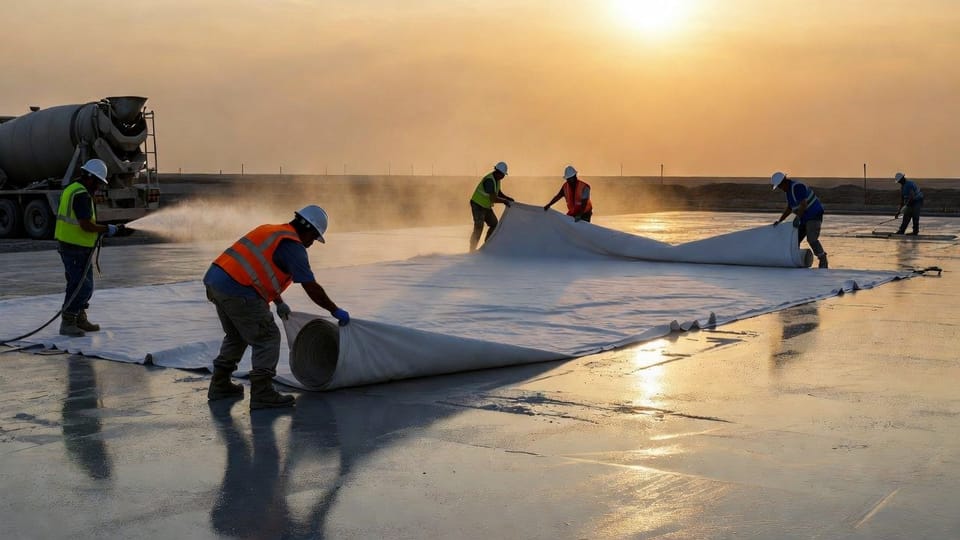
- Wet Curing (Highest Performance)Continuous application of water through ponding, fog misting, or saturated burlap and curing paper. Maintains 100% surface moisture. Ideal for high-traffic slabs and decorative concrete.
- Curing Compounds (Membrane-Forming)Liquid chemical membranes sprayed evenly at 200–400 sq ft per gallon. Forms a temporary barrier that retains 95%+ of mixing water. ASTM C309 compliant products are standard on our commercial projects.
- Insulating Curing BlanketsReusable insulated blankets that retain both moisture and heat. Essential for cold-weather pours below 50°F or hot-weather pours above 85°F where thermal shock must be avoided.
- Combination SystemsWet burlap covered by white polyethylene sheeting plus curing compound for maximum protection on large industrial slabs.
We evaluate wind speed, humidity, sunlight, and slab thickness before selecting the optimal method. Our crews never leave a fresh pour unprotected – even for 30 minutes.
The Costly Consequences of Rapid Drying
Skipping or rushing curing is one of the most expensive mistakes in construction. Here is what actually happens:
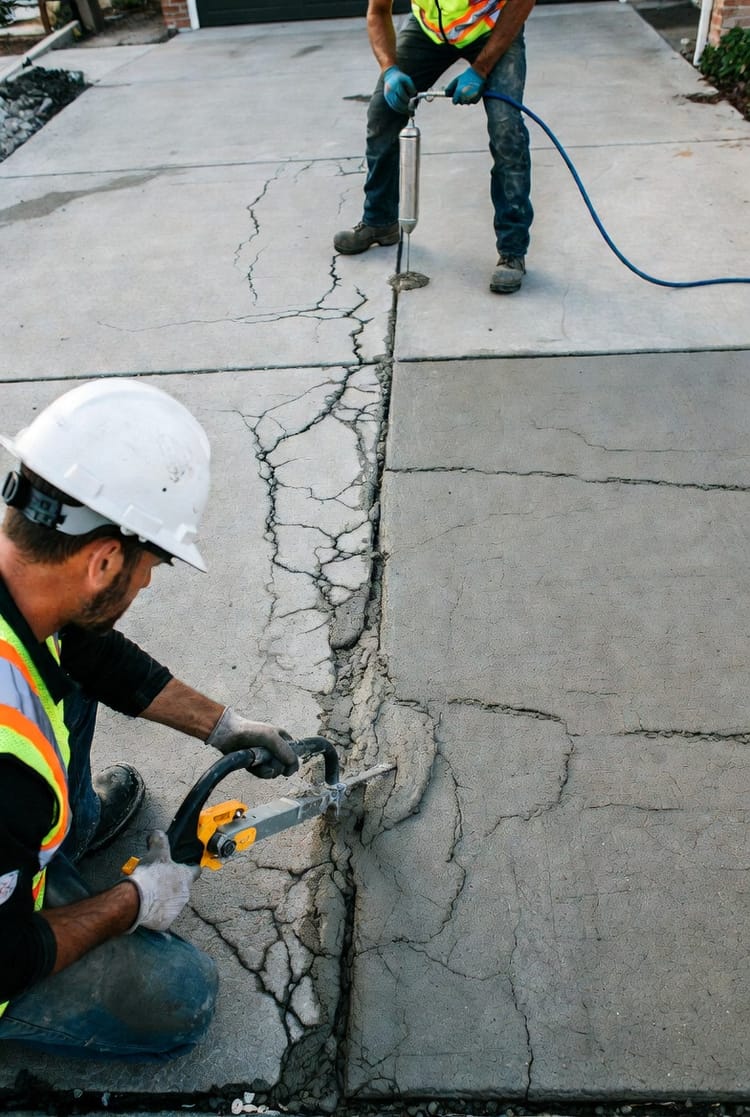
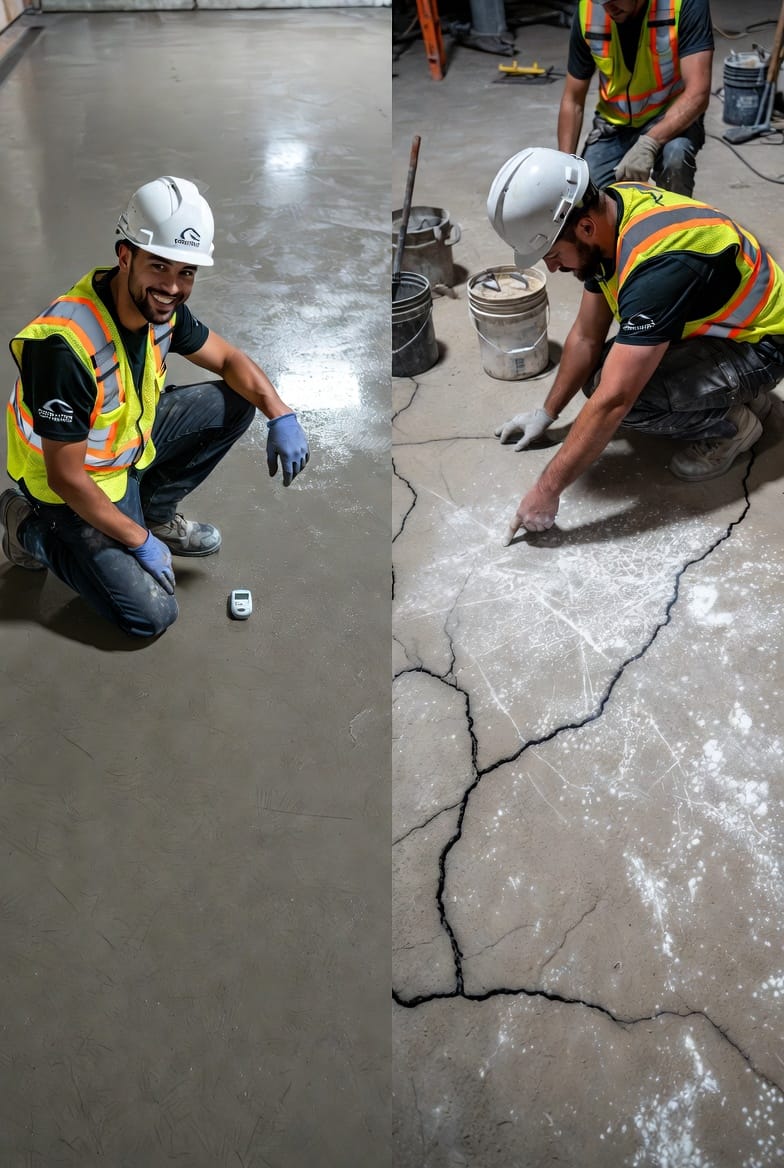
- Cracking – Plastic shrinkage cracks can appear within 4 hours and widen over time, allowing water and chlorides to reach rebar.
- Surface Dusting – The top 1/8 inch becomes a powdery, weak layer that wears away under traffic, creating ongoing maintenance headaches.
- Reduced Load-Bearing Capacity – A slab designed for 4,000 psi may test at only 2,800 psi, forcing expensive overlays or complete replacement.
- Increased Permeability – More pores mean faster freeze-thaw damage and efflorescence.
- Color Inconsistency – Decorative concrete loses uniform appearance when hydration is uneven.
We have seen improperly cured warehouse floors fail under forklift traffic in under 18 months. The repair cost was triple the original pour price.
How Professional Curing Protects Your Investment
At Concrete Service every crew member carries a moisture meter and evaporation-rate calculator. We monitor conditions hourly during the first 72 hours and daily thereafter. Our standard protocol includes:
- Immediate coverage within 30 minutes of final trowel
- Continuous moisture checks using ASTM standards
- 28-day minimum curing duration on all structural slabs
- Detailed curing logs provided to every client
This disciplined approach is why our clients report zero curing-related callbacks year after year.
Final Word: Demand Proper Curing for Your Next Project
The science is clear. The first 28 days are when your concrete slab becomes strong, dense, and durable – or weak, cracked, and costly. Cutting corners on curing is never worth the risk.
For your next residential driveway, commercial floor, or industrial slab, insist on professional concrete curing from day one. At Concrete Service our licensed crews, proven methods, and relentless attention to hydration chemistry deliver slabs that exceed expectations for decades.
Don’t Risk Weak Concrete – Call for Proven Curing Methods