From Stone Gargoyles to Seamless Aluminum: The Evolution of Rainwater Management for Homes

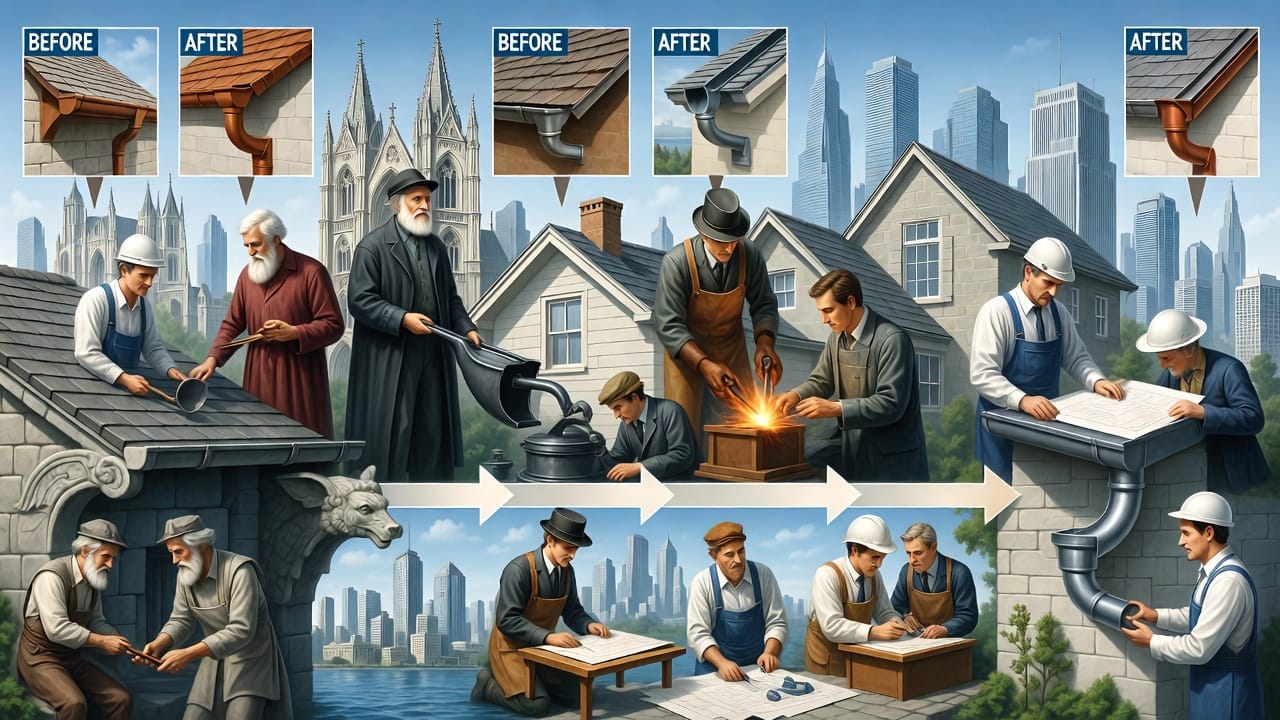
Rainwater management has been a cornerstone of home protection since the dawn of structured living. Imagine your home as a fortress against the elements – without proper systems, water can infiltrate, erode, and destroy. But fear not; centuries of innovation have refined these defenses into reliable, modern solutions. In this deep dive, we'll trace the historical evolution of gutters and downspouts, from medieval ingenuity to today's seamless aluminum and vinyl systems. Each step forward reflects advancements in material availability and building science, ensuring homes stay dry, durable, and damage-free. Whether you're a homeowner curious about your property's heritage or considering an upgrade, rest assured: the path to superior rainwater control is well-paved with proven progress.
Centuries of Evolution, Modern Protection – Call Today
Medieval Beginnings: Stone and Lead as Early Guardians
The story starts in the Middle Ages, around the 12th century, when European architecture began incorporating deliberate rainwater diversion. Castles and cathedrals, built from stone, faced relentless rain that could weaken mortar and foundations. Enter stone gargoyles – those grotesque, carved figures protruding from rooftops. Far from mere decoration, they served a practical purpose: channeling water away from walls to prevent erosion.
Material availability played a key role here. Stone was abundant in regions like England and France, quarried locally for its durability. Building science was rudimentary, relying on gravity and basic hydraulics understood through trial and error. Gargoyles, often shaped as mythical beasts, spouted water dramatically, sometimes 20 feet outward. However, they weren't without flaws – cracks from weathering led to leaks, and their fixed positions limited adaptability.
- Key Innovations: Open channels carved directly into stone parapets, supplemented by lead-lined troughs for flexibility.
- Benefits: Effective at dispersing large volumes of water; added aesthetic value to Gothic structures.
- Drawbacks: Labor-intensive to carve; prone to moss buildup and structural integration issues in non-stone homes.
As feudal societies evolved, these systems spread to manor houses, marking the first widespread rainwater management for residential-like structures. Homeowners today can draw parallels: just as gargoyles protected ancient walls, modern gutters safeguard your siding and basement.
Renaissance Refinements: Lead Channels Take Center Stage
By the 15th and 16th centuries, the Renaissance brought a surge in material experimentation. Lead, mined increasingly in areas like the British Isles, became the material of choice for its malleability and resistance to corrosion. Craftsmen hammered lead into channels and pipes, creating more sophisticated systems than crude stone spouts.
This era's building science advanced with better understanding of metallurgy. Architects like Filippo Brunelleschi influenced designs where lead gutters were integrated into rooflines, directing water to cisterns for reuse – an early nod to sustainability. Availability surged due to trade routes, making lead affordable for affluent homes.
Yet, challenges persisted. Lead's weight required sturdy supports, and toxicity concerns (though not fully understood then) posed hidden risks. Installations involved soldering joints, which could fail over time, leading to drips that damaged timber frames.
- Key Innovations: Molded lead hoppers and downpipes, often ornamented with heraldic symbols.
- Benefits: Watertight when new; allowed for curved and custom shapes.
- Drawbacks: Heavy and expensive; eventual pitting from acid rain in polluted areas.
Reassuringly, these lead systems laid the groundwork for modular designs, evolving into what we now recognize as organized gutter systems. If your older home still has remnants, it's a testament to enduring engineering.
Victorian Era: Cast-Iron's Industrial Strength
The 19th century's Industrial Revolution transformed rainwater management with cast-iron gutters. Victorian homes, booming in urbanizing Britain and America, demanded robust solutions amid heavier rainfall from climate shifts and pollution. Iron foundries proliferated, making cast-iron widely available – smelted from abundant ore and cast into ornate profiles.
Building science leaped forward with thermodynamics and material stress testing. Engineers realized iron's tensile strength could handle expansion from temperature changes, reducing cracks. Ornate designs, like ogee-shaped gutters, not only diverted water but enhanced curb appeal, aligning with Victorian aesthetics.
However, rust was a persistent foe, accelerated by industrial soot. Sectional pieces joined with brackets often leaked at seams, causing fascia rot.
- Key Innovations: Half-round and box-style gutters, supported by decorative brackets.
- Benefits: Durable against impacts; scalable for large roofs.
- Drawbacks: Corrosion over decades; installation required skilled labor to align sections properly.
Authoritatively, this period democratized effective rainwater control, moving it from elite estates to middle-class abodes. Modern homeowners benefit from this legacy in hybrid systems that echo iron's reliability without the maintenance woes.
Post-War Progress: Steel's Resilient Rise
World War II's aftermath in the mid-20th century ushered in galvanized steel gutters. With steel production ramped up for wartime needs, surplus materials flooded markets post-1945. This availability coincided with suburban booms in the U.S. and Europe, where new homes needed quick, cost-effective rainwater solutions.
Building science evolved rapidly, incorporating corrosion-resistant coatings like zinc galvanization. Understanding of aerodynamics improved downspout designs to minimize clogs from debris. Steel's lighter weight compared to iron eased installations, often in K-style profiles that held more water.
Despite advantages, steel wasn't invincible. Galvanization wore off over time, leading to rust in humid climates, and sectional joints remained leak-prone.
- Key Innovations: Roll-formed steel for uniform shapes; integration with fascia boards.
- Benefits: Affordable and strong; resistant to denting from hail.
- Drawbacks: Eventual rust; noise during heavy rain.
Rest assured, steel bridged the gap to modernity, teaching us about longevity through protective treatments – lessons applied in today's alloys.
Modern Mastery: Seamless Aluminum and Vinyl Innovations
Today, seamless aluminum gutters represent the pinnacle of evolution, formed on-site from coils for custom fits. Aluminum's abundance, recycled from bauxite, exploded in the late 20th century with aerospace tech crossovers. Building science now emphasizes seamless construction to eliminate joints, reducing leaks by up to 90%.
Vinyl, a petroleum byproduct, offers lightweight, rust-proof alternatives since the 1980s. Advanced polymers resist UV degradation, tying into sustainable practices.
These materials address historical pitfalls: no corrosion like iron or steel, no toxicity like lead, and adaptability beyond stone.
- Key Innovations: On-site extrusion machines for aluminum; snap-together vinyl kits.
- Benefits: Low maintenance; variety of colors; efficient water flow.
- Drawbacks: Aluminum can dent; vinyl may crack in extreme cold (mitigated by modern formulas).
With these systems, homes achieve optimal rainwater management, preventing foundation cracks, mold, and erosion.

Tying It All Together: Lessons from History for Today's Homes
Reflecting on this journey, each era's advancements built on the last, driven by material scarcity turning to surplus and scientific insights. From gargoyles' dramatic spouts to aluminum's sleek efficiency, the goal remains: protect your investment.
Common risks like overflows or ice dams are now manageable with guards and heated cables, informed by historical data.
- SEO Tip: Searching for "gutter evolution history"? You've found the authoritative guide.
- Pro Advice: Inspect annually; clean biannually for peak performance.
In conclusion, embracing modern systems isn't just an upgrade – it's honoring centuries of refinement.
Benefit from Centuries of Innovation – Call for Your Seamless Upgrade